Europe: Upgrading to Overweight
The policy contrast between the U.S. and Europe is stark: While the Trump administration seems set on constraining government outlays, EU policymakers appear to be in expansion mode and looking to contribute more significantly toward economic growth over the next several years.
In addition to accommodative policy (fiscal and monetary), European corporate earnings are significantly levered to the recently accelerating global goods economy, suggesting to us that Europe could post faster EPS growth than the U.S. We believe this could set the stage for the European equity market to outperform the U.S. and the world in the medium term.
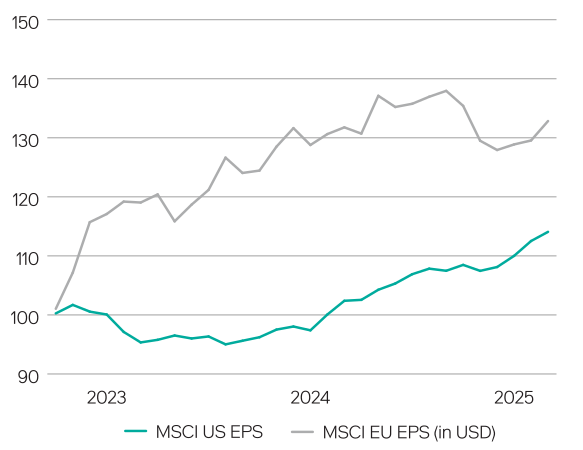
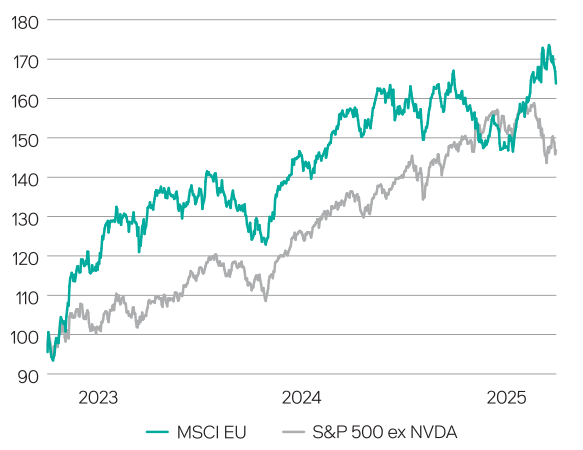
The importance of faster earnings growth has been on display for a while. Consider that between 2010 and 2022, European stocks lagged as U.S. companies increased earnings per share by 14% per year, compared to just 2% per year for their European peers.19 Then the script flipped: Since the fourth quarter of 2022, European companies have increased earnings by 12% per year versus just 5% for U.S. companies, as shown in the left side of figure 4. Faster earnings growth has led the MSCI Europe Index to steadily outperform the S&P 500 Index excluding NVIDIA, which has been a primary driver of the broad index’s recent outperformance (see the right side).
Figure 4: As Corporate Earnings Have Grown Faster in Europe Than in the U.S., the MSCI Europe Index Has Handily Outperformed the S&P 500 Index (After Removing High-flying AI Chipmaker Nvidia)
Source: Neuberger Berman and FactSet, data as of March 31, 2025. For illustrative purposes only. Nothing herein constitutes a prediction or projection of future events or future market behavior. Due to a variety of factors, actual events or market behavior may differ significantly from any views expressed. Investing entails risks, including possible loss of principal. Past performance is no guarantee of future results.
Meanwhile, Europe’s near-term economic momentum also appears to be gaining strength. Economic gauges—including the Eurocoin indicator,20 the Sentix survey,21 the ZEW indicator22 and IFO Business Climate Index23—hint that growth is accelerating across the continent. In addition, growth in real M1 money supply recently turned positive,24 with such rapid improvements often followed by upturns in economic activity. The ECB has also been easing policy, with more rate cuts likely to follow. Given the typical 12- to 18-month lag between monetary easing and economic activity in Europe, we believe any additional rate cuts could boost growth well into 2026.
We also believe cyclical sectors are gaining momentum, as evidenced by substantial increases in housing values and credit demand. Residential property prices in Spain, Italy, Germany and the Netherlands have all surged,25 while mortgage, consumer credit and corporate lending activity have also risen.26 After a decade of extensive deleveraging in southern Europe, household balance sheets are in excellent condition. With debt service ratios at multi-decade lows and personal savings rates at a substantial 15%,27 we believe consumers are much more likely to take advantage of monetary easing by reducing excess savings and boosting consumption, thereby potentially driving growth more broadly across Europe.
In our view, there are even more reasons to feel optimistic about Europe's prospects over the medium term. We expect growth to benefit from higher defense spending, potential structural reforms, banking consolidation, lower oil prices and Ukraine’s post-war reconstruction—a scenario that appears to be priced into the Russian ruble, which is up 30% against the USD year-to-date.28
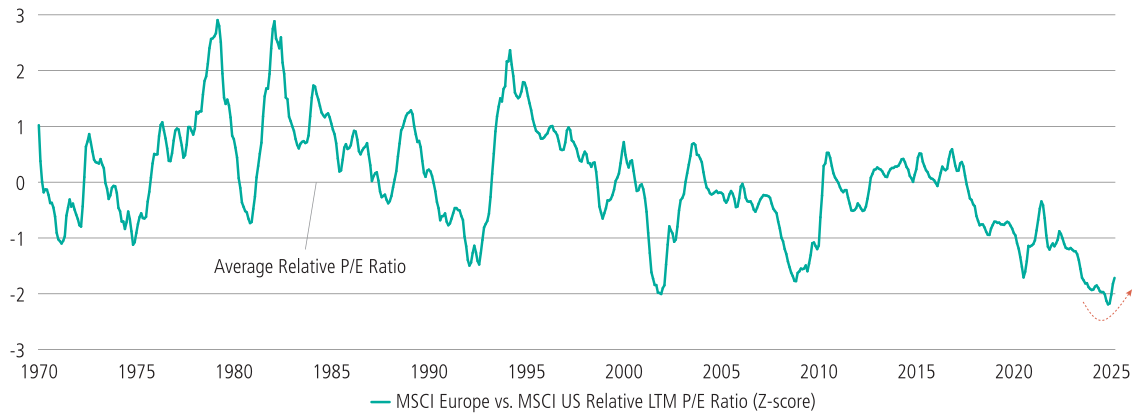
Finally, global investors remain substantially underweight Europe. In fact, only about 5% of the assets that flowed out of Europe at the start of the Ukraine conflict in early 2022 have returned.29 Meanwhile, the relative P/E ratio for the MSCI Europe Index compared to the S&P 500 Index remains two standard deviations below its long-term average, near a five-decade low (see figure 5).30 With plentiful room for relative revaluation, we favor an overweight stance toward European equities in a global portfolio.
Figure 5: European Stocks Remain Historically Cheap Relative to the S&P 500 Index
Source: Neuberger Berman and FactSet, data as of March 31, 2025. For illustrative purposes only. Nothing herein constitutes a prediction or projection of future events or future market behavior. Due to a variety of factors, actual events or market behavior may differ significantly from any views expressed. Investing entails risks, including possible loss of principal. Past performance is no guarantee of future results.
China: Maintaining Overweight
We believe China’s top tech firms are emerging as global contenders to the U.S. Magnificent 7 as President Xi Jinping aims to boost innovation in critical areas such as AI and robotics. Since March 2024, the combined market cap of the China 7,31 which accounts for 43% of the MSCI China Index,32 has grown by 54%, and yet it represents just one-ninth of the combined market cap of the Mag 7.33 Even though China’s leading tech companies appear overbought more recently, the gaping size differential with U.S. megacaps suggests to us that the China 7 still has plenty of room to run relative to the Mag 7. (For more on China’s growing support for its tech sector, see my colleague Yan Taw Boon’s article “Forget the Magnificent 7: Meet China’s Terrific 10”.)
As for China’s beleaguered real estate market, Tier I and Tier II cities have seen faster clearance times,34 reaccelerating transaction volumes and rising property prices35—signs that we believe might point to an early-stage rebound; we believe these trends indicate the early stage of a potential rebound that could broaden to Tier III cities, where prices are still falling.
Sagging home prices tend to stoke feelings of financial insecurity and curb spending; as the housing market has regained some footing and policymakers seek to fortify the social safety net, we believe consumers may have incentive to spend more and save less, driving retail sales growth and broadening China’s equity rally beyond the tech sector.
Meanwhile, China has been easing policy via lower lending rates, bank required-reserve-ratio cuts and increased bank-capital injections.36 Also, we believe green shoots of a new credit cycle are appearing: Property prices have begun to stabilize;37 growth in the M2 money supply has risen;38 and credit growth has begun to accelerate.sup>39 We believe there is room for further fiscal stimulus should economic growth start trailing President Xi’s 5% target.
Finally, with investor positioning in Chinese equities still relatively low, and the potential for positive economic and earnings surprises relatively high in our view, we are maintaining our overweight stance on China.
Japan: Maintaining Market Weight
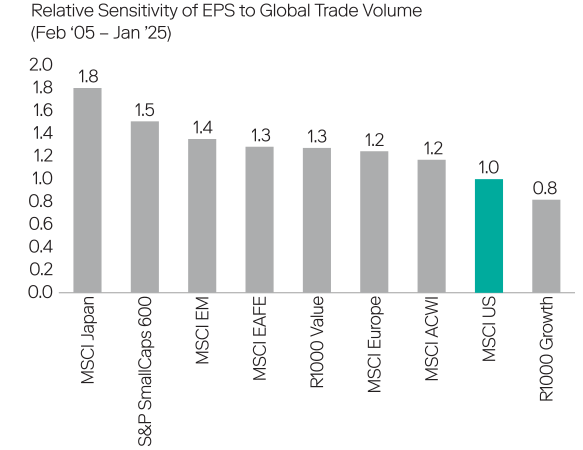
We believe Japan’s equity market is especially poised to benefit from an industrial rebound in 2025 should it pan out. As shown in figure 3, among major global regions, Japan’s earnings have historically shown the greatest leverage to trade; therefore, as global demand for goods picks up, we believe Japanese stocks have the potential to outpace other global equity markets.
Meanwhile, Japan’s economy is exhibiting classic signs of strengthening. Wage growth is accelerating,40 Japan’s labor market remains tight,41 the outlook for consumer spending is brightening,42 and an increasing number of Japanese companies plan to make capex investments.43 This improved economic performance is showing up in subsurface market returns: Japanese value stocks, which tend to be more sensitive to shifts in the cyclical economy, have been outperforming Japanese growth stocks since January 2021.44
Notably, the Bank of Japan’s policy shift away from zero and negative interest rates has breathed new life into the banking system: Bank profits have doubled over the last two years due to greater deposit and lending activity; banks remain well funded; borrowing costs are low;45 and real interest rates are still negative. We believe low rates will continue to drive loan growth, spur consumer spending and boost business investment.
However, a stronger economy may not guarantee superior stock market performance. The BOJ’s benchmark policy rate, at just 0.5%, lags these economic improvements, especially when inflationary pressure is ratcheting up and wages have been rising at 2.8% (with bigger negotiated boosts still to come).46 If the BOJ is forced to tighten faster than expected, we worry that domestic growth could slow and strengthen the yen, which could hamper the relative performance of the export-heavy Japanese stock market. While we are pondering an upgrade to overweight next quarter, for now we are standing pat. (For more detail on our constructive near-term outlook on Japan, please see my colleague Kei Okamura’s recent paper, “Japanese Equities in 2025: Goldilocks Would Approve.”)
Consumer Discretionary: Downgrading to Underweight from Overweight
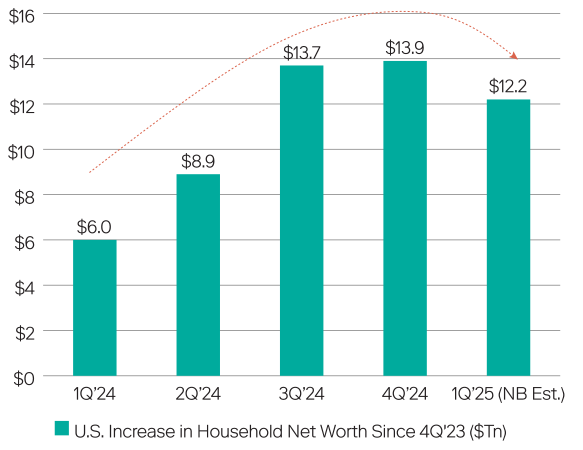
We believe a potentially diminishing wealth effect, reduced real income from tariff-driven inflation, anticipated public-sector layoffs and declining consumer confidence may increase the personal savings rate, putting downward pressure on spending growth.
Financials: Downgrading to Underweight from Overweight
The financial sector tends to be strongly levered to economic growth. While we do not anticipate a significant economic downturn (see the first section of this paper), we believe tariff impacts, DOGE cuts and increased overall uncertainty may ultimately dampen growth. In our view, slower growth, a flattening yield curve and reduced business activity would likely crimp profits at banks and financial institutions, making them less attractive to investors. Until uncertainty subsides, we remain cautious on the sector.
Energy: Upgrading to Overweight From Underweight
A combination of improving fundamentals and stabilizing risks has increased our optimism on the energy sector. While the elevated risk premium in oil prices seems to be retreating in hopes of de-escalating conflict in Ukraine, we think rising global industrial activity will continue to buoy oil demand and keep prices aloft. Additionally, we believe energy stocks appear to be the most undervalued sector in the S&P 500 relative to its current and potential earnings growth. We think much of the negative news—including regulatory concerns and geopolitical risks—appears to be priced in, suggesting to us that energy stocks could rise as sentiment improves.