Japan’s recovery from the “lost decades” of deflation and meager growth has been an on-again, off-again phenomenon. Dating to the days of Abenomics over 10 years ago, global investors have heard repeated announcements of market and corporate reforms, which highlighted good intentions, but also met with reluctance and practical impediments that often held back progress until the next round of initiatives. Gradually, however, these changes gained traction, culminating in the robust equity environment of the past 18 months, which has reached a crescendo with the rise of Sanae Takaichi as prime minister of Japan.
In our view, it helps to think of the reforms as an airplane in motion. Japan hit the runway in the early 2010s with the government’s push for structural reforms and the launch of the Corporate Governance Code aimed at strengthening board effectiveness to ultimately raise corporate value over the mid- to long-term. It then moved to the take-off phase starting in 2022, when the government, along with shareholders and industry associations, worked to push companies to reform their capital management, disclosing their plans to foster improved investment returns and promoting mergers and acquisitions to help loosen up sclerotic keiretsu-oriented business cultures. Next, we believe that Japan should reach the “cruising altitude” phase this year and beyond, with a revised code to push companies to make better use of their cash and other assets in helping drive long-term growth.
Japan’s Equity Reemergence Continues After Decades of Stagnation
Topix Index Total Return
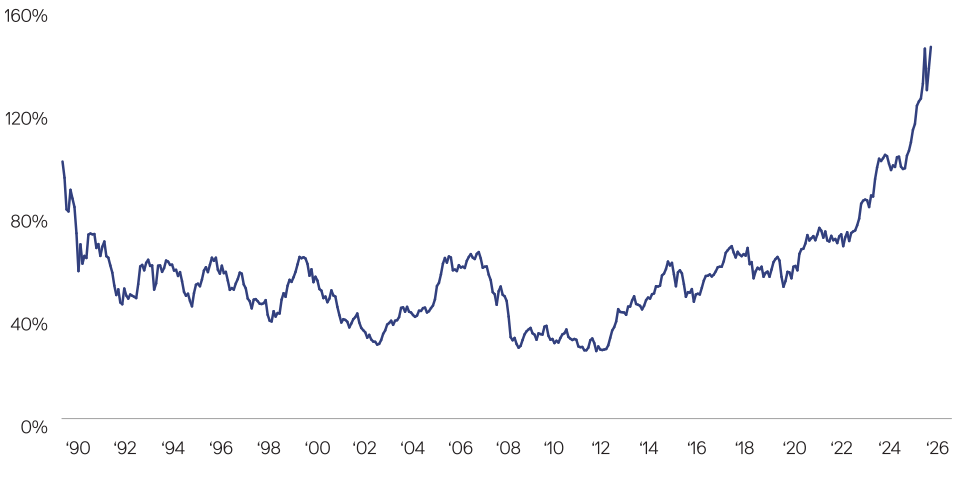
Source: Bloomberg, as of May 29, 2026.
The strong equity market response to Takaichi’s election to head the ruling Liberal Democratic Party in October, followed by her landslide victory in a parliamentary snap election in February, reflects investor consensus that she can effectively pilot Japan in this new phase. A longtime protégé of the late Shinzo Abe, Takaichi is a populist conservative who supports strong growth and a robust national defense. She favors a variation of her mentor’s policies, known as “Sanaenomics,” which calls for strategic investment in key industries, fiscal stimulus and reforms to drive economic expansion.
Since taking office, Takaichi has proposed suspending the 8% food tax to ease cost-of-living issues, and a broader $100+ billion stimulus package. Importantly, she is also looking to accelerate corporate reforms designed to enhance capital efficiency, support research and development, and promote economic security—something that could be crucial to winning over the remaining global investors who may be skeptical of the Japan recovery story.
There are challenges. Takaichi needs to support domestic demand through wage gains, while limiting the chronic inflation that can erode confidence. But the return from the long-term deflationary environment, while a policy success, has also led to consumer stress and tighter financial conditions that could pressure domestic earnings. The recent downward trend in yen valuation, although helpful to exporters, could also squeeze consumers by increasing the cost of imported goods. And although Japan has improved its fiscal picture (in contrast to most G7 countries), Takaichi still needs to manage its heavy debt load (more than 200% of GDP). Outside of her control are Middle East conflict-related higher energy prices, which if maintained over the long term (not our base case), could create a significant headwind given Japan’s dependence on imported oil and natural gas.
One major advantage for Takaichi is her current supermajority in Japan’s Lower House, along with control of important policy committees, which should help smooth the way for her agenda. This is a key reason that, despite near-term issues, we believe that the Japan story should continue to show progress over the medium to long term.
Key Variables: Flows and Valuations
That said, it bears noting that the Japan equity market, even with recent volatility, has come far in a short period of time—raising a key question of whether it may be “too late” for investors to become involved. Although we could see near-term periods of volatility from here, we believe that there could be considerable room to run given positive secular trends and improved investor sentiment.
A look at history may be instructive. At the peak of enthusiasm for Shinzo Abe’s policies a decade ago, the Japanese market saw some JPY 24 trillion in cumulative net foreign investment; from the April 2025 “Liberation Day” announcements through mid-February 2026, that figure reached JPY 15 trillion—well short of the previous mark despite the meaningful contributions to growth and profitability of recent corporate reforms (see display).
Foreign Investment in Japan May Have Room to Run
Cumulative Foreign Buying/Selling (JPY Trillion)
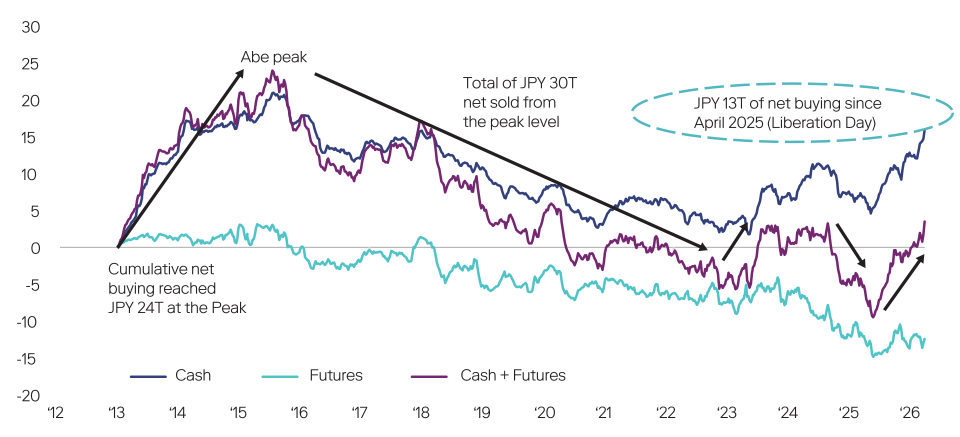
Source: Bloomberg, Goldman Sachs. Data as of January 31, 2026.
Valuations are also worth considering. Although many investors focus on the relatively narrow (and currently pricy) Nikkei 225 index, we think the more diversified Topix Index (with around 1,700 issuers) is a more appropriate reflection of the Japanese investment opportunity. Here, valuations, while higher than a couple years ago, remain reasonable in our view, with Japan’s benchmark Topix trading at 16.1 times 2027 earnings compared to 18.7 for the S&P 500 Index, and a price/book ratio of 1.8 versus the S&P 500’s 5.6.1
Premium on Stock Picking
Importantly, we believe that the environment moving forward is likely to favor stock pickers. Faced with structurally increasing input and labor costs, and amid challenges from U.S. tariffs and inflationary shifts, we have found that quality Japanese companies with scale, market share, strong brand loyalty and pricing power have tended to be more resilient than others. In addition, while artificial intelligence has decimated some corners of the U.S. marketplace, it has actually led to interest in Japan’s substantial capabilities in robotics and automation, which are generally considered the next wave of the AI trend. And rather than limiting the search for opportunities to large-cap names, we think that venturing into mid- and small-cap stocks could also be rewarding, in part because growth- and profitability-driving reforms are taking hold more slowly in this tier of the market. Such companies may also be particularly open to engagement with investors to enhance their business practices and help drive shareholder value.
Looking to the Future
Japan’s corporate governance and capital management reforms remain central to the nation’s recovery story. However, we believe that investors are now focusing on what they could lead to: secular earnings growth. Companies are increasingly looking to put their excess capital to work and use it to expand the business, whether through capital expenditures, research and development, or mergers and acquisitions. With the decisive election of the new prime minister, and the potential for maintaining current reforms and growth momentum, we believe that the Japanese market could have much to offer investors in the coming years.