Private Credit Is Much More Than Direct Lending
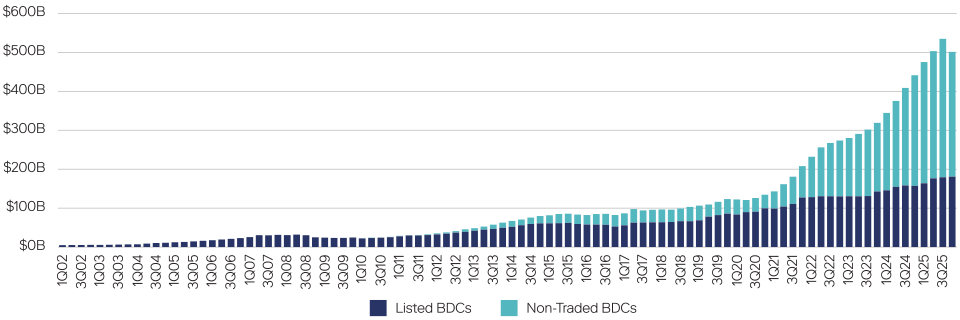
The private credit market is diverse, reaching well beyond traditional direct lending into asset-backed finance, infrastructure debt, real estate credit and specialty finance. The total addressable market across these asset classes is estimated in the tens of trillions of dollars, a reflection of how much the opportunity set has grown. But a narrow subset of that market has been the subject of investor focus recently: Business Development Companies (BDCs). We think some investors may be missing the nuance of the private credit market, especially as the entire BDC universe, listed and non-traded combined, amounts to only about $500 billion (see below).
While BDC Assets Have Grown, They Remain a Small Part of the Private Credit Universe
BDC Assets Under Management
Source: KBW. Data as of December 31, 2025.
Non-Traded BDCs: Redemptions Don’t Appear to Reflect Performance
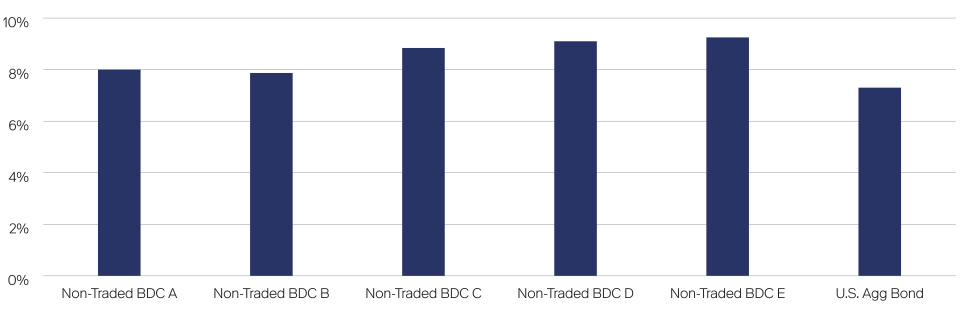
Redemption activity in non-traded BDCs does not appear to be driven by investment performance. Many of the larger BDC vehicles produced high single-digit returns last year, which compares favorably to a range of fixed income alternatives. Redemptions reflect other factors, including investor liquidity needs and a broader reassessment of portfolio positioning, rather than dissatisfaction with how the underlying assets have performed.
Non-Traded BDC Performance Has Remained Solid
2025 Total Net Returns for Top 5 Largest Non-Traded BDCs by Assets vs. U.S. Aggregate Bond Index
Source: Bloomberg, Company filings. Data as of December 31, 2025. Returns for Class I Shares.
That said, some larger vehicles have approached or reached their quarterly redemption caps, a trend that is worth watching given how these structures were designed. Specifically, non-traded BDCs include quarterly redemption limits that are intended to prevent forced asset sales in periods of elevated demand. These limits are a structural protection built into the vehicle from the beginning. Managers operating near those levels are doing what the structure was designed to allow: manage outflows in an orderly way without having to sell portfolio assets at unfavorable prices.
Hypothetical Non-Traded BDC: Leverage Can Stay Contained Even Amid Heightened Stress
| Year 0 | Assumptions | Year 2 | |||
|---|---|---|---|---|---|
| Portfolio | 100 | Net Outflows | 24 | Portfolio | 80 |
| Equity | 60 | Note: 20% Annually | Equity | 36 | |
| Debt | 40 | Repayments | 20 | Debt | 44 |
| Leverage | 0.7x | Note: 10% Annually | Leverage | 1.2x | |
Source: Neuberger. For illustrative purposes only. Values are dollar amounts. The hypothetical assumes a stylized BDC with moderate starting leverage, where investor outflows (assumed at 20% of equity annually) outpace scheduled debt repayments (10% of debt annually) over a two-year period. No portfolio performance assumption is included. These examples are for illustrative purposes only and are not actual results. If any assumptions used do not prove to be true, results may vary substantially.
Listed BDCs vs. Non-Traded: A Distinction That Matters
Publicly traded, or listed, BDCs, which have approximately $180 billion in assets under management,1 are structurally distinct from their non-traded counterparts. They trade on exchanges, have no redemption mechanism and are supported by permanent capital. They are not exposed to the flow dynamics affecting non-traded vehicles. As such, grouping the two together tends to obscure more than it clarifies.
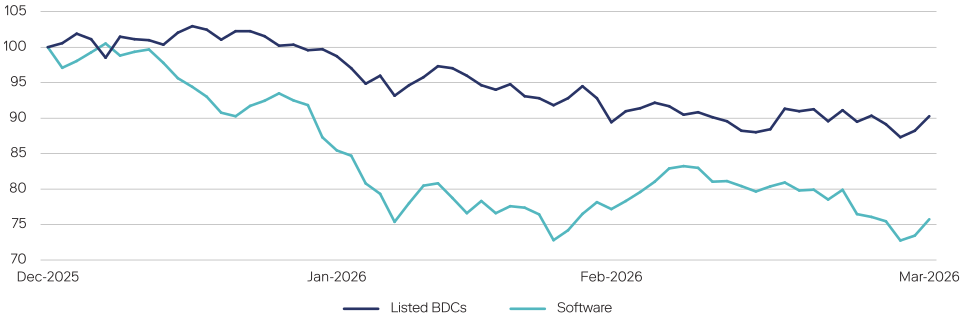
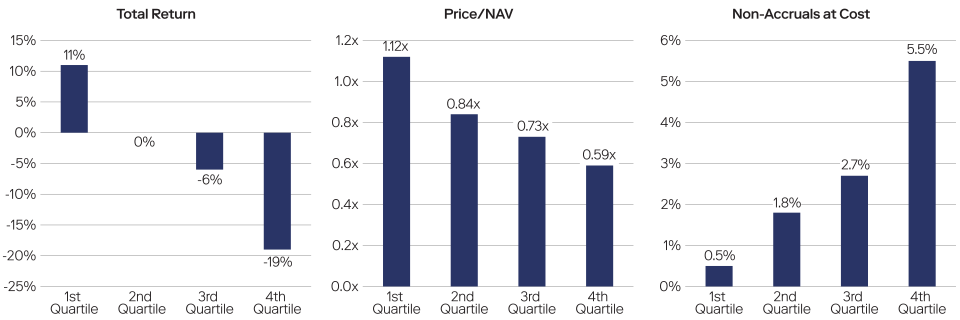
That said, the trading dynamics of listed BDCs may be influencing sentiment around non-traded BDCs. Specifically, listed funds have experienced a notable correlation to software and the technology sector, creating concern about portfolio concentration in that space for listed and unlisted companies alike. At the same time, looking across the listed BDC universe, the difference in outcomes between top-quartile and bottom-quartile managers has been wide overall, whether measured by price-to-NAV, share price performance or non-accrual rates. That range is likely to remain a feature of the market for some time.
BDCs and Software Stocks Have Shown High Correlations This Year…
Price Performance: BDCs vs. Software Equities
Source: FactSet. Data as of March 31, 2026. BDCs = VanEck BDC Income ETF and Software = iShares Expanded Tech-Software Sector ETF. December 31, 2025 – March 31, 2026, indexed to 100.
…While Listed BDCs Have Shown Wide Performance Dispersion Overall
1Q 2026 Results
Source: Company filings and KBW Research. Non-accruals at cost per KBW Research as of December 31, 2025, based on S&P BDC constituents. Price/NAV as of March 31, 2026. Total return performance for December 31, 2025, through March 31, 2026. Based on S&P BDC Index constituents.
There Are Potential Supports for Non-Traded BDCs and Private Credit Broadly
We believe that several factors could provide tailwinds for non-traded BDCs and private credit more broadly, including capital flows, healthy secondary markets and continued bank support.
Institutional Capital May Support Non-Traded BDCs From Here
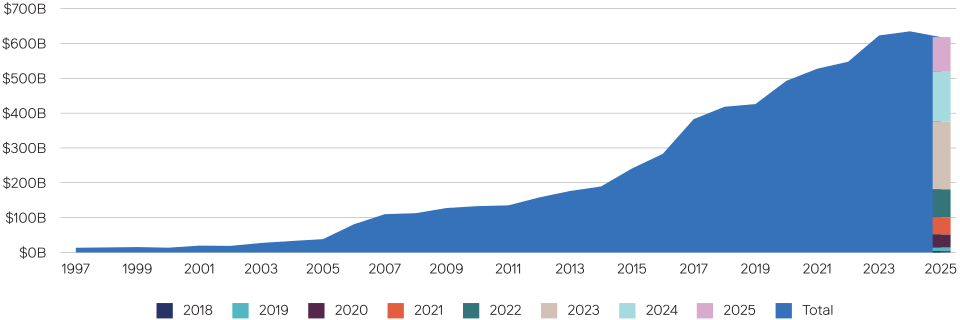
In non-traded BDCs, the outward movement of retail flows is contributing to a broader change in market conditions. Institutional private credit dry powder has remained meaningful, around $600 billion in committed but undeployed capital (approximately half of which is dedicated to direct lending). That capital has the potential to offset outflows from semiliquid vehicles, and its presence in the market is one reason the supply and demand picture for new originations looks different from a few years ago.
Capital May Be Ready to Move From the Sidelines
Global Private Debt Dry Powder
Source: PitchBook. Data as of June 30, 2025.
The rapid pace of retail inflows in recent years put pressure on spreads and, in some cases, on underwriting discipline, as managers competed to deploy capital. As that dynamic shifts, spreads on newly originated credits have started to move wider in some parts of the market, and lender-friendly terms and tighter documentation are becoming more common. These are early observations, and the direction of travel may depend on how broader conditions evolve.
Private Credit Secondaries Are a Growing Segment of the Market
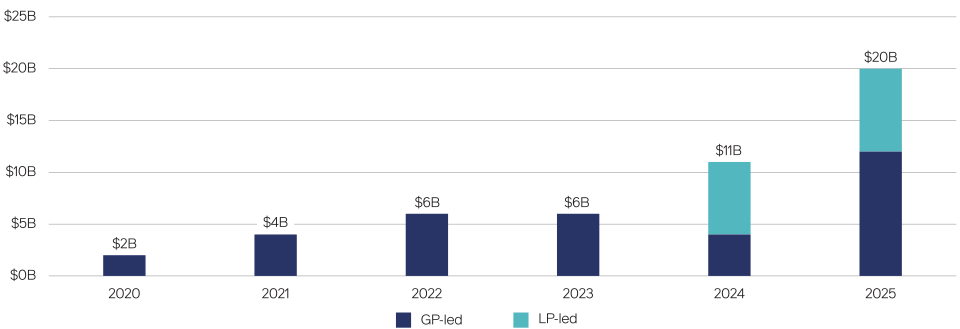
One of the more meaningful developments within private credit has been the maturation of the secondaries market: the purchase and sale of existing private credit fund positions to provide liquidity for limited partners and portfolio management options for general partners. Transaction volume in this market reached approximately $20 billion in 2025, nearly double the prior year, with GP-led structures accounting for a growing share of activity. Dedicated capital targeting in this space has grown considerably, and pricing has been relatively firm; secondary portfolio sales by certain managers have cleared at levels that suggest institutional buyers are finding value, even in books with software or payment-in-kind concentrations. The market remains small in the broader context, but is growing, with annual volume expected to scale meaningfully in the years ahead.
Secondaries Are Enhancing Private Credit Liquidity
Private Credit Secondary Transaction Volume
Source: Evercore. Data as of December 31, 2025.
For multi-credit platforms, credit secondaries offer both a portfolio management tool and a potential source of compelling opportunities. As some managers work through portfolio complexity or consider the future of vehicles that grew quickly during the 2021 to 2023 period, secondary processes may create openings for buyers who are positioned to move.
Banks’ Enthusiasm for Private Credit Shows Little Sign of Wavering
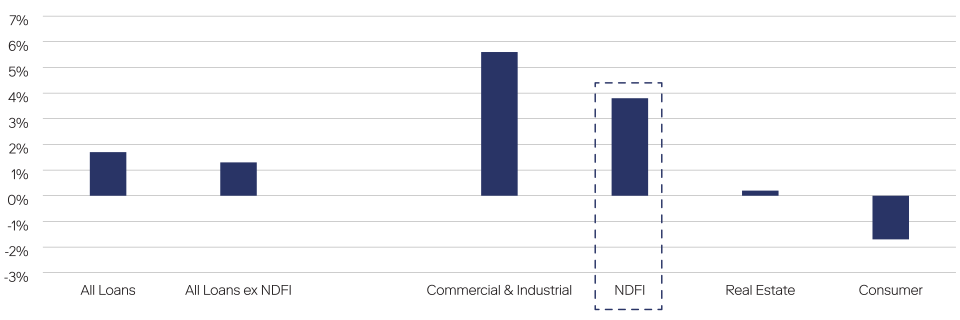
A reasonable question is whether stress in the private credit market could affect the appetite of bank lenders given how much their lending to non-depository financial institutions (NDFI) has grown in recent years. The data so far does not point in that direction. As shown in the display, lending to NDFI has shown little sign of contraction year-to-date, and the largest U.S. banks, based on what we can observe, are not pulling back from private credit counterparties in any meaningful fashion. This lending has historically been among the lowest-loss categories on bank balance sheets, and it tends to be concentrated in the banks’ largest and most established relationships. That said, some banks may be more selective at the margin, particularly when it comes to managers with less-established track records or more concentrated exposures.
Banks Retain Their Commitment to Private Lending
U.S. Commercial Bank Loan Growth Breakdown for 1Q 2026 (Not Annualized)
Source: Federal Reserve. All commercial banks, not seasonally adjusted. December 31, 2025 – April 1, 2026.
Reports that certain institutions are reviewing software-related exposures in their books reflect standard portfolio oversight, in our view. Moreover, the market is likely to be self-correcting on this front: Private credit managers have their own incentives to diversify away from concentrated software exposures over time. And for new money, software credits—including those in segments that may prove most resilient to AI disruption—could offer favorable spreads, terms and documentation precisely because of the caution that currently surrounds the sector.
Loss and Dispersion Are Often Part of the Lending Environment
Stepping back, it is important to remember that lending at scale, across any market or period, may produce a range of outcomes. Some credits perform well; others do not. High-profile events, whether from sector concentration, operational failures or fraud, are an expected part of a market this size and are not unique to private credit. As such, the key point is not that such events occur, but what they tell us about the importance of underwriting discipline, collateral controls and portfolio diversification.
As the market matures and the consequences of rapid growth in some vehicles become more visible, performance differences among managers are likely to become a more prominent feature of the landscape. Portfolios with broader sector and geographic diversification, conservative leverage and strong documentation are likely to be in a better position to navigate a range of outcomes than those built on more concentrated assumptions. Investors who can evaluate those differences with care may find that selectivity matters more than it has in recent years.
Conclusion: Looking for Opportunity in Turbulence
Private credit is adjusting to a different environment from the one that prevailed during its period of rapid growth. For investors with the right time horizon and the tools to evaluate the market carefully, we believe that some of the dynamics emerging from that adjustment are worth paying attention to: spreads that have moved in a more favorable direction for lenders, documentation that has improved, a secondaries market that is opening up new forms of access and a wider range of outcomes among managers that rewards selectivity.
Multi-credit platforms that can move across public and private instruments, participate in credit secondaries, engage with bank risk-transfer structures, and take a considered view of manager quality are, we think, in a good position to navigate what comes next. We would not overstate the opportunity, and there are real uncertainties ahead. But the picture in certain parts of this market is, in our view, more interesting than the headlines suggest.