“Each time history repeats itself, the price goes up” – Ronald Wright, ‘A Short History of Progress’
Emerging market equities have had a remarkable run in 2026, with the MSCI Emerging Markets Index up 22% year to date. This is a number that has rightly attracted attention, but if we look closer we see that a more complicated picture emerges, and the sense of a “ghost rally” takes shape.
While the index may have risen by 22%, 14% of this can be accounted for by just three companies: TSMC, Samsung Electronics and SK Hynix. TSMC is up 53% YTD; Samsung is up 150% and SK Hynix is up by 200%. These moves have propelled the latter two into the 14-strong club of companies with a market capitalization of over $1 trillion. This kind of performance in such a short period of time is staggering, but what about the other 1,202 companies in the MSCI EM index? How much have they benefited from this rally?
The answer is: not much. In fact, most emerging market companies have been left behind. On a sector basis, the picture is clear: Information Technology, in which the top three companies reside, is the clear outperformer, but all other sectors are underperforming the index. This effect is even more pronounced in the last three months, as can be seen in the right-hand side table below. This does not look like an emerging market rally, but a rally in semiconductor stocks.
The Narrowest Rally in Years
MSCI EM sector total return (YTD and Mar-Jun)
| YTD until June 1 | March 1 to June 1 | |||
|---|---|---|---|---|
| Sectors | Total Return | Sectors | Total Return | |
| Information Technology | 62.31% | Information Technology | 44.15% | |
| Industrials | 15.44% | Industrials | 3.59% | |
| Real Estate | 8.37% | Energy | 0.41% | |
| Consumer Discretionary | 3.30% | Utilities | -2.63% | |
| Financials | 1.96% | Financials | -5.88% | |
| Utilities | 1.31% | Consumer Staples | -6.87% | |
| Materials | 0.29% | Consumer Discretionary | -7.60% | |
| Consumer Staples | -1.13% | Real Estate | -8.66% | |
| Energy | -1.42% | Healthcare | -9.90% | |
| Communication | -3.28% | Communication | -10.06% | |
| Healthcare | -3.56% | Materials | -13.35% |
Source: Bloomberg, data as of June 1, 2026.
The chart below shows just how unusual these market conditions are.
New Lows in Underperformance
Percentage of Constituents Outperforming the EM Benchmark
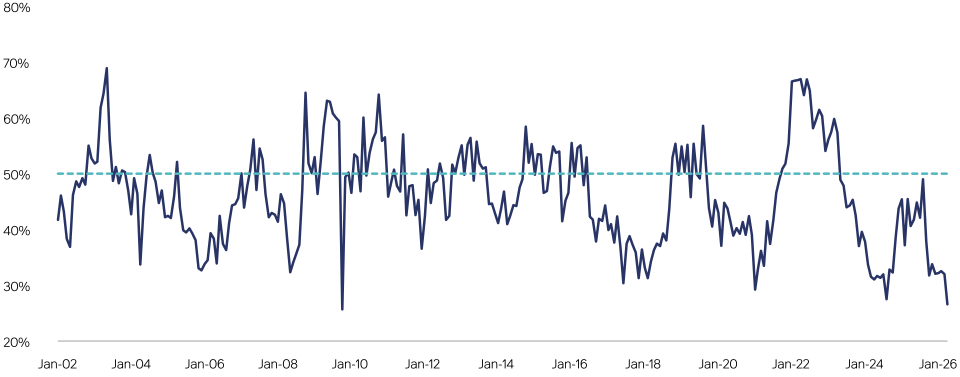
Source: Bloomberg, data as of June 1, 2026. Data in USD and shown on a year-over-year basis.
Historical trends do not imply, forecast or guarantee future results.
By definition, it’s impossible for all constituent stocks in an index to outperform the benchmark. This metric dipping below 50% is not unusual, but only once in the last 25 years has under 25% of stocks outperformed the benchmark, and this was at the end of 2009 during exceptional market conditions. The chart above indicates that these conditions do not tend to last very long, and the reversal that follows has been sharp. But AI, powered by the semiconductor industry, is a powerful force that is reshaping markets as much as it is reshaping our lives. So perhaps this time is different?
What History Tells Us
When a narrow cohort of companies drives the bulk of index returns, the consequence has been a more pronounced concentration of top names by weight; whether measured by top 10 holdings or by the dominant theme propelling those stocks upward. We firmly believe that the history of financial markets is one of the most useful tools available to investors, helping us to better understand the new and innovative developments that occur in the world. With that in mind, we have reviewed two decades of emerging market equity market history and identified three prior instances of heightened index concentration:
- 2010 – 2011: Commodity Supercycle. Exceptional GDP growth in China drove the largest cycle commodity and materials consumption the world had seen. The MSCI EM Index’s top 10 was dominated by resources companies Petroleo Brasileiro, Gazprom, and Vale.
- 2014/2015: It’s All About China. China’s economic growth trajectory continued to captivate global capital. The MSCI EM Index’s top 10 was dominated by Chinese companies Tencent, China Mobile, and China Construction Bank.
- 2020/2021: Chinese Tech. A global technology boom, accelerated by Covid-19, saw Chinese tech companies conquer not only domestic markets but also overseas. The MSCI EM index’s top 10 was dominated by Chinese tech names Alibaba, Tencent, and Meituan.
Across each period, we examined both top 10 concentration and thematic, that is to say the weight of the stocks geared into the dominant theme of that period. We then looked at the following market performance:
Historical Drawdowns in Emerging Markets
EM Equity Market Drawdowns Following Major Thematic Periods
| Time Period | Theme | Top 10 Concentration | Theme Concentration | Max Index Drawdown Within the Next 12 Months |
|---|---|---|---|---|
| 2010/2011 | Commodity Supercycle | 16% | 6% | -31% |
| 2014/2015 | It's All About China | 19% | 12% | -35% |
| 2020/2021 | Chinese Tech | 28% | 15% | -42% |
Source: Bloomberg, data as of June 1, 2026. Historical trends do not imply, forecast or guarantee future results.
Two observations stand out to us. In each episode, concentration by holding and by theme increased in the following cycle, and so did drawdowns. In the latest instance the MSCI EM Index fell by 42% following peak index concentration. These are striking numbers.
Where do we stand today? Below are the current top 10 constituents of the MSCI EM Index as of MSCI’s end-of-May rebalancing, followed by how concentration levels look today across both the top 10 holdings and by theme.
Today’s Top 10 EM Companies
MSCI EM Index Top 10 and Thematic Weightings
| Jun-26 | Weights | AI Theme Stocks | |
|---|---|---|---|
| 1 | TSMC | 14.5% | 14% |
| 2 | Samsung Electronics | 7.8% | 8% |
| 3 | SK hynix | 6.6% | 7% |
| 4 | Tencent | 2.7% | |
| 5 | Alibaba | 2.1% | |
| 6 | MediaTek | 1.6% | 2% |
| 7 | Delta Electronics | 1.2% | 1% |
| 8 | Hon Hai Precision | 0.9% | 1% |
| 9 | Samsung Electronics Prefs | 0.9% | 1% |
| 10 | China Construction Bank | 0.8% | |
| 39% | 33% |
Source: MSCI (https://www.msci.com/documents/10199/c0db0a48-01f2-4ba9-ad01-226fd5678111). Data as at June 1.
How The Picture is Changing: Drawdowns in Emerging Markets
EM Equity Market Drawdowns Following Major Thematic Periods
| Time Period | Theme | Top 10 Concentration | Theme Concentration | Max Index Drawdown Within the Next 12 Months |
|---|---|---|---|---|
| 2010/2011 | Commodity Supercycle | 16% | 6% | -31% |
| 2014/2015 | It's All About China | 19% | 12% | -35% |
| 2020/2021 | Chinese Tech | 28% | 15% | -42% |
| 2026 | All Eats The World | 39% | 33% |
Source: Bloomberg, data as of June 1, 2026. Historical trends do not imply, forecast or guarantee future results.
Clearly, concentration levels today exceed what we saw in the previous three episodes. We do not have a crystal ball, but the question worth asking is: if 2026 follows the pattern of the three previous market concentration episodes, how should investors position themselves to mitigate a potential drawdown?
Based on the historical examples above, investors need to be positioned away from the largest index components to avoid the worst of any potential drawdown. In the same way as they have led the gains this year, they could lead the losses; partly if the shares are priced to perfection, and partly if they have become deeply consensus positions. In our estimates, TSMC currently trades at 80x cyclically adjusted price-to-earnings, Samsung Electronics at 50x, and SK Hynix at 125x CAPE, as compared to the MSCI Emerging Markets Index at 19x. These may be exceptional businesses, but the price required to own them today may leave little margin for error. The degree of market consensus is equally striking: 93% of public emerging market funds own TSMC, 86% own Samsung and 75% own SK Hynix, according to Copley research.
Being part of the crowd may offer temporary comfort. But history's lesson is not simply that extreme concentration ends, it is that it can end sharply. The data presented here mirrors the conditions that preceded each of the three drawdowns we have reviewed; and in an index of more than 1,200 companies, the current rally has been primarily defined by just three. As the old saying goes, there are plenty more fish in the sea.