Alan Tsang | Director of Equity Research, Asia
Yan Taw Boon | Head of Thematic Equity Research, Asia
Charles Nguyen | Head of ESG Investing, Asia
Preliminary trade talks in Paris in March laid the groundwork for what both sides have described as a potential turning point in U.S.-China relations. A one-year truce that forestalled triple-digit tariffs is holding, new U.S. trade investigations are testing its edges, and the Iran conflict has added an energy dimension that neither side can ignore. Against all of that noise, the 15th Five-Year Plan—covering 2026 to 2030—has arrived with relatively little fanfare in Western investment circles. That may be an oversight.
Given China's scale—the world's second-largest economy, dominant force in global manufacturing supply chains, and a technological leader—the plan is not a domestic policy document so much as a structural investment thesis. Two themes in particular carry direct implications for global portfolio positioning: China's national artificial intelligence (AI) strategy and the government's effort to reshape domestic competitive dynamics through what officials have termed anti-involution policy.
AI as Industrial Policy
The 15th Five-Year Plan mentions artificial intelligence 52 times—four times more than its predecessor. That arithmetical shift alone conveys a strategic reordering. AI is no longer one priority among many; it is the organizing principle of China's modernization agenda for the next half-decade.
The vehicle for execution is the AI+ initiative, released in August 2025, which aims to embed AI across every segment of the real economy. The stated target is 90% penetration of AI-enabled devices and applications across Chinese industry by 2030. The core AI industry, valued at roughly 1.2 trillion yuan in 2025, is targeted to surpass 10 trillion yuan within the plan period, with national R&D investment set to grow at more than 7% annually.1
The infrastructure supporting that ambition is more deeply embedded in global AI supply chains than is widely appreciated. Chinese technology hardware manufacturers are key enablers of critical data center components—optical networking modules for high-speed connectivity, printed circuit boards for AI servers and multilayer ceramic capacitors, the passive components that power AI infrastructure at scale. Alongside this, China is emerging as a leader in physical AI; the humanoid robotics industry has attracted strong top-down policy support under the plan, positioning China at the frontier of the next wave of AI deployment—one that extends well beyond the data center and into the physical economy.
Chinese AI Models Are Materially Cheaper
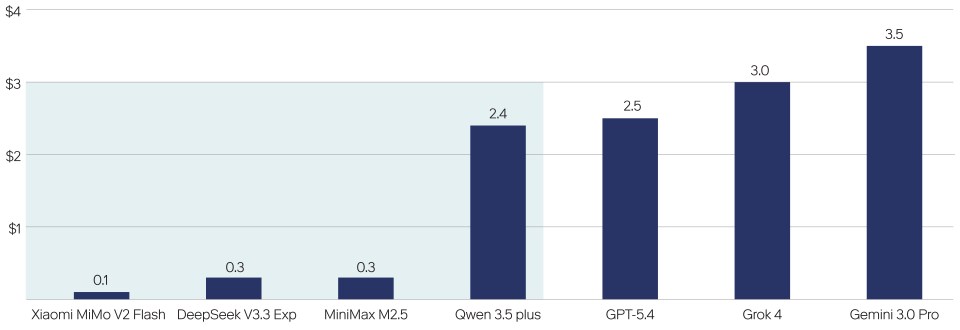
Source: Frontier Model USD/m tokens (as of March 2026): Neuberger research, as of March 2026.
What distinguishes China's AI ambition from headline-level comparison with the U.S. is the architecture beneath it. Energy cost is the factor that Western analysis most consistently underestimates. The renewables overcapacity discussed below has, as an inadvertent byproduct, produced electricity prices in Western China that are lower than those in most U.S. states2—driven primarily by some of the world's most abundant and lowest-cost solar, wind and hydro resources. That distinction matters: because the advantage is rooted in renewable infrastructure rather than fossil fuel subsidies, it is structural and sustainable, which creates a genuine competitiveness problem for the U.S. Model training, inference at scale and the transition toward energy-intensive agentic AI systems all translate energy costs directly into unit economics. China's ability to site large-scale data centers in Western China under the East-West Computing Resources Transmission Project effectively converts that renewable overcapacity into a durable AI infrastructure advantage.
The LLM strategy reinforces this logic. Rather than competing frontier-to-frontier with OpenAI or Google in a race for the most capable closed models, Chinese developers have pursued an open-source, low-token-cost approach. February 2026 offered early evidence that this strategy is gaining real-world traction: Chinese LLM usage surged during the month, driven by rising demand for agentic applications, the viral adoption of tools such as Openclaw, and token pricing sitting substantially below Western equivalents.3 As AI systems become heavier in compute and data requirements, the cost-per-output metric will matter more, not less. China's positioning on that curve looks increasingly intentional rather than opportunistic, in our view.
Rewriting the Rules of Competition
The second theme with global investment consequences is arguably more immediately material to earnings: anti-involution policy.
"Involution" describes a condition of excessive competition in which firms continually undercut one another on price without generating genuine productivity gains—a race to the bottom that destroys margins, distorts capital allocation and hollows out entire industries. Nowhere has the dynamic been more acute than in renewable energy. China's solar manufacturing capacity reached approximately 1,200 GW in 2025—nearly double total global installation demand4—with six of the largest manufacturers reporting combined losses of roughly $2.8 billion in the first half of 2025 alone.
China's Producer Price Deflation Is Easing
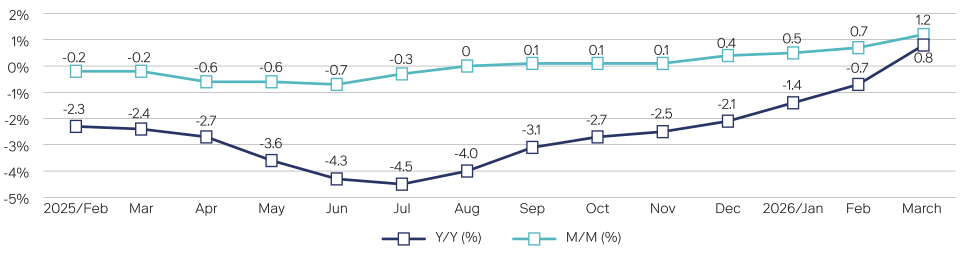
Source: National Bureau of Statistics of China, as of April 2026 Industrial Producer Price Indexes in March 2026.
The 15th Five-Year Plan marks a deliberate break from that model, explicitly prioritizing orderly competition over unconstrained capacity additions. One implication of this for investors is that less destructive price competition means producer prices stabilize, and stabilizing producer prices feed directly into corporate margin recovery and earnings growth. PPI inflation rising to -0.9% year-on-year in February—a 19-month high—is early evidence that this chain is beginning to function. With deflationary pressure easing, the language around hard capacity cuts has softened, pivoting toward regulating capacity, enforcing anti-monopoly rules and reining in the local subsidies that have historically fragmented China's industrial base. Pursued through structural market discipline rather than top-down intervention, this is a more durable route to margin recovery—and a more investable one.
The Earnings Case Hardens
The policy shifts described above are beginning to show up where it matters most: in earnings.
Consensus expectations have moved decisively. MSCI China earnings growth is forecast to accelerate from approximately 6% in 2025 to 14% in 2026, according to Goldman Sachs. The onshore CSI 300 tracks a similar path, from roughly 10% to 12%.
CSI 300 Earnings Revisions: 2026 Breaks a Decade-Long Trend
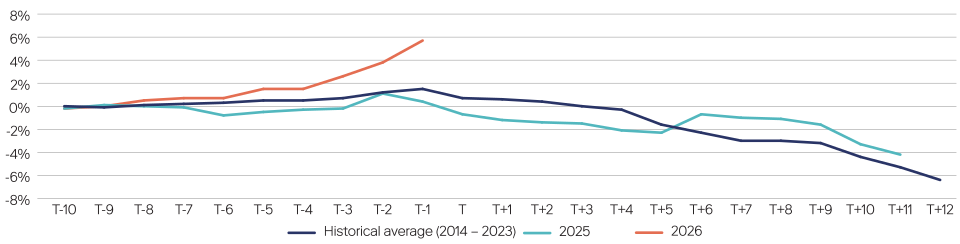
Source: UBS research, as of March 2026.
Three drivers underpin this. AI adoption is feeding through both technology supply chains and broader corporate productivity. Chinese companies expanding overseas offer a second tailwind—international revenues now account for around 16% of aggregate Chinese corporate revenues, at margins that run structurally higher than domestic equivalents. Anti-involution's stabilizing effect on producer prices is the third, with pricing discipline beginning to feed through to margin recovery across industrial sectors.
The revisions data offers early confirmation. CSI 300 earnings revisions have turned positive year-to-date in 2026—the first sustained break from persistent downward revisions stretching back to 2014, according to UBS. China's energy independence, built on its renewables base, has reinforced that resilience further, insulating A-share earnings from the external energy shocks the Iran conflict has amplified elsewhere.
A quiet but substantive capital market upgrade reinforces the picture: corporate governance reforms, a market value management policy, and a new investor stewardship code collectively address the information asymmetries that have historically weighed on Chinese equity valuations. The disclosure framework deserves particular attention. China's new sustainability reporting standards are designed for broad compatibility with International Sustainability Standards Board, and their adoption of double materiality mirrors the EU's Corporate Sustainability Reporting Directive. At a moment when sustainability disclosure is fragmenting in parts of the U.S. and Europe, China's alignment with globally recognized standards may meaningfully reduce complexity for multinational institutional investors and improve the quality of data available for transition risk assessment and corporate engagement.
A Question of Calibration
None of this eliminates the risks that institutional investors rightly weigh. Geopolitical uncertainty remains material, property sector stress persists, and the durability of domestic demand recovery requires ongoing scrutiny. The Paris trade talks illustrate the fragility of the current equilibrium: new U.S. trade investigations are already testing the one-year truce, and the summit could produce either further stabilization or renewed disruption.
Yet the positioning picture is striking. As of February 2026, Nvidia alone represented more than 4% of the MSCI All Country World Index. China, the world's second-largest economy, accounted for less than 3%. In our view, most global institutional investors sit at 2 – 3% effective exposure—underweight by any benchmark-relative measure.
The 15th Five-Year Plan is a credible, funded and detailed commitment to transforming China's economic structure around AI productivity and disciplined capital allocation. The earnings trajectory is supported, for the first time in over a decade, by positive revision momentum. An important question for global investors therefore is not whether China belongs in a diversified institutional portfolio. The question is whether current exposure is appropriately calibrated to the opportunity that this plan has now put on the table.