Amid market volatility driven by Middle East tensions, we believe it is important for investors to assess their exposures and to understand the risks and opportunities that may be associated with different types of issuers. Given their central role, one segment of particular interest has been the GCC banks: financial institutions operating in the Gulf Cooperation Council region of Saudi Arabia, Kuwait, the United Arab Emirates, Qatar, Bahrain and Oman.
In our view, GCC banks’ differentiation in terms of resilience and longer-term prospects becomes apparent through a quality lens. Specifically, we look for five mutually reinforcing layers of protection: a market heavily comprised of senior unsecured instruments, strong liquidity buffers, solid capitalization, sovereign ownership anchors and a decades-long track record of decisive government intervention. Together, these elements constitute a multilayer defense that we believe can withstand the current geopolitical environment.
A Position of Strength
GCC banks entered this period of conflict from a position of financial strength, carrying sound liquidity and capital ratios that are materially above regulatory minimums. This, combined with $6 – 7 trillion in total sovereign wealth assets and FX reserves (of which, an estimated $2 – 3 trillion are in liquid assets), reinforces a $4 trillion banking system across the six countries. In other words, the GCC's capacity to absorb stress is substantial.
Three of the central banks in the region—UAE, Kuwait and Qatar—have already moved preemptively to announce liquidity and capital support packages since mid-March 2026, ensuring that no stress materializes in the system. This support is not a novel response: GCC sovereigns have intervened in every major stress episode since 2008—the Global Financial Crisis, the 2014 – 16 oil price shock, the Qatar blockade and COVID-19—resulting in not one GCC bank failure across all of those episodes. In our view, the current policy response is following the same pattern: early, decisive and well-funded.
Liquidity
The GCC banks whose bonds we favor have Basel-III Liquidity Coverage Ratios (LCRs) that are well above their 100% minimum requirements, and in most cases greater than the average of major banking systems in developed markets. LCR measures a bank’s ability to meet all obligations using cash and easily sellable assets, under 30 days of heavy withdrawals—including a partial run on deposits (see below).
GCC Banks’ Coverage Ratios Are Comparable to Developed Market Counterparts
| Developed Markets Sample – Average LCR | GCC Banks Sample – Average LCR | ||
|---|---|---|---|
| U.S. | 120 – 130% | United Arab Emirates | 146% |
| China | 180 – 200% | Saudi Arabia | 167% |
| Germany | 140 – 150% | Qatar | 207% |
| U.K. | 145 – 155% | Kuwait | 220% |
| Japan | 170 – 180% | Bahrain | 292% |
| France | 150 – 165% | Oman | 162% |
| Average | 157% | Average | 199% |
Source for developed markets: Office of Financial Research, S&P Global, FitchRatings. Latest available information through April 1, 2026. Source for GCC: simple averages of the GCC banks’ regulatory disclosures. Include banks representing at least 93% of their respective banking system assets, and roughly 80% in UAE (the combined share of all its Domestic-Systemic Important Banks, the only banks required to report LCR there). Data as of December 2025. Figures are approximate.
Beyond these aggregate figures, we believe it is crucial to stress-test specific banks to understand how they may fare in periods of volatility. Our Stress Test Model simulates an immediate and simultaneous 5% deposit withdrawal and full repayment of all short-term wholesale funding, alongside a drag from reduced income. In our view, banks should have no problem honoring these outflows without drawing from central bank liquidity facilities.
Capitalization
GCC banking systems entered the current regional conflict well-capitalized, with capital ratios materially above regulatory minimums. CET1 measures how much of a bank’s own money (not borrowed funds) sits as a cushion to absorb losses before depositors or bondholders are affected, as a share of risk-weighted assets. GCC banks in the U.S. dollar bond space carry an average CET1 ratio of 13.2%, or nearly double the Basel III minimum of 7.0%,1 providing a substantial 620-basis-point cushion before approaching the regulatory floor.
At the country level, among banks with USD bonds outstanding, Saudi Arabia (CET1 of 15.0%), Qatar (16.0%) and Oman (14.9%) are the best-capitalized, while UAE (11.3%) and Bahrain (12.5%) sit at the lower end of the GCC range—though they remain meaningfully above regulatory minimums. On a CET1 basis, GCC banks exceed both the U.S. and China, the two largest banking systems globally, as shown below.
Quality Measures: GCC Banks vs. Other Major Banking Systems
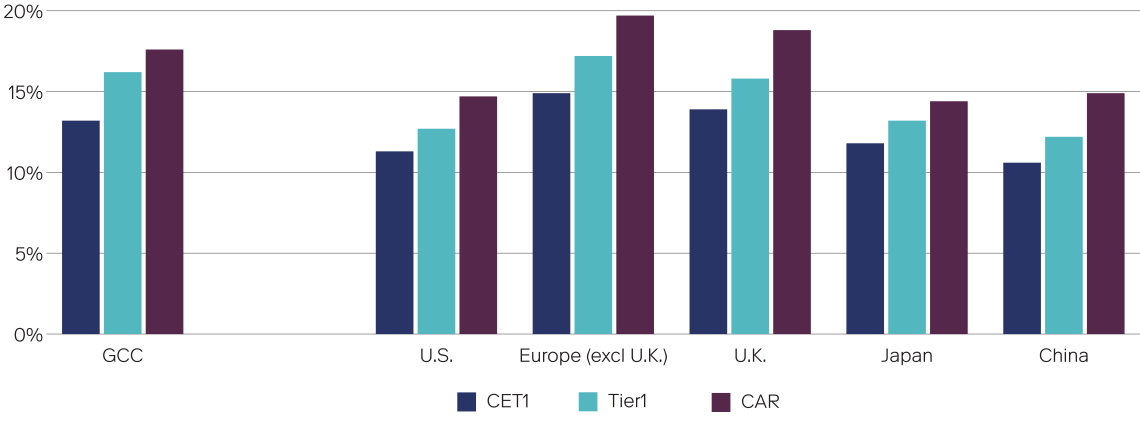
Source: Bloomberg, Company filings. Data as of April 1, 2026, latest available financial reporting. GCC banks: Simple average of commercial banks with USD bonds outstanding. Other countries: Simple average of constituents of S&P 500 Banks Index for U.S., ESTX Banks Index for Europe ex-U.K., FTSE 350 Banks Index for U.K., top nine banking groups for Japan, CSI300 Banks Index for China.
Sovereign Ownership
In our view, strong government ownership is one of the most important qualitative factors in a geopolitical stress scenario. Governments in the GCC countries hold varying, but meaningful, proportions of ownership, ensuring confidence in their banking systems.
Substantial Government Ownership in Major GCC Commercial Banks
GCC Governments’ Bank Ownership
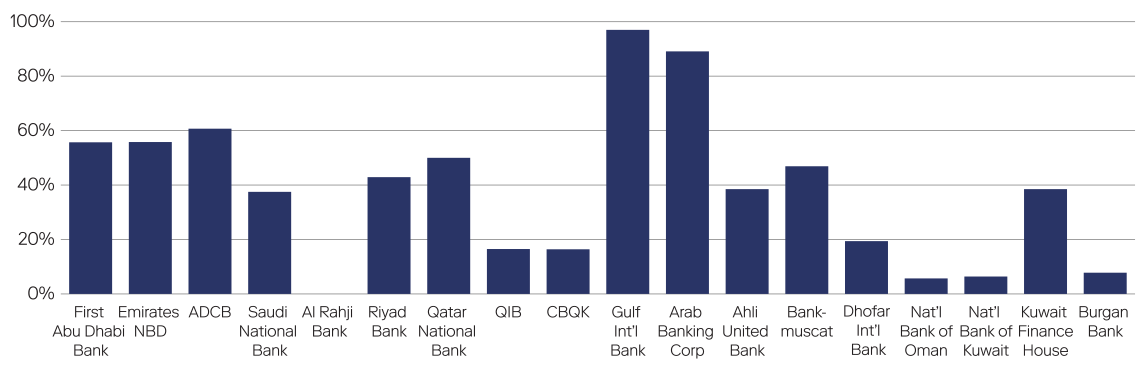
Source: Bloomberg, company and exchange filings. Data as of April 1, 2026. Top three banks by total assets in each GCC nation.
GCC Central Bank Policy Response: Post-Conflict Support Measures
In light of recent geopolitical developments, three GCC central banks have already moved swiftly and decisively to announce preemptive support packages for their banking sectors. We believe the rest are likely to act in a broadly similar way soon. The speed and breadth of these policy responses—spanning liquidity relief, capital buffer releases and credit flexibility—reinforce a key thesis for us: GCC sovereigns have both the willingness and capacity to support their banking systems. The recent actions were taken from a position of strength, not stress, with each central bank explicitly affirming that its banking sector entered this period with capital and liquidity ratios already exceeding international benchmarks.
- UAE (March 17): The country’s central bank launched a five-pillar resilience package—releasing capital buffer requirements, relaxing LCR/Net Stable Funding Ratio (NSFR) requirements, allowing loan classification deferrals, and opening enhanced reserve and term liquidity facilities—measures representing AED 1 trillion (over $272 billion) in support.
- Kuwait (March 26). The central bank eased liquidity requirements (LCR, NSFR, local regulatory liquidity ratio), raised maximum lending limits and released a portion of the capital conservation buffer to expand refinancing and credit quality absorption capacity and support economic activity.
- Qatar (March 29 – 30): Qatar’s central bank cut the reserve requirement from 4.5% to 3.5% for deposits, introduced unlimited riyal repurchases and new three-month term repo facilities, and allowed banks to grant affected borrowers up to three months of principal and interest deferral.
Historical Track Record of Government Support
Although their current financial condition and government support are reassuring to us, it is worth noting that GCC sovereigns have demonstrated a consistent and credible pattern of decisive intervention to support their banking systems during periods of stress:
- 2008 – 09 Global Financial Crisis: No GCC bank failed, as the UAE deployed nearly $40 billion in sovereign bond and term funding programs, Abu Dhabi injected $4.3 billion directly into five banks, and Saudi Arabia cut repo rates by 350bps while injecting $8.4 billion in liquidity.
- 2014 – 2016 Oil Price Shock and 2017 – 2020 Qatar Blockade: Further reinforcing the support track record, central banks deployed targeted liquidity facilities and, in Qatar’s case, mobilized an estimated $38.5 billion (about 23% of GDP) within two months to fully offset a 28% drop in nonresident deposits.
- 2020 COVID-19 Pandemic: This was arguably the most aggressive response, with the UAE, Qatar and Saudi collectively deploying over $100 billion in zero-cost funding, capital and liquidity buffer relief, and loan deferral programs, enabling GCC bank returns on equity to recover sharply in 2021.
In each episode, the scale, speed and breadth of sovereign intervention left no ambiguity as to the willingness and capacity of GCC governments to stand behind their banking systems.
Conclusion: A Strong Foundation
We believe these key variables provide a strong foundation in supporting exposure to the region. Within the banking sector, we largely favor the U.S. dollar bond space; it is predominantly comprised of senior unsecured bonds issued by highly rated investment grade banks. The strong liquidity and capital buffers, sovereign ownership anchors and the proven historical willingness of GCC governments to support their banking systems provide a multilayered defense against potential challenges that the current geopolitical environment might create for their banks.