When a new financing model is applied to an asset that markets have not yet fully embraced, typically capital is scarce and specialized expertise is rare. That tends to reward the early providers of capital who are willing to do work that others cannot. As the sector matures, that advantage is typically competed away over time. The opportunity, in our view, is to take part while this process is underway but not yet complete—a phenomenon we currently see at play in music royalty finance.
How Music Royalties Became an Asset Class
Music royalties are contractual rights to income earned when a song is “consumed.” That includes streaming, public performance, broadcast and licensing into film, television and advertising. For most of their history, these rights sat with artists, songwriters, publishers and labels. They were not easy for outside investors to own. In the era of CDs and record sales, income was lumpy and hard to forecast, ownership was fragmented and there was little standardized data to underwrite against.
Two developments changed that. First, streaming turned music income into a recurring, subscription-like cash flow, and made it far more transparent, because platforms report usage in detail. Second, the collection infrastructure matured. Performing rights organizations and mechanical rights collectives (focused on reproduction or distribution) now track usage across markets and pay income to rights holders on a set schedule. The result is a documented, third-party record of what a catalog earns. In our view, these two changes are what made music royalties underwrite-able, and therefore investable.
The scale and direction of that income underpin the opportunity. Global recorded music revenue has risen every year for more than a decade, driven by streaming and largely independent of the economic cycle; the market surpassed $30 billion for the first time in 2025 (see display).
Global Recorded Music Revenue Keeps Climbing
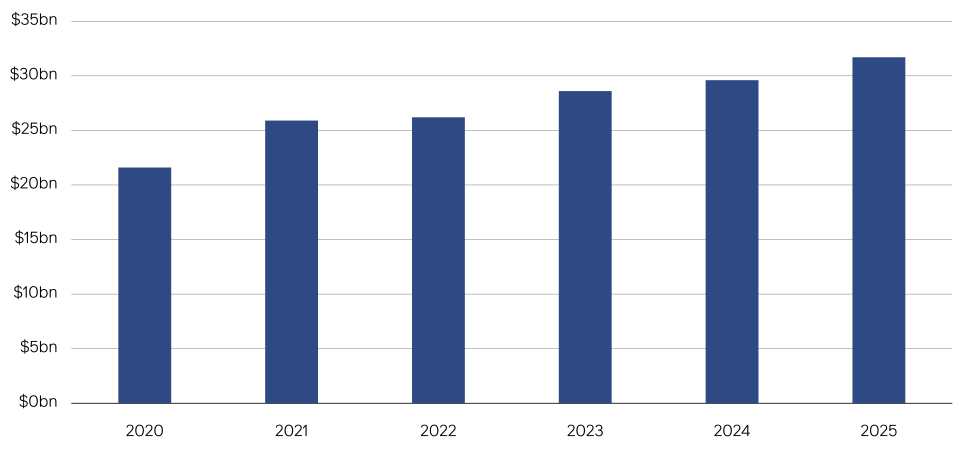
Source: IFPI Global Music Report (2021 to 2026 editions). Global recorded music trade revenue; 2025 was the eleventh consecutive year of growth.
Although growth has moderated from its post-2020 pace as subscriber additions have slowed in mature markets, the trajectory has stayed positive across widely varying conditions, supported by emerging-market adoption and periodic price increases. For a credit investor, what matters is less the headline growth rate than its steadiness: Income that expands gradually (and may have held up through the last downturn) supports the durable cash flows that the asset class depends on.
Contractual, Durable: What Makes Royalty Cash Flows Attractive for Investors
Beyond the overall trend, we believe several features make income from music royalties distinctive:
- Contractual, recurring and auditable. Income is collected and paid by a regulated infrastructure, not negotiated deal by deal. It recurs as long as the music is used. And because collection societies produce documented histories, the cash flows can be independently verified.
- Long-lived and diversified. In major markets, copyright generally lasts for the life of the author plus 70 years. Income also arrives through several independent channels, so the income does not depend on any single platform or channel.
- Low economic sensitivity. Music consumption has been relatively steady across economic conditions.1 The income has also shown limited correlation to traditional corporate credit and equity risk.
We would frame music royalties as a complement to traditional private credit, not a substitute. Corporate lending centers on a borrower whose credit must be underwritten. A royalty is a direct claim on a diversified stream of usage-based income, so there is no single borrower whose failure impairs the asset. As part of a diversified private credit allocation, we view income of this kind as a useful complement, with return drivers that differ from corporate spread risk.
An Asset Class That Is Becoming ‘Institutional’ Through Banks and Securitization
Two financing markets have grown up around music royalties. In our view, their growth is the clearest sign the sector is maturing.
First, banks now lend against music catalogs, extending senior secured facilities collateralized directly by copyrights. Because the cash flows are contractual and can be verified, lenders can underwrite them much as they would other asset-backed loans, and senior facilities of meaningful size have become a regular feature of the market.
Second, a rated bond market has emerged. Catalog cash flows are packaged into securities, rated and bought by insurers and other institutions. By the rating agency KBRA's count, rated issuance has grown quickly over just a few years, and the number of issuers has expanded (see display). We believe this is a clear sign of institutional adoption.
Rated Music Royalty Securitization Has Grown Rapidly Since 2023
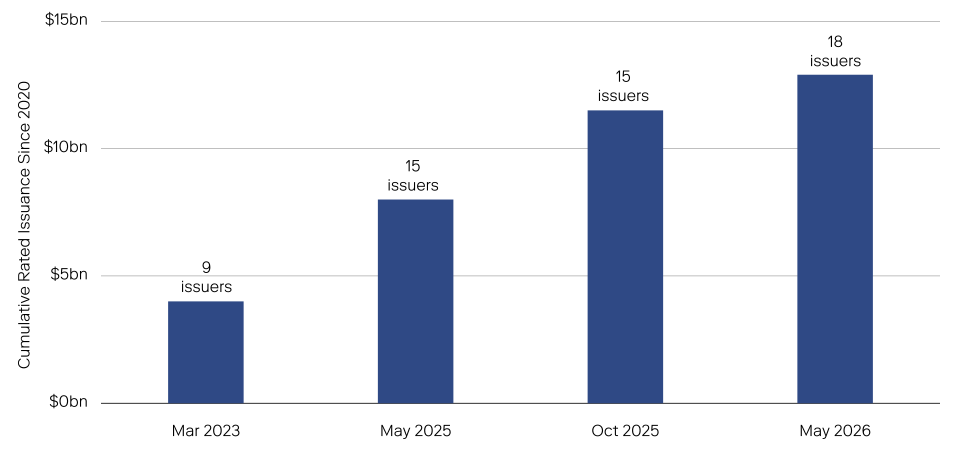
Source: KBRA. Data as of May 2026.
Why Financing Markets Matter: Investor Comfort and Auditable Income
The growth of both a bank market and a rated bond market does two things at once, in our view. It shows that credit-focused institutions have grown comfortable underwriting these cash flows. It is also the mechanism by which contractual, auditable income can, with prudent leverage, support a potential return profile we consider attractive relative to the risk.
One lesson from the sector's short history concerns discipline. These cash flows are long-lived, so their value moves with the discount rate applied to them, and the entry price matters a great deal. Catalogs are priced as a multiple of net publisher share, or NPS: the income the owner keeps after paying the songwriter's share on every royalty collected. The multiple is simply the purchase price divided by annual NPS. Masters work the same way, using net label share, which is net of the artist's royalty. Independent valuation work shows that these multiples have held broadly steady in recent years but vary widely by catalog, from the low-teens on recent-vintage masters to the mid- and high-teens on publishing and older masters (see display). Just as telling is where the competition sits: Generalist capital concentrates in the broad, mainstream genres, with bidding especially competitive for the most visible material. We think a more durable edge lies not in that contested core but in selecting specific categories that generalist buyers overlook, which is where we turn next.
Valuation Multiples Vary Widely by Catalog
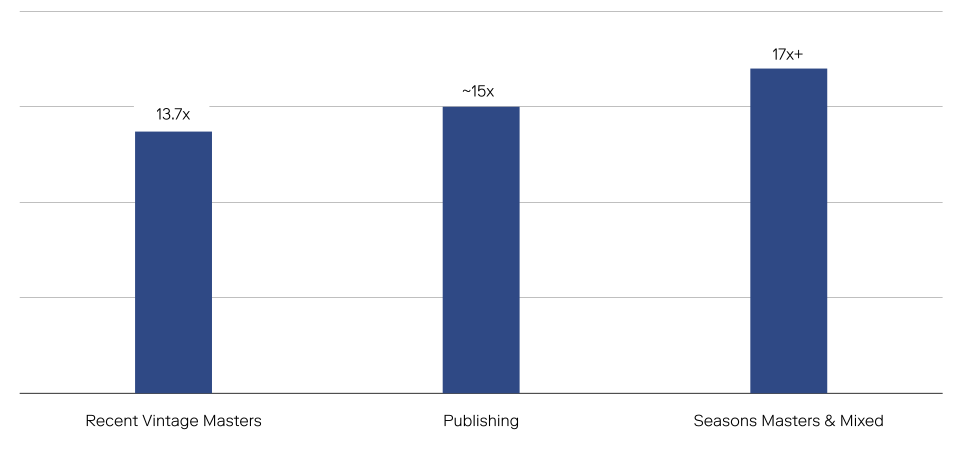
Source: Citrin Cooperman, 2025 music catalog valuations (published April 2026). Average valuation multiples by catalog type; recent vintage reflects newer masters.
Where We Think Value Remains: Music Sub-Genres and Specialty Categories
As the market matures, pricing tightens most at its most visible end: the marquee catalogs of globally recognized artists. They attract competitive processes, strategic buyers and premium valuations. As a specialized capital provider, we see minimal advantage in competing for them.
The most compelling opportunities within the royalty space, in our view, reside in sub-genres such as country and Christian music, and in master, soundtrack and television/film royalties. We also find value in smaller catalogs that lend themselves to thoughtful aggregation, which can improve marketability and support valuation on exit. In 2025, several hundred catalogs changed hands, at an average of roughly $23 million each,2 including a small number of large transactions. Reported activity has centered on mainstream genres such as pop, hip-hop and rock, which suit generalist buyers, while some smaller segments, including Christian music, have begun to attract greater investor attention.
Christian/Gospel Has Been the Fastest-Growing U.S. Streaming Genre
U.S. On-Demand Audio Streaming Growth, 2025 vs. 2024, by Genre
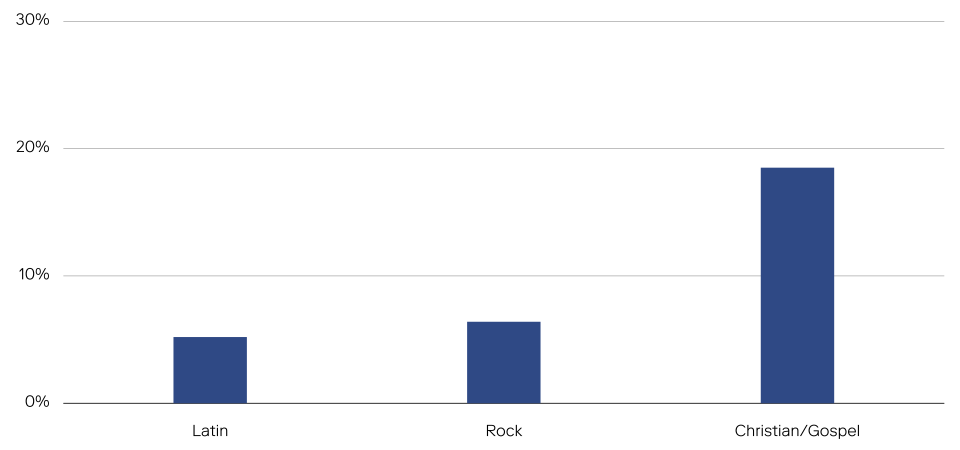
Source: Luminate music consumption data, as of December 31, 2025.
Price, Concentration and AI Impacts Are Key Considerations in Assessing Music Royalties
No asset class is without risk. We watch a few things closely: available price, since these long-dated cash flows are sensitive to the discount rate; concentration among the streaming platforms that pay the royalties; the added uncertainty in younger, less-seasoned catalogs; the early question of how AI-generated music may dilute the streaming pool; and limited liquidity, since these assets trade infrequently. Together they are why we believe careful sourcing and valuation discipline matter, and why the return for that work has not yet been competed away.
Conclusion: What Works in Royalties Can Work Elsewhere
As this article highlights, many sectors across the private credit spectrum carry their own cyclicality. That cyclicality is often a function of market conditions and investor behavior; for novel asset classes like royalties, it is also a function of institutional adoption.
The growth of bank and rated-bond financing confirms the direction of travel and, in our view, supports the asset's ability to finance. Within royalties, we see particular value in smaller sub-genre catalogs accessible through differentiated sourcing and aligned publishing partners. More broadly, we believe it offers an example of a repeatable discipline: finding where new financing models are creating opportunity, and taking part while that value remains.
Key Themes We Are Observing in the Private Credit Market
Relative value can shift meaningfully over the investment cycle. The ability to move toward it, rather than being committed to a single strategy, is in our view a durable edge in the asset class. Here are three investment themes we are “moving toward” in the current environment:
- Transitional finance. Bridge opportunities to fully stabilize real assets or project finance. In our view, these opportunities have the potential to generate attractive risk-adjusted returns, often with meaningful collateral coverage.
- Secular opportunities. Investments that benefit from long-term structural financing needs, including selective infrastructure projects in utility scale solar, commercial and residential housing.
- Novelty premium (e.g., in music royalties). Nascent asset classes and origination models that have not yet been fully institutionalized and, as such, may deliver durable cashflow with reduced economic sensitivity.