Investors tend to look to elections with some apprehension due to news attention and potential uncertainty created around policy, taxes, spending and more. In this context, midterms are a somewhat curious phenomenon, given that the executive remains in power regardless of changes to the U.S. House or Senate. This limits the potential legislative fallout, but opens up the possibility of real headaches for the president when faced with active pushback from the now emboldened opposition party. The net result is discernable return patterns for stocks in the runup to the election, the immediate aftermath and, notably, the following year. Keep in mind that the average pattern of past activity may be quite different from the actual pattern brought about by economic, geopolitical and technical forces associated with the current environment.
Stocks Have Often Stumbled Before Midterms, but Moved Up Sharply Afterward
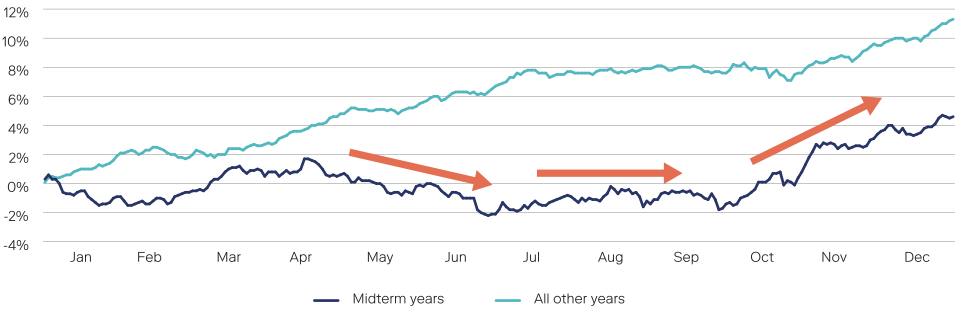
S&P 500 Seasonal Pattern Since 1950, YTD Change
Source: Bloomberg, Vanda. Data through December 2025.
Before the Vote. Markets have historically become more choppy heading into an election, with the 12 months prior to voting often underperforming the historical average and volatility building through spring into fall. Thus far in 2026, events have not played out exactly as scripted, given the strength of artificial intelligence-related business activity and continued strong earnings growth (the S&P 500 is up about 12% year-to-date through October 23). However, ongoing worries about the Middle East conflict, and its effect on oil prices and inflation, have been a source of turbulence that appears to have been exacerbated by November election worries.
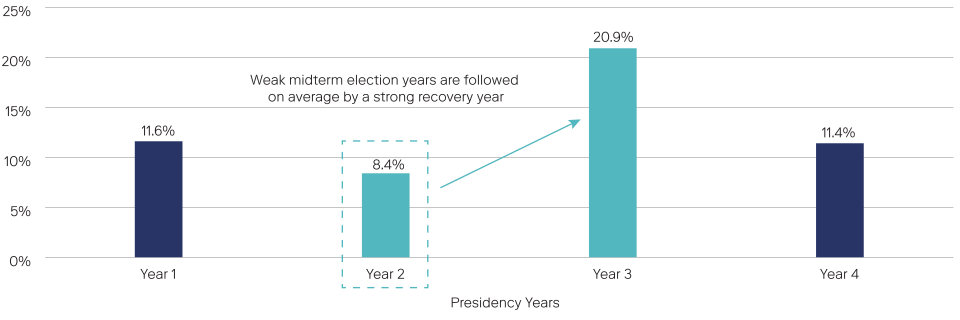
After the Vote. Once the results are in, historically market uncertainty has evaporated quickly, contributing to more moderate volatility. The 12 months following midterms have generally provided some of the strongest results of the entire four-year cycle, with positive returns in every such period since at least 1950.
The Year After a Midterm Has Typically Seen Market Strength
S&P 500 Average Total Returns Across Presidential Election Cycles
Source: Bloomberg. Stocks represented by the S&P 500 Index from December 1950 to December 2025.
Potential Effects on Power and Policy
As of this writing, we believe the most likely outcome of the election is a divided Congress, with Democrats favored to flip the House and the Senate staying in Republican control by a narrow margin. This result would end unified GOP control of the government and narrow the president's room to maneuver on any major legislation.
With one chamber changing hands, fiscal policy would likely go on autopilot. In this scenario, we would not expect another round of major tax cuts or new stimulus. More realistic would be a mild fiscal headwind for markets as previously scheduled government belt-tightening kicks in. For example, scheduled cuts to programs like Medicaid and food assistance, put in place to help fund the 2025 tax package, are set to take effect and could create a real drag for lower income households after the election.
Budget drama would probably intensify: Divided government would raise the odds of shutdowns and debt ceiling brinkmanship since reconciliation (passage of fiscal bills with a 50-vote Senate majority) would stop being a reliable tool for the presidential party.
If Republicans somehow held both chambers, they would likely lean on reconciliation for targeted tax cuts, but with budget deficits this large (over an estimated $2 trillion in 20261) there is not much room to be ambitious. If Democrats flipped the House, however, we would expect them to push hard on softening or delaying those social program cuts and fighting for things like Affordable Care Act subsidies—although the Republican president's veto power would make any moves subject to negotiation and maintain a real ceiling on what could be achieved. That said, President Trump has been open about building a legacy, which could foster more dealmaking with Democrats than many assume. More basically, the executive maintains considerable powers that lie beyond Congressional control: Foreign policy and defense, as well as trade and tariff policy, will largely stay out of legislative hands regardless of the election outcome.
Stepping back, we would not characterize the election as signaling a market-moving regime shift; it is likely more about gridlock, budget theater and whether the scheduled social program cuts are softened. Policy conflicts may get noisy, but we believe they are unlikely to affect markets more than economic factors.
Positioning Portfolios (or Not) Around Elections
Although it may be tempting to adjust your asset allocation or investment selection based on political headlines, history has shown that the fear associated with an election is usually worse than the market moves that ultimately take place. That said, it is possible to capitalize on spikes in volatility to rebalance asset allocations toward desired strategic (or tactical) positioning.
Typically, investors engaged in active allocation may become more defensive in the runup to an election and then move to more cyclical/growth positioning later on. Given the unusual fundamental dynamics we have seen this year, however, there may be some variance from past patterns. As the dust settles, market performance may be less about the balance of power in Washington, DC, and more about the sustainability of AI capital expenditures, Federal Reserve policy, global interest rates and ongoing geopolitical tensions. One potential subtlety is that a divided government may foster a lighter touch on spending, which could lessen pressure on long-term interest rates and, by extension, stock valuations.
In sum, we believe that the result of the election will likely have little impact on market dynamics. The end of the election in itself, however, could generate relief around reduced uncertainty, and allow investors to return their attention to the fundamentals that tend to drive markets over the long term.