Many allocators think of their public equity book as a passive asset to be indexed while spending their active-risk budgets in the private markets or elsewhere. We argue that rising exposure to the AI theme has rendered broad equity benchmarks passive in name only, and that equity indexing now amounts to a deliberate, one-size-fits-all bet on AI.
In this article we highlight the percolating risk within passive public equity portfolios and offer some considerations for managing it.
All in on AI
In 2015, the Mag 7 accounted for 11% of the S&P 500 Index. As the AI theme has gathered steam, their collective weight surged to nearly 35% while most sectors without them declined.
If rising equity concentration sounds like a tired refrain at this point, we encourage investors to put it in terms of risk: On a contribution-to-risk basis,1 we find these seven stocks recently accounted for nearly half of the index’s volatility (see Figure 1).
Figure 1: Just Seven Stocks Now Account for Nearly Half of Overall U.S. Equity Risk
S&P 500 Relative Risk Contribution by Sector (Mag7 and ex-Mag7)
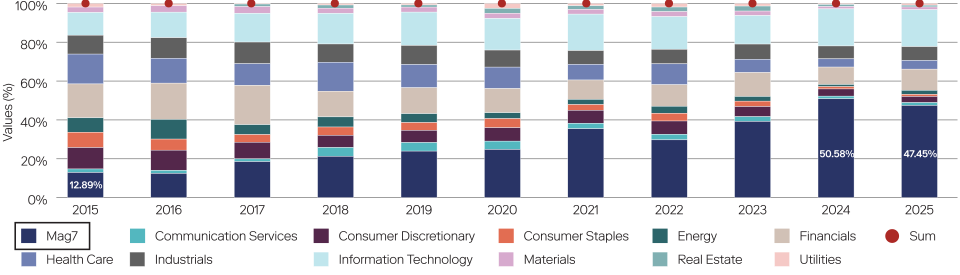
Source: Neuberger, CapIQ. Mag7 includes Apple, Microsoft, Alphabet, Amazon, Meta, Tesla, and NVIDIA. Date range: 2015 to 2025. All the sectors above exclude the names in Mag 7. Relative risk contribution is the proportion of the total index volatility contributed by sectors/baskets, incorporating weights, return volatility, and correlations. Past performance is not indicative of future results. For illustrative and discussion purposes only. Nothing herein constitutes a prediction or projection of future events, future markets behavior, investment advice or a recommendation to buy, sell or hold a security. It should not be assumed that any investments in securities, companies, sectors or markets identified and described were or will be profitable. Due to a variety of factors, actual events or market behavior may differ significantly from any views expressed.
This isn’t just a U.S. phenomenon—global markets are well on the lean, too: We find that an AI basket of roughly 120 companies drives more than half the volatility of the MSCI All-Country World Index, a passive global benchmark spanning more than 3,000 names (see Figure 2).
Figure 2: The AI Theme Now Commands More Than Half of Global Equity Risk
MSCI ACWI Relative Risk Contribution by Sector (AI and ex-AI)
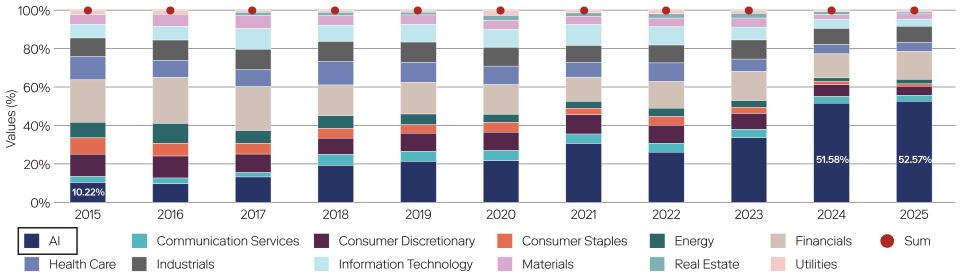
Source: Neuberger, CapIQ, and Bloomberg. Date range: 2015 to 2025. AI Basket is sourced from the Bloomberg AI Index (ticker: baiat), which includes 124 companies as of 2025-12-31. All the sectors above exclude the names in the AI basket. Relative risk contribution is the proportion of the total index volatility contributed by sectors/baskets, incorporating weights, return volatility, and correlations. Past performance is not indicative of future results. For illustrative and discussion purposes only. Nothing herein constitutes a prediction or projection of future events, future markets behavior, investment advice or a recommendation to buy, sell or hold a security. It should not be assumed that any investments in securities, companies, sectors or markets identified and described were or will be profitable. Due to a variety of factors, actual events or market behavior may differ significantly from any views expressed.
Viewed in terms of risk, we argue that rising exposure to the AI theme has rendered broad equity benchmarks passive in name only. In our view, equity indexing now amounts to a very deliberate bet inside a public portfolio that few investors treat as a bet at all.
From frontier models to physical infrastructure, there are now few industries that AI doesn’t touch. As a result, we believe popular indices have become growthier, more capital-intensive, more funding-dependent—and ultimately more vulnerable to significant drawdowns than many investors may assume.
Consider that, in the dotcom heyday of the 1990s, the Nasdaq 100 Index experienced three drawdowns greater than 15%, compared to just one for the S&P 500 Index (left side of Figure 3). In the 2020s, both indices have suffered four such drawdowns thus far.
Figure 3: The S&P 500 Index Has Grown More Vulnerable to a Dominant Group of Names
Number of Drawdowns Greater than 15%
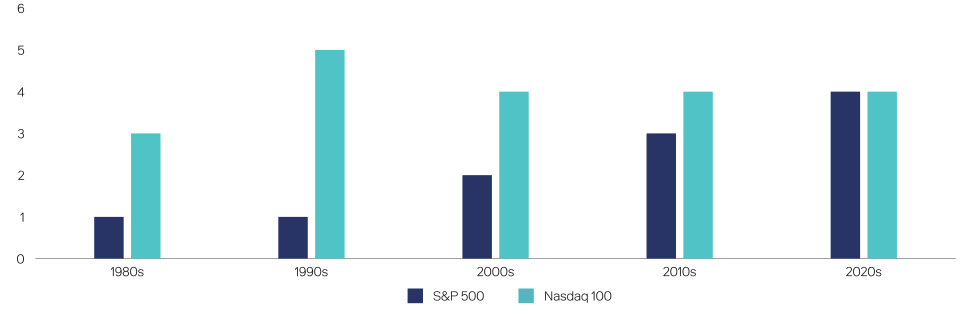
Effective Number of Constituents
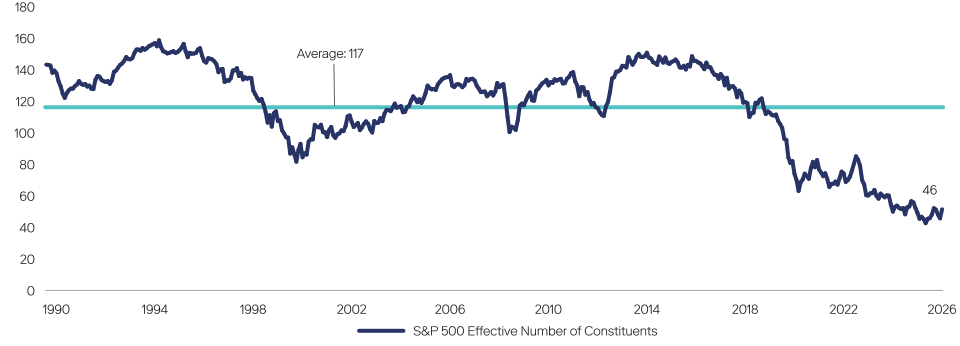
Source: Neuberger and FactSet, data as of May 30, 2026. Past performance is not indicative of future results. For illustrative and discussion purposes only. Nothing herein constitutes investment advice or a a recommendation to buy, sell or hold a security. It should not be assumed that any investments in securities, companies, sectors or markets identified and described were or will be profitable. There is not guarantee that other opportunities will have similar characteristics or results to the ones described herein.
Another way to frame the directional tilt within passive benchmarks is to look at the “effective” number of constituents within them. (This analysis is enlightening because indices have lots of smaller-weighted names that don’t tend to move the risk needle.) As shown on the right side of Figure 3, the historical average effective number of stocks in the S&P 500 Index is 117; we are now approaching 46.
That’s not passive diversification, in our view. It’s an active bet with material risk.
Equity Indexation’s Slippery Active Slope
Passive investors may get incrementally more exposure to the AI theme as more of the industry’s rising stars get added to popular benchmarks.
This summer SpaceX loudly joined the Nasdaq 100 Index, the Russell 1000 Index and various MSCI indices, and leading large language model makers Open AI and Anthropic are likely to follow. Yet those three AI titans are still a far cry from meeting established index-selection criteria, including profitability and free-float requirements. We believe these exceptions represent active decisions made by the index providers, for reasons we have explored in depth in previous papers.2
The short story: As indexation’s popularity grew, the asset management industry had to adapt to meet demand. The big three for-profit index providers—S&P Global, FTSE Russell and MSCI—generate revenue by licensing their benchmarks to large asset managers, which build index products based on them. Index companies, remember, answer to their own shareholders—not to the asset managers who license their benchmarks, and not explicitly to the end investor. Lately, index providers have altered their inclusion rules to fast-track high-profile new issues such as SpaceX, with more likely to come.
We believe these moves amount to active decisions that stand to benefit the index providers, passive managers and public stock exchanges in the near term. While we hope investors are well served, too, it is clear to us that none of these parties has taken a fiduciary stand like an active manager would be required to do.
What Should Allocators Do?
We believe AI is clearly a transformational technology with potential for significant value creation across various sectors. Yet we do not believe AI is an all-in bet: As adoption rates and business models continue to shift, we expect to see meaningful winners and losers—even as the benchmarks buy them all.
Against this backdrop, we offer allocators two pieces of advice:
- Assess your true AI exposure. Consider building an AI risk budget across all asset classes. Don’t trust simple GICS classifications and standard risk systems to isolate and define your true exposure because AI now permeates nearly every part of the portfolio.
- Increase overall awareness. Educate your constituencies—CEOs, boards and investment committees—about rising AI concentration risk. If you told them an index had 50% of its risk in a single theme, that would be worth a conversation, in our view.
To be clear: We are not saying to sell the broader equity index, nor are we arguing that AI exposure is inherently bad. Rather, we believe drawdown risk has significantly risen and that a reassessment of liquidity and optimal diversification is in order.
Don’t make a big active bet by accident.