One of the largest ongoing themes in financial markets is hyperscaler investment in artificial intelligence, funded in part through significant bond issuance from investment grade technology companies. SpaceX is the latest entrant, pricing a $25 billion five-tranche senior unsecured deal in June 2026 after drawing nearly $89 billion in orders—upsized by $5 billion from its original target.
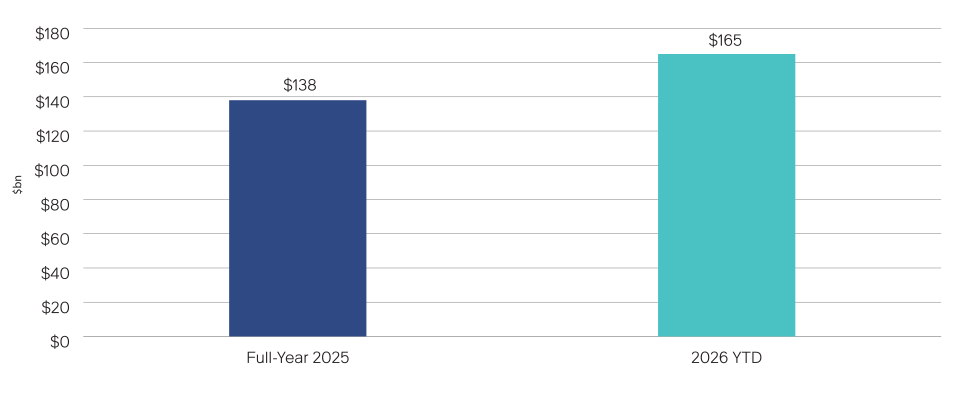
The pace of issuance is striking. Hyperscaler, data center and semiconductor financing reached approximately $165 billion before the midpoint of the year, around $27 billion more than was issued across the whole of 2025. The investment grade credit market is, as a result, shifting materially in composition, with the technology sector now sitting alongside financials as one of the largest parts of the index.
What Does This Wave of Supply Mean For Fixed Income Investors?
We believe the picture is more nuanced than a straightforward positive or negative. These are, in the main, very high quality issuers—the depth of demand for the SpaceX deal alone illustrates the appetite that exists for the sector at the right price. At the same time, the scale and pace of issuance introduces risks that require careful navigation, notably around the durability of AI infrastructure demand, which is ultimately what these debt stacks depend on. Exposure to this part of the market needs to be managed actively and with close attention to fundamentals at the issuer level.
Technology’s Rising Weight in the Index
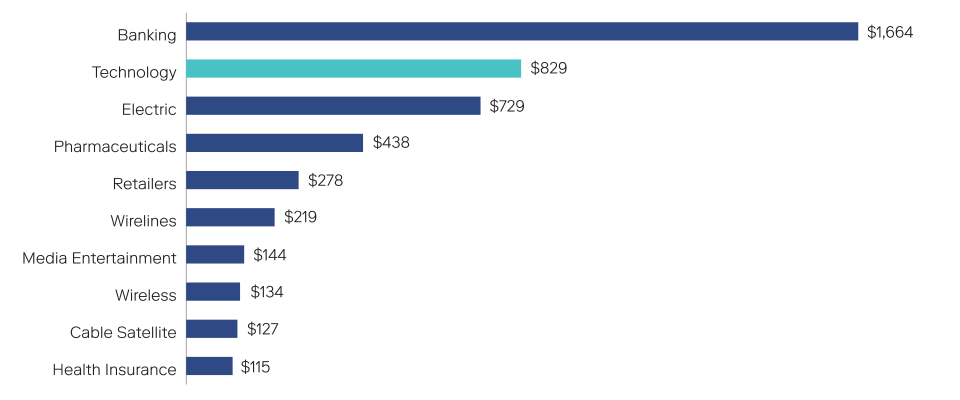
The composition of the investment grade credit market has shifted materially over the past 12 months. While banking remains the largest sector at around 21% of the Bloomberg US Corporate Index, technology has climbed to approximately 10% on the back of AI-driven supply. In several major indices, technology borrowers have now overtaken banks in weight for the first time. The five largest hyperscalers issued around $121 billion of US corporate bonds in 2025, more than four times their annual average over the preceding five years, and the pace has accelerated further in 2026. Wells Fargo Securities estimates technology-related investment grade issuance could reach $350 billion this year and, with SpaceX now settled, the cohort of issuers is also broadening.
Before this cycle, the five largest hyperscalers collectively represented close to 20% of global equity market capitalization but only around 3.5% of public investment grade debt. The recent shift to bond market financing reflects the scale of AI capital expenditure requirements rather than any change in financial health. These companies have not historically needed the debt markets given sufficient cash generation; however, the scale of these funding requirements has prompted a change in approach.
The credit quality of the arriving issuers is generally high. SpaceX and Oracle are the only names in the cohort carrying a BBB rating; the remainder sit in the single A to double A range. What the pace of supply does introduce, however, is a more complex set of questions around valuations, credit spread dynamics and divergent returns within the sector.
Technology is Now the Second-Largest Sector in the U.S. IG Index
U.S. Investment Grade Market Composition by Sector ($bn Outstanding)
Source: Bloomberg. Data as of June 19, 2026.
Issuance in 2026 Has Already Eclipsed All of 2025
AI-Related Investment Grade Issuance ($bn)
Source: Bloomberg. Data as of June 1, 2026.
Banks Still Lead, but Hyperscalers Have Arrived in Force
Top 15 U.S. IG Issuers by Amount Outstanding ($bn), Jan 1, 2025 (top) and June 19, 2026 (bottom).
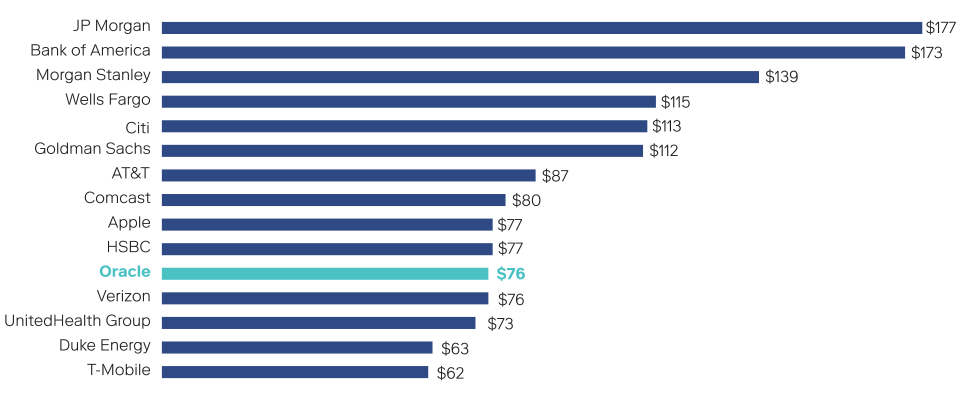
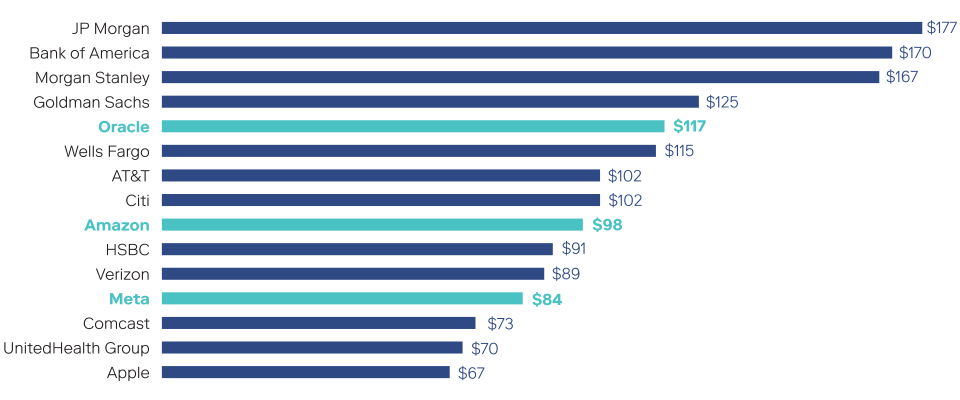
Source: Bloomberg. Data as of June 19, 2026. Hyperscalers shown in turquoise.
The Case For Exposure
The hyperscalers issuing significant volumes in the investment grade market are some of the most creditworthy corporate borrowers in the world. Microsoft, Alphabet, Amazon and Meta carry ratings in the single A to double A range, with balance sheets that generate cash at a scale few industrial companies can match.
Investors understand this quality well. Strong demand, at spreads wider than these issuers have commanded historically, has provided attractive entry points, while technicals have remained robust despite the pick-up in supply. The market has, so far, shown a considerable capacity to digest this volume.
Until recently, hyperscalers were meaningfully underrepresented in investment grade debt relative to their weight in equity markets. Investors now have access, through the public bond market, to the credit of companies whose debt they previously could not hold at scale. This helps to diversify their portfolios and gain exposure to some of the most consequential growth themes in the global economy.
The Case For Caution
Concerns around credit metrics are well-founded. Hyperscaler capital expenditure is expected to reach approximately $700 billion in 2026, nearly six times the level of spending in 2022. Free cash flow across the group has deteriorated materially as a result, with aggregate free cash flow for the five largest names falling by around 24% in 2025 vs. 2024. All are expected to see further pressure in 2026. The highest-rated names within the cohort retain the balance sheet strength to absorb this. BBB-rated issuers such as Oracle and now SpaceX, however, face more substantive questions.
SpaceX reported around $101 billion in cash as of June 2026, but negative free cash flow of around $14 billion in 2025—more than double the previous year's figure. The debt build has begun, and the $25 billion June issuance is, by the company's own indication, the start of a sustained program rather than a one-off. Unlike established hyperscalers, SpaceX does not yet have a track record of operating through a full debt cycle, and the pace at which cash burn is accelerating warrants close monitoring.
Underpinning all of this is the central question: whether the demand for AI infrastructure driving this capex cycle will materialize at the scale, and on the timeline, that justifies the investment. As active credit investors, this is precisely where our focus lies—starting with fundamental analysis of these issuers and their projected credit quality at higher levels of leverage and issuance.
Capex Spending Is Accelerating and Additional Funding Is Needed
Hyperscaler Capital Expenditure (top) and Cash from Operations by Company, $bn (bottom)
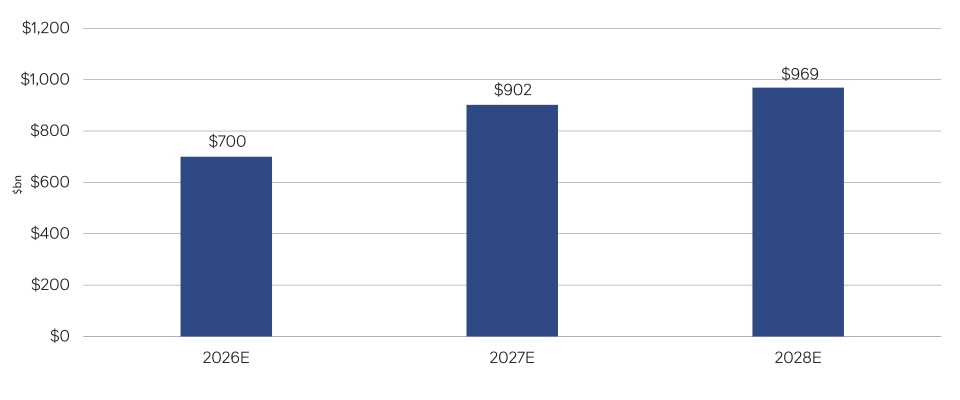
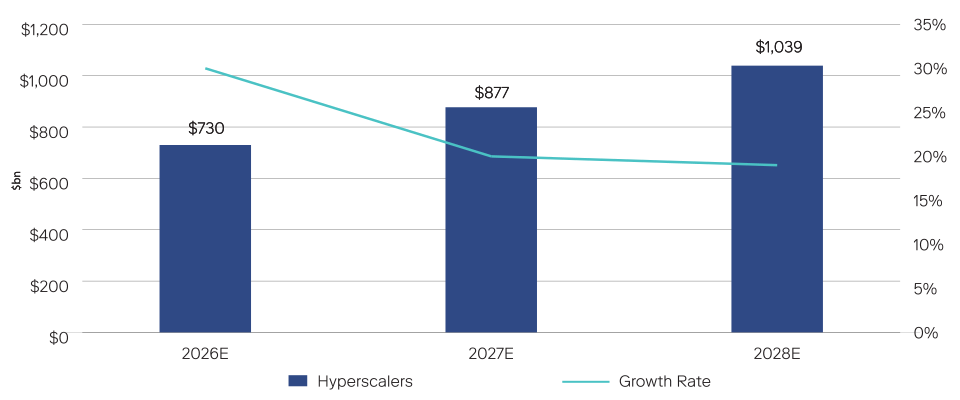
Source: Bloomberg, JP Morgan, as of June 24, 2026. LHS chart shows estimated hyperscaler capital expenditure; RHS chart shows hyperscaler cash from operations along with the growth rate. Hyperscalers are: Amazon, Alphabet, Meta, Microsoft and Oracle.
Summary: What It Means For Credit Investors
In a relatively short period of time, a small number of very large issuers, pursuing a capital expenditure cycle of unprecedented scale, have reshaped the investment grade credit market. That is neither inherently good nor bad for credit investors—the quality of the cohort is high, there is real demand and diversification has increased. However, the level of supply and uncertain demand for AI introduces a justified degree of uncertainty.
For us, the focus is not on making binary calls on technology adoption. We are instead focused on the credit consequences of various outcomes. These include: how leverage evolves under different scenarios, how financially flexible these issuers will remain and how strategy and management will adapt to unexpected technology developments.
The SpaceX deal signals what is ahead. The pipeline of hyperscaler issuance is strong, the number of issuers entering the market is growing, and the amounts involved are large enough to continue shaping index composition and spread dynamics for some time. Navigating this landscape requires active, bottom-up credit investing to identify the winners and losers as this cycle plays out.