Divestment Activity in 2026 Could Surpass 2025’s Levels
Global Private Equity-Backed Exits
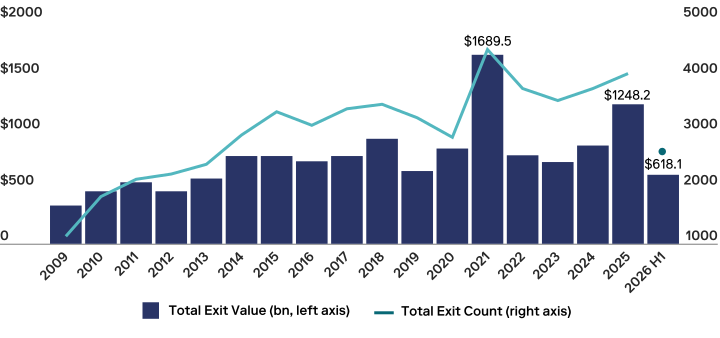
Source: Pitchbook, as of 2026 Q2. Note: The data for 2025 Q3-Q4 and 2026 Q1-Q2 is estimated.
A Rebounding Market
- Exit activity hit $618bn during the first half of the year, putting it on track to surpass the average total annual value of transactions (on an annualised basis) of any given year prior to 2021 and the period 2022-2024, potentially even beating last year’s $1,248bn of deals (full year).
- Putting the first half’s executed deal value into historical perspective, it represents c.80% of the annual transaction value during 2014-2017.
- Exits, both in terms of deal value and count, peaked in 2021 at $1,689bn and 4,482, respectively.
- The value and volume of exits fell sharply between 2022 and 2023, reflecting the market slowdown driven by the fading of COVID support programs, rising interest rates, inflation, and the Ukraine war, among other market factors.
- However, there has been a sustained recovery in the value and volume of deals since 2024, accelerating further in 2025.
- Deal count has grown more steadily than deal value—average deal size has been more volatile, with larger transactions driving the 2021 and 2025 peaks.
A Liquidity Environment That's Strong and Getting Better
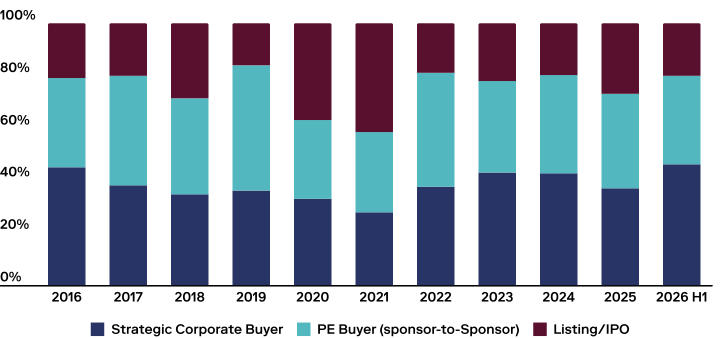
- Sales to strategic or corporate buyers and sponsor to sponsor deals have driven the exit recovery.
- But after a few stagnant years for IPOs, there has been a surge in new issuance during 2026, led by mega equity offerings from the technology, aerospace and telecoms sectors—most notably the record $85bn listing of SpaceX, Elon Musk's aerospace, satellite communications and artificial intelligence company—potentially helping to drive PE-backed listing volume back to 2021 record levels.
Global Private Equity-Backed Exits
Source: Pitchbook, as of 2026 Q2.
The Benefits for Evergreen Funds
The exit rebound carries a direct implication for institutional allocators evaluating evergreen private equity funds: we believe it strengthens the structural mechanics that can support liquidity available to fulfill redemptions and capital efficiency in these vehicles.
- Self-funding: A healthier exit market means realization proceeds—not just new subscriptions—can fund redemption requests, reducing the risk of gating or liquidity mismatches.
- Faster capital reinvestment than closed-end funds, reducing “reinvestment drag”: As exits accelerate, evergreen funds recycle realizations and re-invest the same dollar of NAV into new opportunities faster that closed-end funds. This is due mainly to investors in closed-end funds needing to decide where to re-deploy exit proceeds, a process that can be delayed for years and ultimately drag on returns.
- A key due diligence question: the benefit only holds if managers have a high-quality and sufficient deal pipeline and underwriting capacity to redeploy this faster-reinvesting productively; institutional investors should assess a manager's sourcing capacity alongside its exit track record before relying on evergreen structures for both investment returns and liquidity needs. It’s key that the fund has enough pipeline capacity to keep deploying into new attractive opportunities that support diversification, while maintaining a healthy liquidity position for new investments and satisfaction of redemptions.