For decades, hedge funds have served a critical role during periods of market stress. We believe a properly constructed hedge fund allocation can generate alpha, reduce drawdown risk and increase overall portfolio efficiency, important considerations for those anticipating shorter and more volatile macroeconomic regimes ahead.
In this article we highlight the potential diversification benefits of hedge funds, as well as the key elements we believe investors should consider when building an optimal hedge fund allocation.
Hedge Funds: Then and Now
As an asset class, hedge funds have moved in and out favor over the last three decades as broader market conditions and investment regimes have evolved.
For example, the period from 1990 through the start of the 2008 Global Financial Crisis saw wide dispersion between asset classes and high single-stock and interest-rate volatility, a regime ripe for skilled managers running global-macro and managed-futures strategies. By contrast the 2010s, marked by near-zero interest rates, negative equity-bond correlations and subdued volatility, generally rewarded traditional 60/40 investment portfolios that effectively offered built-in portfolio diversification.
We believe a thoughtfully constructed hedge fund allocation to be well suited for the current regime. Key structural drivers include:
- Rising volatility and dispersion. Treasury and swaption volatility remain above 2010 – 2021 norms; meanwhile, the AI theme has widened dispersion within the public equity markets, helping to push single-stock-to-index-volatility ratios to 20-year highs.
- Positive equity-bond correlations. The correlation between stocks and bonds is no longer reliably negative, diluting the diversification benefits of traditional 60/40 portfolios and underpinning the need for uncorrelated returns.
- Global policy divergence. The U.S. Federal Reserve, BoE, ECB and BoJ are taking different approaches to monetary policy, creating more potential trading opportunities for hedge fund strategies due to dispersion in interest rates, currency values and yield curves across countries.
- Higher nominal cash rates. Many hedge funds take a “cash plus alpha” approach, using cash as collateral for derivative trades. In these structures, higher nominal rates are a tailwind for total returns.
Institutional investors are taking notice: According to a recent survey of allocators by Goldman Sachs Prime Insights, nearly half intended to increase their hedge fund exposure (see Figure 1), and after 16 consecutive quarters of growth, global hedge fund assets stood near a record $5 trillion.
Figure 1: Hedge Funds Are Gaining Renewed Attention in the Current Macroeconomic Regime
Percentage of Institutional Allocators Planning to Increase / Decrease Exposure to Various Asset Classes
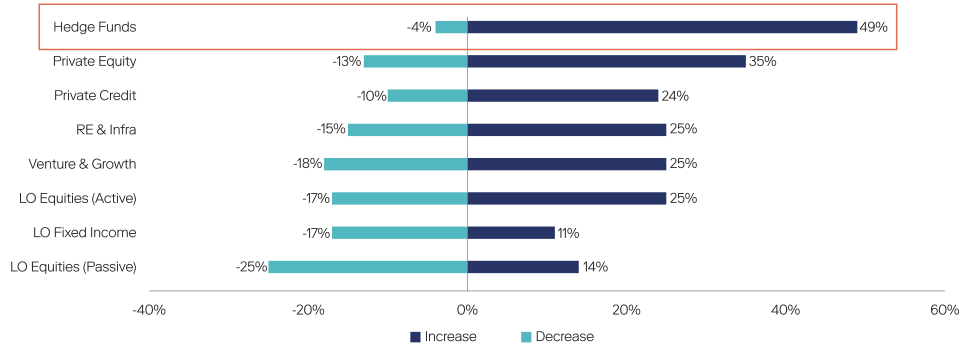
Source: GS Prime Insights & Analytics Allocator Survey. As of January 16, 2026. For illustrative and discussion purposes only.
Quantifying the Diversification Dividend
We believe the case for hedge funds is not dependent on their ability to outpace public equities; most haven’t and nor should they be expected to, given their likely lower-beta profile. It rests instead on the potential for hedge funds to generate alpha while delivering an uncorrelated or minimally correlated return stream. In this way, a diversifying hedge fund allocation excels in periods of significant market stress to produce an overall compounding benefit over time.
What’s the potential size of that benefit? We find that hedge fund allocations can compress drawdowns materially and increase overall portfolio efficiency, particularly important characteristics in more uncertain and volatile macroeconomic regimes.
Figure 2 demonstrates the potential impact of adding a hedge fund allocation to an index-based, multi-asset portfolio over a 20-year period. The orange dot represents a traditional 60/40 portfolio while the dark blue and turquoise dots show how adding 10% and 20% allocations to either a Global Macro strategy or a Commodity Trading Advisor (CTA) strategy, respectively, would have improved the efficiency of the overall portfolio.
As shown in the chart, adding a 20% allocation to either hedge fund approach would have decreased annualized volatility by more than 1.4% while sacrificing only 0.1% to 0.2% annual return.
Figure 2: Hedge Funds Can Serve a Crucial Diversifying Role in Broader Investment Portfolios
Hedge Funds Can Reduce Portfolio Risk While Sacrificing Modest Return
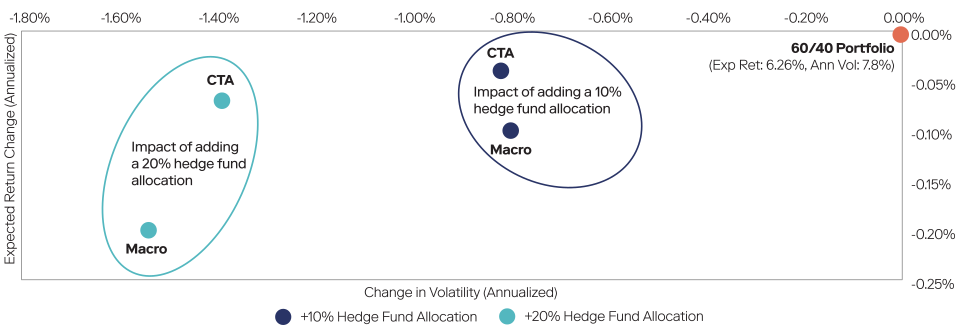
Source: Neuberger, Bloomberg, MSCI, HFRI, BarclayHedge. Hypothetical portfolio backtest analysis using MSCI All Country World Index, Bloomberg Global Aggregate Total Return Index, HFRI Macro Index and BarclayHedge SF Trend Index from January 2007 to July 2026. All analysis is in USD, gross of fees.
We believe hedge funds, when strategically employed, can serve this crucial diversifying role in broader investment portfolios, enhancing overall risk-adjusted returns.
Constructing the Portfolio: Best Practices for Optimal Diversification
Position Sizing and Risk Management
When building a diversifying hedge fund portfolio, we believe in taking a risk-focused and role-based approach. This process starts by identifying each strategy’s underlying risk factors, alpha source and function in the portfolio, rather than by focusing primarily on its strategy label (long/short, CTA, etc.).
History has shown that, under certain market conditions, hedge fund strategies can converge toward each other or toward market indices. For example, in broad equity drawdowns, equity long/short strategies tend to converge toward broad equities; in trending regimes, global-macro strategies tend to converge toward managed-futures strategies.
To build a truly robust hedge fund portfolio, we therefore believe it is critical to consider the correlation and covariance of the component strategies rather than simply relying on their expected returns or strict subcategory. As shown in Figure 3, we prefer to group strategies into three tiers according to the function each is meant to perform within a total portfolio:
- Uncorrelated Alpha: This tier includes strategies designed to be structurally independent of market direction.
- Controlled Beta: This group seeks to retain deliberate market exposure with additional targeted security selection.
- Convexity: This tier is expected to perform well during significant market dislocations and underperform in calmer conditions.
Figure 3: Grouping Hedge Fund Strategies by Risk-Management Function, Not By Strict Subcategory Label, Can Help Deliver Optimal Diversification
| Role | Strategy | Opportunity Source | Key Risk Factors | Typical Volatility |
|---|---|---|---|---|
| Tier 1: Uncorrelated Alpha | Convertible Arbitrage | Mispricing of embedded options | Credit spread, liquidity | Low-Medium |
| Fixed Income Relative Value | Price dislocations across curves, basis, swaps | Duration, repo/funding | Low-Medium | |
| Merger Arbitrage / Event-Driven | Deal spread capture, corporate events | Deals may not go through | Low-Medium | |
| Multi-Strategy / Pod Shop | Diversified alpha across all of the above | Manager concentration | Low-Medium | |
| Tier 2: Controlled Beta | Equity Long/Short | Stock selection, factor exposure, sector themes | Net beta, factor crowding | Medium |
| Global Macro (Discretionary) | Macro regime divergence, central bank policy | Directional risk, drawdown | Medium-High | |
| Distressed / Credit L/S | Credit cycle, capital structure complexity | Illiquidity, credit default | Medium-High | |
| Tier 3: Convexity | Systematic / CTA | Trend & momentum across all asset classes | Whipsaw, crowding | Medium |
| Volatility Trading | Implied vs. realized vol spread; convexity | Gamma/vega risk, tail events | Variable |
Source: Neuberger, for illustrative and discussion purposes only.
In practice, the overarching objectives for the hedge fund allocation, including target return, volatility, beta and correlation, should dictate the optimal composition. Given the objectives, we believe allocators should size their positions based on a strategy’s absolute and marginal contribution to risk within the overall hedge fund sleeve. Budgeting risk rather than capital ensures clearer management of risk concentration, in our view.
We also believe building a “liquidity ladder” is important when sizing positions and to allow for opportunistic rebalancing into market dislocations. This is an important exercise because different hedge funds can have vastly different terms, including lockup dates, notice periods and redemption frequencies.
Crucially, we believe all portfolios and correlations should be stress-tested under extreme scenarios. While these calculations can be complex, recent software innovations have made it easier to examine structures and correlations under myriad historical and simulated conditions. Today, thorny computations, such as estimating regime-conditional covariance, mapping non-normal tail-risk scenarios and modeling hedge fund allocations inside broader investment portfolios (rather than optimizing in isolation), have become routine tasks rather than bespoke, time-consuming projects.
Realize, however, that no model can accurately predict when historically uncorrelated returns will suddenly converge in a severe, unforeseen market disruption. (The 1987 stock market crash, the 1998 Long Term Capital Management collapse, the 2001 dot-com meltdown and the 2008 Global Financial Crisis are just four recent reminders.) That’s why we believe daily management and oversight are essential when seeking to optimize the performance of any hedge fund allocation.
Manager Selection
We believe hedge fund manager selection should be driven by both a thorough quantitative analysis and a qualitative assessment of the investment team, its processes and its operational structure. Furthermore, we believe each manager’s characteristics should be evaluated on both a standalone basis and in the context of the broader allocation.
The standalone analysis should seek to determine whether a manager has potential to generate durable alpha (within acceptable risk parameters) and can clearly explain the source of returns. Recent factor-based tools can provide insight by decomposing performance into market beta, factor exposures and alpha, thereby highlighting sensitivity across various regimes and helping allocators recalibrate as market conditions evolve.
For example, Figure 4 offers a regime analysis for a single hedge fund manager. The colored bars represent the historical return contributions attributed to market beta, systematic factors and an unexplained residual (aka manager alpha) across pre-defined macroeconomic regimes.
Figure 4: A Return-Decomposition Analysis Can Clarify How a Manager May Perform in Specific Regimes
Average Annualized Contribution to Manager Return
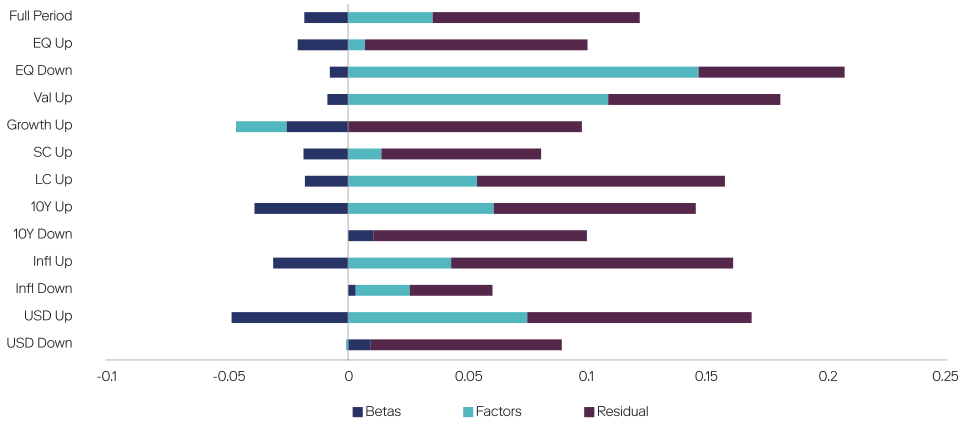
Source: Neuberger. For illustrative and discussion purposes only. Bars decompose the average annualized return of the manager universe in each regime into three components. “Betas” are returns attributable to directional exposure to broad asset-class markets; “Factors” are returns attributable to systematic style exposures (e.g., value, size, duration, credit); “Residual” are those not explained by either, i.e., manager-specific return. Components are stacked, with negative contributions plotted to the left of zero and positive contributions stacked to the right of it. Total manager return is the sum of all three components and is lower than the visible bar length in any regime containing a negative segment. Past performance is not indicative of future results.
From this “footprint” we observe:
- The residual (purple) bars are both positive and dominant, potential evidence of persistent, sizable alpha across market regimes.
- The betas (dark blue) bars mainly convey negative beta, broadly a performance drag and more so in risk-on market conditions.
- The factors (turquoise) bars suggest that factors display defensive benefits, especially in Equity Down and Value Up regimes.
- Finally, the return profile demonstrates clear convexity, offering welcome diversification in times of stress. For example, this manager tends to deliver twice the return in Equity Down regimes compared to Equity Up periods; a similar pattern emerges during USD-Up-vs.-Down and Inflation-Up-vs.-Down regimes.
Based on this analysis, we can see that the manager’s overall return conceals a unique profile that shifts materially by regime, making this type of analysis invaluable when taking a risk- and role-based approach to constructing hedge fund allocations.
Next, we believe allocators should seek to determine how a particular manager might enhance the overall hedge fund allocation. For example, a manager with a 1.0 Sharpe ratio and a 0.7 correlation to two existing positions might be less additive than one with a 0.5 Sharpe ratio and a 0.1 correlation to everything in the book.
Again, this analysis requires deciding in advance how a strategy fits within a broader allocation and potentially eliminating managers that play duplicative roles (even if their individual performance might add value in isolation). We believe this approach can also help avoid unwanted style drift as correlations shift over time: If a manager’s marginal contribution has deteriorated, resizing may be necessary to maintain the overall desired characteristics of the hedge fund allocation.
Adding Cost-Efficient Alpha: Implementation Considerations
We believe hedge funds can allow allocators to add an uncorrelated, skill-based return (alpha) to complement their existing market exposures. When implementing an allocation, we believe allocators should seek to maximize their net-of-fee, net-of-financing Sharpe ratio while minimizing operational complexity, funding risk and unintended tracking error.
This is where the notion of “portable alpha”, the process of adding durable, non-traditional sources of return to an existing portfolio without disrupting its core asset allocation and governance structure, comes in. Portable alpha has gained renewed institutional interest as narrow, macro-led markets have complicated traditional stock selection and technological advancements have reduced the cost and complexity of implementation.
As with manager selection, we believe it is crucial to have a clear understanding of an allocation’s primary objectives and constraints. Here are just two general approaches:
- Derivative-based beta + funded alpha: Say an allocator desires broad equity market exposure with an extra hedge fund return. One efficient solution might involve buying futures contracts on a public equity index while taking a position in a market-neutral hedge fund. Using futures to gain $100 million in notional exposure to the S&P 500 Index might require just $10 million of margin up front, allowing the allocator to put the other $90 million in a market-neutral strategy generating roughly 5% of alpha with low correlation to equities. In this scenario, the allocator’s total return would approximate the S&P 500 Index return plus the 5% from the hedge fund, for roughly the same amount of all-in risk.
- Funded beta + financed (levered) alpha: Now say an allocator wishes to seek higher returns while accepting additional risk. Here the structure can be reversed: fund the beta and lever the alpha. In this scenario, the allocator might put $100 million in cash into the S&P 500 Index and implement the hedge fund portion using derivatives or an overlay. The hedge fund exposure might be set at a notional amount, say $150 million, supported by pledged collateral. Once again, the total return would include the index return plus the return on the (larger) hedge fund position, net of financing costs—in short, more risk for potentially higher returns.
In evaluating hedge fund implementation, we advise allocators to compare all-in costs, including financing. This analysis should include stress-testing how, say, rising rates or wider financing spreads might erode overall returns.
Finally, recognize that governance and operational constraints may dictate which route is ultimately most suitable. For example, a derivative-based beta + funded alpha strategy might be more cost‑efficient for allocators with the requisite implementation infrastructure for an unfunded overlay, while others might be better off by taking a funded beta + financed alpha approach.
Conclusion
We believe the current macroeconomic regime, characterized by elevated volatility, unstable asset correlations, greater market concentration and simmering geopolitical risk, has increased the need for genuine diversification within multi-asset portfolios.
Against this backdrop, we believe a properly constructed hedge fund allocation has the potential to generate alpha, reduce drawdown risk and increase overall portfolio efficiency.
When constructing allocations, we encourage investors to size positions based on each strategy’s role, risk contribution and alpha source, rather than by strict strategy subcategory. While these calculations have grown increasingly complex and manager selection remains crucial, we believe recent software innovations have made it easier for allocators to stress-test their structures for various regimes and recalibrate as conditions evolve.