When we published our last detailed outlook on corporate hybrids—subordinated bonds that combine features of both debt and equity—we argued that the U.S. market had arrived and that the asset class was on the cusp of going global. The data since then has largely supported that view. Global gross issuance reached €108 billion in 2025, up 38% from the €78 billion recorded in 2024, with the market now representing more than 3% of investment grade debt and more than 20% of global high yield1.
In 2026, that momentum continued, with $89 billion equivalent issued across our universe of North America, Europe and Australia in the first half of the year alone, and we anticipate an approximately equal split between U.S. and European issuance this year, though we believe there is a credible path on which U.S. non-financial corporate hybrid issuance again surpasses European levels.
The six themes below point to where the opportunity is concentrating: the dispersion in returns that globalization, new structures and a wider issuer base are opening up beneath the surface. This is an environment that rewards selection, not just exposure.
1. Diversification and a Wider Issuer Base
After contracting between 2022 and 2024, the European hybrid market saw net supply rise again in 2025, and this year has started at a record pace, with approximately €40 billion issued by June 30, 2026 (including GBP issuance). More important than the headline issuance figure is its composition: roughly one-third of issuers are new names or represent sectors entering the hybrid market for the first time. In 2024 and 2025 alone, first-time hybrid issuers included a healthcare management organization, a train manufacturer and a cable maker, among others—a broadening we expect to continue into non-traditional sectors.
The key drivers have been electrification, reshoring and AI-related digital transformation. M&A was previously forecast as another primary growth engine and, while it has not yet materialized as a dominant catalyst, 2025 did see hybrid issuance for M&A purposes, including from Prysmian in Europe and Spire in the U.S. It remains a potential wild card, with M&A-driven hybrid supply potentially exceeding $10 billion. A wider issuer base means greater diversification for investors and deeper secondary market liquidity over time.
2. New Structures and Innovation Are Defining the Market
The corporate hybrid market has matured around three distinct structures:
- The European-style structure (rating-led, with a step-up coupon and a structure that incentivizes issuers to call at the first opportunity) has become the dominant format in Europe and Australia.
- The American-style structure (now the standard in the U.S. and becoming more prevalent in Canada) uses a 30-year non-call (30NC) format with no coupon step-up, losing equity credit at year 10 rather than at the call date.
- A third structure is accounting-led rather than rating-led, features punitive reset mechanics, and does not receive equity credit from S&P. This means it carries significantly higher risk than either of the two other structures.
Within these established formats, innovation continues. U.S.-style structures have begun incorporating coupon floors as spreads have tightened. In Europe, revised Moody's methodology has encouraged more credit-friendly structures, including shorter-tenor issues, senior subordination, caps on coupon deferral and ratings positioned just one notch below the corporate family rating.
Finally, a new strand has emerged within high yield: Moody's Basket H structures, which can receive 100% equity credit. Typically, if the issuer's rating falls to the CCC range, these instruments are effectively equivalent to equity from a Moody’s ratings perspective. It is an early-stage development, but one that points to where the boundaries of the asset class may extend next.
3. Demand Has Broadened as Much as Supply
The evolution of corporate hybrids is usually told through issuance, but the investor base has widened just as materially. Investment grade accounts were the original constituency, drawn to familiar issuers at a spread premium—but the asset class has since grown in depth, liquidity and issuer breadth to the point where it warrants a dedicated allocation in its own right, rather than a tactical sleeve within a broader credit mandate. High-yield investors moving up in quality, and insurers and pension funds attracted by income, have broadened demand further still.
The consequence is a market whose demand has, for extended periods, outpaced net supply. This is a technical that has supported spreads, improved new-issue execution and underpinned resilience through bouts of volatility. A deeper, more diverse buyer base is not merely price support; it is what lets the asset class absorb record issuance without indigestion.
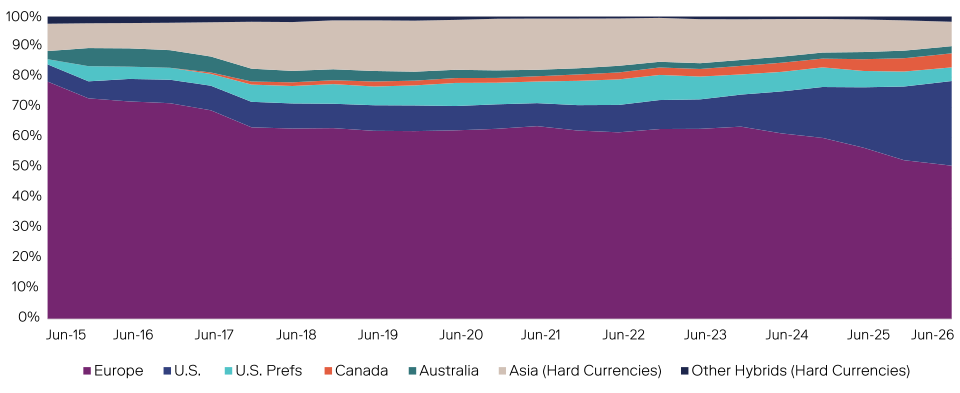
The U.S. is increasingly a home game. The 2024 change in Moody's methodology effectively created a U.S. corporate hybrid market, and it has scaled fast—from roughly $7 billion of issuance in 2023 to about $44 billion in 2025, with utilities and telecoms alone accounting for the vast majority of supply2. These are names U.S. credit investors know, NextEra, Duke, Dominion and TC Energy among them. For a dollar-based investor the appeal is direct: an IG-rooted asset, in domestic names, in dollars, with no FX to manage.
4. The Market Is Now Genuinely Global
Corporate hybrids, once a niche European product, are now establishing themselves across global capital markets. The Canadian dollar and Australian dollar markets have each roughly doubled in size compared to 2023, with growth concentrated (as in Europe) in capital-intensive sectors such as utilities and telecommunications—a trend we see continuing in 2026. Canada has largely migrated to the American-style 30-year non-call (30NC) structure, while Australia continues to issue European-style hybrids although often with floating-rate formats.
We also saw U.S. issuers accessing the euro-denominated hybrid market (so-called Reverse Yankees) tapping whichever market offers the most attractive pricing while broadening their investor base. They represent slightly under 20% of total issuance in euro year to date.
Yet coverage of the global hybrid market tends to be fragmented, focusing primarily on euro and dollar issuance rather than the global picture. Viewed globally, the asset class offers considerable dispersion, with diverging structures, spreads and market conventions creating relative value opportunities that a regional lens alone will miss.
Hybrids Are Going Global
Corporate Hybrid Issuance by Region as a Share of Total Universe, June 2015 – June 2026)
Source: Bloomberg, as of June 30, 2026.
5. AI Is a Structural Tailwind
The artificial intelligence buildout is reshaping capital allocation across the economy. For corporate hybrid investors, we see this as a tailwind operating on two levels. First, the asset class is relatively insulated from AI disruption. Hybrids are concentrated in capital-intensive, tangible-asset businesses—utilities, energy, telecommunications, industrials. These businesses are generally less exposed to software-driven disruption than many other sectors. Second, the infrastructure demands of AI are significant. Power generation, data center capacity, energy transmission and midstream infrastructure all require sustained capital investment. The companies financing that buildout are precisely the type of issuers that populate the hybrid market. They are, in effect, the landlords of the AI economy, and hybrids are one of the tools they will use to finance it.
6. Call Discipline Remains the Asset Class's Strongest Credential
One question that investors new to corporate hybrids consistently raise is extension risk: what happens if an issuer does not call the instrument at the first opportunity? The empirical answer continues to be reassuring. More than 300 hybrids have reached their first call date within the S&P-rated investment grade universe; approximately 99% were called on schedule, through periods of significant market stress, including COVID-193. The structural logic is clear: once the equity credit window closes at the call date, the economics of keeping a hybrid outstanding deteriorate sharply for the issuer. The incentive to call is built into the instrument's design. That alignment of issuer and investor interest is, ultimately, what makes corporate hybrids a credible part of a fixed income allocation.
Summary
Corporate hybrids have made the transition from a European specialty to a global asset class. The pace of that transition—in issuance volume, geographic reach, structural diversity and investor adoption—has been faster than many market participants anticipated. For investors who have not yet engaged seriously with the space, or whose allocation still reflects the market as it was rather than as it is, the six themes above suggest that now is the moment to look again.
Looking ahead, we see continued issuance from capital-intensive industries (utilities, telecommunications and energy, along with further issuance from new sectors such as chemicals, manufacturing and aerospace), as well as continued growth in cross-border formats and in the high-yield hybrid market. Innovation and convergence across structures and geographies remain central to the story. The asset class is still in motion.