In March 2025, we called attention to the equity market’s growth-oriented tilt and made the case for increasing exposure to value stocks. That observation proved prescient when the relative performance of growth versus value peaked last fall.
In this article, we demonstrate why we believe the value rally is ready to resume despite a pause during the Iran conflict, the effective closure of the Strait of Hormuz and the latest surge by several AI-driven, mega-cap growth names. We also discuss the importance of maintaining a consistent, rigorous process when selecting value stocks and seeking optimal diversification across broader equity portfolios.
Value Mounts a Comeback
In March 2025, as a handful of U.S. Big Tech companies were pushing passively managed public equity portfolios into “growthier” territory, we advised managing risk by increasing exposure to value stocks (see Rebalancing Act: Rethinking Growth Versus Value). Six months later, value stocks—including those in the energy, banking and health care sectors—began mounting a comeback on the strength of economy-wide earnings growth and swelling doubts about Big Tech’s trajectory from already elevated levels.
Then came the conflict in Iran and the closure of the Strait of Hormuz. While energy stocks got a boost from spiking oil and natural gas prices, the rally in other traditional value-heavy sectors began to sputter. AI gave another gale-force tailwind to Big Tech—seen as a secular haven with a hint of cyclicality—and now gargantuan initial public offerings (IPOs) from the likes of SpaceX, Anthropic and OpenAI could further whet investors’ appetite for growth.
Yet we believe value’s comeback is only on pause. Assuming tensions in the Strait begin to ease within the next few months, we expect the market’s broader rotation into value may again gather steam, giving investors the opportunity to add exposure at potentially attractive prices.
Heady Growth Assumptions
For sobering perspective on the market’s current hunger for growth, consider SpaceX’s forthcoming IPO. At an expected market cap target of $1.75 trillion (the largest offering in history), the company would be valued at roughly 94 times its $18.7 billion 2025 revenue.
We can’t help recalling what Scott McNealy, head of workstation-and-server maker Sun Microsystems, told Bloomberg in March 2002, after watching his company’s stock ping-pong from $5 to $64 and back to $5 during the dotcom bubble:
“At 10 times revenues, to give you a 10-year payback, I have to pay you 100% of revenues for 10 straight years in dividends…That assumes I have zero cost of goods sold, which is very hard for a computer company. That assumes zero expenses, which is really hard with 39,000 employees. That assumes I pay no taxes, which is very hard. And that assumes you pay no taxes on your dividends, which is kind of illegal. And that assumes with zero R&D for the next 10 years, I can maintain the current revenue run rate…Do you realize how ridiculous those basic assumptions are?”
Meanwhile, the current aggregate price-to-sales ratio of the S&P 500 Index is approximately 3.7, and its long-term average, measured over the last 80 years, is roughly 1.2.1
Why the New Value Cycle Is Ready to Resume
We believe historically heady valuations for growth stocks are just one variable in the broader growth versus value calculation.
First, despite ongoing geopolitical conflicts and growing concern about near-term market volatility, we believe the fundamental case for global economic growth appears intact and remains broadly supportive of value stocks relative to growth stocks. (For more details on the macro backdrop, see our 2Q 2026 Equity Outlook.)
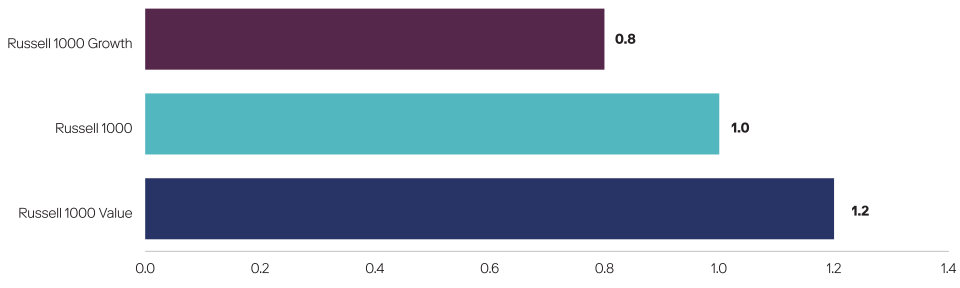
History suggests to us that value stocks are relatively more sensitive to rising global growth: As shown in Figure 1, the sensitivity of corporate earnings to global trade volume across the Russell 1000 Value Index has been roughly 1.2; for the Russell 1000 Growth Index, the earnings beta was just 0.8.
Figure 1: Value Stocks Tend to Be Especially Sensitive to Rising Global Growth
EPS Beta to Global Trade Volume
Source: Neuberger research and FactSet, data as of April 30, 2026. Nothing herein constitutes a prediction or projection of future events, future markets behaviour, investment advice or a recommendation to buy, sell or hold a security. Due to a variety of factors, actual events or market behavior may differ significantly from any views expressed.
Second, history suggests that value stocks tend to outperform growth stocks during periods of rising interest rates and inflation. The intuition: Value companies are shorter-duration assets—they generate a greater portion of their profits sooner—and thus are less sensitive to fluctuations in rates; value stocks also tend to include more raw materials and energy companies, which are naturally geared to inflation.
Even as economic growth slowed last year, it remained at the high end of the Federal Reserve’s range. Should economic growth accelerate later this year, we expect inflation to tick up along with it. Furthermore, higher oil prices due to stalled traffic through the Strait have put U.S. rate cuts on hold; if inflation should rekindle in the second half of 2026, the Fed might even choose to hike, which could add relative support for value stocks.
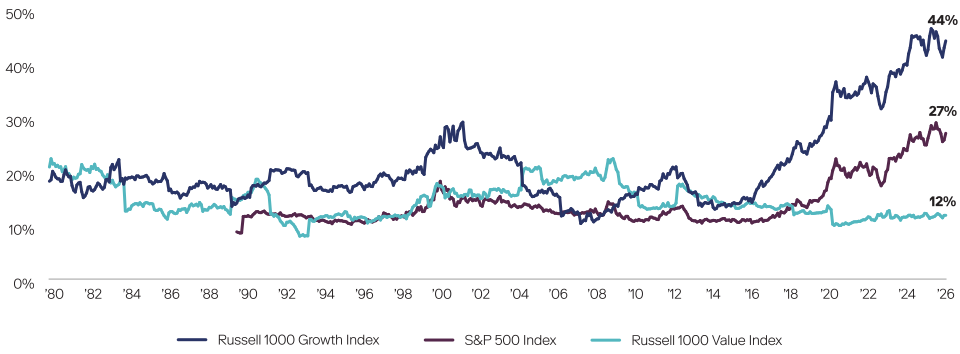
Third, extreme overconcentration continues to deter diversification within popular large-cap benchmarks. As shown in Figure 2, the largest five stocks in the Russell 1000 Growth Index and the S&P 500 Index represent roughly 44% and 27% of their respective benchmarks. Meanwhile, momentum has surged to 2009 levels, with the 10 largest stocks accounting for roughly 85% of the index’s year-to-date return, according to Wolfe Research. Should momentum begin to unwind (triggered, perhaps, by the reopening of the Strait), mega-cap growth names could be especially vulnerable, in our view. At these levels, we believe prudent risk management calls for increasing exposure to value.
Figure 2: Popular Growth Indices Are Still Overly Concentrated in a Few Large Names
Weight of the Largest Five Stocks Within the Index
Source: Neuberger research and FactSet, data as of April 30, 2026.
Finally, and not least, we believe potential AI-driven efficiencies may generally favor value over growth. Generally, we find that value companies produce less operating profit and carry more debt than their growth peers. All else equal, that means every dollar saved with AI could translate into larger earnings gains among value companies than among growth companies, as illustrated in Figure 3.
Figure 3: AI Productivity Gains May Offer Relatively Greater Support to Value Stocks
| Value Company Pre-AI Improvement | Value Company Post-AI Improvement | Growth Company Pre-AI Improvement | Growth Company Post-AI Improvement | |
|---|---|---|---|---|
| Revenue | $100 | $100 | $100 | $100 |
| Operating Profit | $10 | $10 | $20 | $20 |
| Savings From AI | $0 | +$1 | $0 | +$1 |
| EBIT | $10 | $11 | $20 | $21 |
| Interest Expense | $5 | $5 | $0 | $0 |
| EPS | $5 | $6 | $20 | $21 |
| % EPS Improvement | 20% | 5% |
Source: Neuberger analysis. Hypothetical, simplified illustration; not representative of any company/index; not a forecast.
Avoiding the Passive Slouch Toward Growth
In recent years, significant amounts of capital have flowed into passively managed, market-cap-weighted investment funds. This trend has been a tailwind for mega-cap growth stocks that already carry the most weight in passive benchmarks and therefore receive a larger proportion of the flows, increasing investors’ relative exposure to those big names over time.
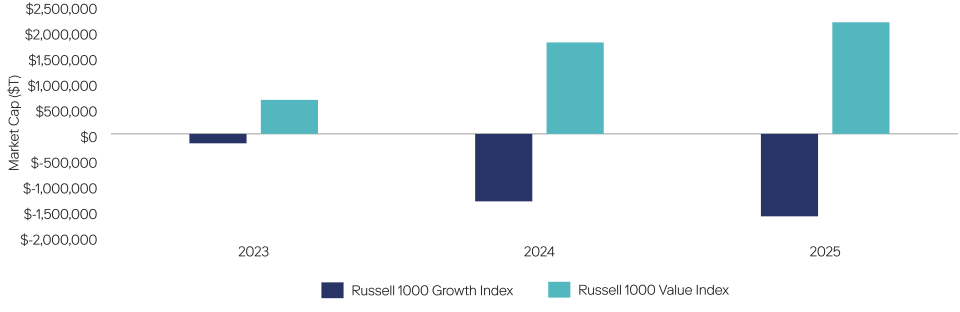
Meanwhile, a significant amount of market cap has moved out of the growth benchmark and into the value benchmark: As shown in Figure 4, index reshuffling has shifted a cumulative $4.6 trillion in market cap from the Russell 1000 Growth Index to the Russell 1000 Value Index since 2023. With IPOs from SpaceX, Anthropic and OpenAI on the way, major indices appear poised to tip into even growthier—and riskier—territory.
Figure 4: Russell Index Reconstitutions Have Given Value Indices More of a Growth Tilt
2023-2025 Pre-/Post-Rebalance Changes
Source: Bloomberg. Nothing herein constitutes a prediction or projection of future events, future markets behavior, investment advice or a recommendation to buy, sell or hold a security. Due to a variety of factors, actual events or market behavior may differ significantly from any views expressed.
To us, these benchmark reconstitutions amount to active management decisions that have arbitrarily and mechanically ratcheted up passive investors’ exposure to growth at the expense of optimal portfolio diversification. For value managers, the size of the additions being made in the next rebalance are hard to ignore and may require some level of accommodation while maintaining a determined focus on managing risk.
Against this historic backdrop, we believe the next leg of the value cycle will instead call for true active portfolio construction, driven by a consistent selection process and rigorous focus on both valuation and risk management.