The recent correction raised a fair question: is AI infrastructure spending sustainable?
Signed multi-year supply agreements, persistent capacity constraints, and the structural shift from training to inference all suggest the AI infrastructure cycle is still early. The supply chain hasn't caught up.
The semiconductor sector took a sharp hit on 23 June. The KOSPI fell 10% overnight, after Korean chipmakers had nearly tripled over the prior twelve months, while the Philadelphia Semiconductor Index dropped close to 8%. Moves of that magnitude invite an obvious question: is this the beginning of the AI bubble deflating? We do not think so, and the reasons matter.
The selloff
The trigger was not a fundamental shock. It was a debate about whether the companies pouring capital into AI infrastructure can sustain that pace. Google's recent share issuance was cited as a sign of strain, and at the margin that may be fair. But there is a meaningful difference between a company managing its balance sheet and demand destruction. In our view, the market conflated the two.
The contracts tell a different story
- After close on the same day the sector sold off, Micron disclosed 16 multi-year supply agreements carrying approximately $100 billion in minimum contracted revenue, backed by $22 billion in customer deposits. These are take-or-pay structures, meaning buyers are legally committed to minimum volumes regardless of whether they take delivery, with pricing floors and multi-year volume commitments attached. They are not forecasts, they are signed contracts. Memory is being repriced from commodity input to critical AI infrastructure.
- The same dynamic is visible further down the supply chain. Substrates, the densely layered circuit boards that physically connect chips to the wider systems they power, are under acute supply pressure because AI processors now run so hot and fast that legacy substrate designs cannot handle the load. Building new capacity takes two to three years, so the gap between what is needed and what exists is not closing quickly. The same is true in optical networking, where single-mode fibre prices rose 75% in the year to January 2026 as data centres scrambled to handle surging AI traffic. Passive components, the capacitors and resistors that regulate power and filter electrical noise across every circuit board, tell a similar story. These are unglamorous components, but the power densities that modern AI hardware demands have made them scarce, and prices have reflected that.
- Much of this traces back to a shift that the market has been slow to price. Training AI models requires specialised accelerators concentrated in a handful of hyperscale facilities. Running those models at scale, across millions of users simultaneously executing tasks, draws on a far broader range of components throughout the supply chain. That broadening of demand is still early.
Memory is being repriced from commodity input to critical AI infrastructure.
Surging AI storage Demand for NAND (Exabytes)
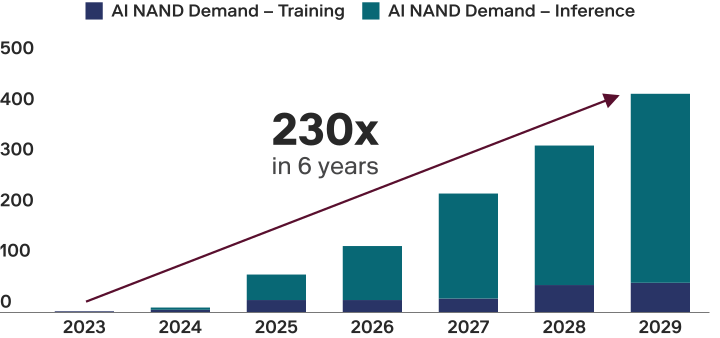
Source: Morgan Stanley, as of February 2026. Neuberger analysis.
Neuberger Investment View: Look for the bottlenecks
- We look for the places in the supply chain where demand is outrunning the ability to respond, and where that imbalance translates into pricing power and earnings resilience.
- Memory, substrates, passive components and optical networking each fit that description today. We aim to identify those choke points ahead of consensus, rotate as the cycle evolves, and hold through short-term volatility when the underlying thesis remains intact. Nothing in the past period has changed that.
Note: The securities mentioned are for illustrative purposes only. Nothing herein constitutes investment advice or a recommendation to buy, sell or hold a security. It should not be assumed that any investments in securities, companies, sectors or markets identified and described were or will be profitable.