We believe the latest rotation into U.S. value stocks may be far from over and that disciplined managers appear poised to capitalize on it.
Last June we argued that the equity market’s rotation into U.S. value stocks, temporarily stymied by the Iranian conflict, would resume. Since then, value indices have continued to outpace their growth peers,1 and we believe they still have room to run.
In this article, we show why we think value stocks may continue to offer protection from potentially stickier inflation and elevated interest rates, as well as welcome diversification as broader equity benchmarks have tilted into growth territory. We also discuss why we believe disciplined managers have potential to generate durable alpha within this asset class. As market volatility has ticked up in the wake of a consequential mid-term election season, we encourage investors to reassess their strategic asset allocations and make adjustments in line with their long-term goals.
The Case for Value: Less Duration, More Diversification
Value stocks tend to hail from sectors that directly benefit from rising prices, such as energy, industrials and financials. We believe that rising energy and commodity prices, tariff pass-through costs and further deficit spending (among other factors) may continue to put upward pressure on prices.
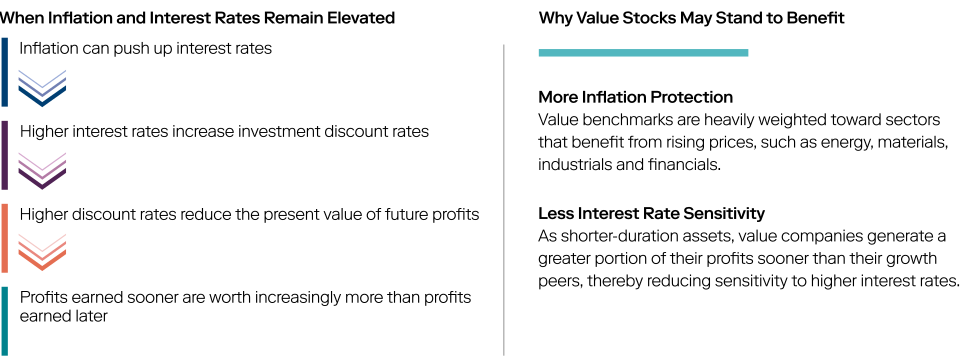
As inflation increases, so do interest rates. Value stocks are often less sensitive to higher rates than their growth peers because value stocks are shorter-duration assets—that is, companies in traditional value sectors tend to generate a larger portion of their profits in the near term, thereby increasing their present value and, in tandem, their stocks’ relative performance (see Figure 1).
Figure 1: Value Stocks Can Provide Protection as Inflation and Interest Rates Rise
Source: Neuberger research. For illustrative purposes only.
We also believe value stocks can provide welcome diversification in broader equity portfolios that have increasingly tilted into growth territory.
As we discussed in "The Great Rotation: Why the Recent Value Rally Is Ready to Resume“, large capital flows into passively managed, market-cap-weighted investment funds have been a tailwind for mega-cap growth stocks. These names already carry significant weight in passive benchmarks and therefore receive a larger proportion of asset flows—hence the considerable share of assets under management among growth and core funds compared to value funds (see Figure 2).
Figure 2: Considerable AUM Is Poised to Shift from Growth and Blend Funds to Value Funds
That structural shift has increased investors’ relative exposure to those mega-cap growth companies over time: The five largest stocks in the Russell 1000 Growth Index and the S&P 500 Index represent roughly 40% and 28% of their respective benchmarks (see Figure 3).
Figure 3: Broad Market and Growth Indices Are Still Overly Concentrated in a Few Large Names
While mega-cap concentrations have eased since our last report, due mainly to recent index rebalancing, they remain quite high and there is still considerable overlap between the growth and broad-market benchmarks: At the beginning of November, the eight largest companies in the Russell 1000 Growth Index also appeared among the top names in the S&P 500 Index.
In short: We think value stocks may offer welcome diversification if higher interest rates and stickier inflation put pressure on earnings growth and if market volatility continues to rise, as we suspect.
The Case for Active Management in Value Investing
We not only argue that value stocks have an important role to play in broader portfolios, but we also believe there is potential for durable alpha within this asset class. Over the last decade, a period that has witnessed a variety of investment regimes, we find that value managers generally posted the best median excess returns, across nearly every size and region, relative to their growth and core peers.
As shown in Figure 4:
- The median value manager outperformed her growth and core peers in nearly every geography—except in the U.S., where small-cap value trailed small cap growth but outpaced small-cap core (see top chart).
- Successful manager selection delivered even more alpha: Top-quartile value managers added 90 bps to 130 bps to that median annual excess return (see middle chart).
- Between 75% and 87% of value managers beat their benchmarks, broadly outshining their large-cap growth and core peers during the same period (see bottom chart).
Figure 4: Many Active Value Managers Have Generated Meaningful Excess Returns vs. Their Growth and Core Peers Over the Last Decade
Note: Please see specific benchmark definitions in the Disclosures section at the end of this paper.
Source: eVestment monthly USD composite returns (mostly gross of fees), 10 years to June 2026; Neuberger analysis. Universe: eVestment Portfolio Management Strategy = Active, excluding Primary Investment Approach = blank, Passive or Technical Analysis. Past performance does not predict future returns. Top quartile = eVestment 25th percentile (top 25% of managers).
Conclusion
We believe the case for value stocks remains solid, especially in an environment marked by potentially stickier inflation and elevated interest rates. We argue that value stocks can provide diversification as broad equity benchmarks tilt further into growth territory, ratcheting risk across broader portfolios.
Finally, we think history suggests that not only is there potential for durable alpha within this asset class, but also that manager selection—not mere sector or regional exposure—can significantly impact investor outcomes.
To ensure that investors truly get the diversification they seek, we suggest they not only consider a value fund’s headline performance and Morningstar rating, but also its correlation to the growth and core benchmarks. All else equal, less is more.