Hybrid Market Surpasses European High Yield
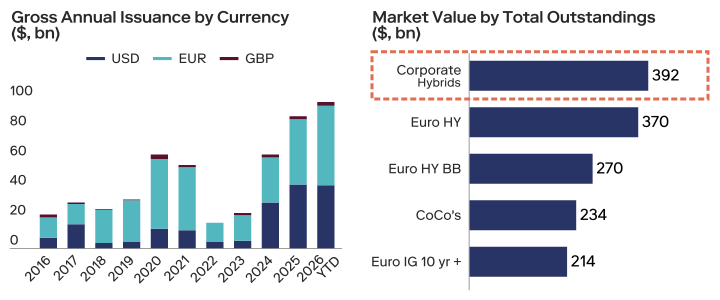
Source: Neuberger, Bloomberg, 30 October 2026. Issuance: non-financial, developed-market corporate hybrids of $200m or more, by currency of issue, USD equivalent. Market values: Neuberger global investable universe and Bloomberg indices.
Capex is Driving Record Supply
- Gross global issuance of corporate hybrids reached $101 billion in the year to October 30, surpassing full-year 2025 volumes ($88 billion) and 3x the 2016–23 average of $34 billion. Capex is the main driver, but some sectors, more impacted by M&A or cyclicality, have also been issuing corporate hybrids to protect their ratings.
- U.S. issuers have added to the supply—representing about 48% of 2026 issuance versus 7% on average in the 2016–23 period—which has materially increased since the rating agencies clarified the treatment of U.S. structures in 2024.
- The growth in the market matters for allocators. At $392 billion, the hybrid asset class is now larger than the European high yield bond ($370 billion, including the BB-rated segment at $270 billion) and CoCo markets ($234 billion). We now think the asset class no longer fits as a sleeve of an investment grade or high yield allocation. The risks that drive returns—namely call and extension, coupon deferral, equity-credit treatment and subordination—are structural and are assessed bond by bond, which argues for a standalone strategy and a specialist manager.
Concentration: Issuers Increasingly Diversified, Sectors Still Asset-Heavy
- Issuer concentration has fallen sharply. The universe has expanded to 154 issuers today from 39 issuers in 2013, lowering intra-sector concentration as well. The top 10 issuers account for 29% of outstandings compared to 48% in 2013 and a peak of 54% in 2017. The largest issuer today is U.S. power group NextEra Energy (4.2% of total market outstandings) versus energy group EDF (7.9%) in 2013 and automaker Volkswagen (11.2%) in 2018. Part of the 2025 drop in issuer concentration relates to wider use of US dollar bonds as well as organic diversification.
Issuer Concentration Has Been Decreasing
Issuer Concentration By Top 10 Issuers and Largest Issuer (% of Market Outstandings)
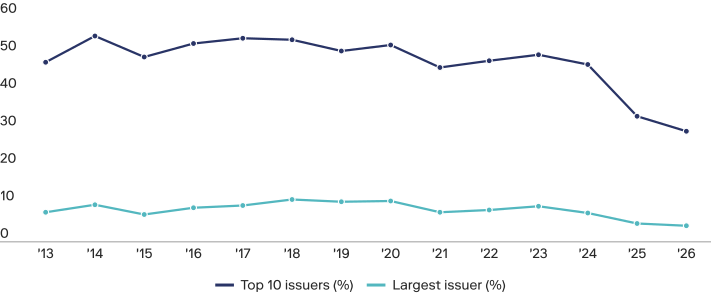
Source: Neuberger, Bloomberg; ICE BofA Global Hybrid Non-Financial Corporate (GNEC) and High Yield (HNEC) Indices, benchmark universe (Sector Level 3). Data as of November 6, 2026.
- Sectors remain asset-heavy. Utilities, energy and telecoms, capital-intensive defensive businesses with long-lived assets, compose 74% of outstandings. Utilities alone command 42.5% of the market, with issuance bolstered by the AI-driven power demand boom in the U.S. and, to a lesser extent in Europe, the energy transition and electrification of societies. While we would still expect utilities to compose a large share of issuance, new sectors are emerging, such as consumer goods. Its weight has risen from 2.1% at the end of 2025 to 5.4%. The sector is also well-diversified across various industries including global food distribution (Sysco, the largest issuer), brewing (Carlsberg), and food and beverage manufacturing (Campbell’s and General Mills). Issuers in this segment have used hybrids to protect ratings against higher input costs, and we expect other consumer names to follow.
Relative Value: High-Yield Type Return for Investment-Grade Risk
- Hybrids yield 5.76% hedged into euros (7.27% in dollars), which is about 159 basis points above euro investment grade corporate bonds and about 41 basis points above euro BB-rated (sub-investment grade) bonds. The bond-level and issuer-level ratings are BBB- and BBB+, which are two and four notches, respectively, above BB ratings. Hybrids also carry 3.77 years of duration against 4.36 for euro investment grade, and yield 1.53% per year of duration against 0.96% (Neuberger's calculation).
- The global hybrid spread was 225 basis points on November 12, close to its 12-month wide of 260 basis points, and 2.6x the 87 basis point senior spread of the same issuers. The extra yield is paid for subordination, not for weaker credits. We favour subordination over credit risk, but hybrids remain junior, can defer coupons and can extend, and spreads can widen further in a risk-off move.
Source: Bloomberg, Neuberger analysis, November 12, 2026.