The decade-long habit of benchmarking European credit spreads against post-GFC lows, COVID dislocations, the oil price collapse and the Russia-Ukraine war has left investors with a distorted baseline for "fair value". Strip those extremes out and European investment grade spreads, currently in the seventh percentile over the last ten years, look less alarming. The most important question is whether the structural shifts now reshaping this market demand an entirely new framework for assessing spread compensation. We believe they do.
Fundamentals Are Doing the Heavy Lifting
For the first time since 2023, net issuance across EUR IG, EUR HY, USD IG and USD HY has exceeded fund flows. This is a meaningful reversal of the technical-driven tightening that defined the prior two years, yet spreads have continued to grind tighter. The answer is straightforward: fundamentals are genuinely strong. Improving earnings, low defaults and robust corporate balance sheets have kept demand for credit strong even as the technical tailwind has faded. Political uncertainty has been the dominant source of market volatility in 2026, but it has expressed itself almost entirely in rates, not credit. Spreads have remained well-anchored throughout.
Issuance Has Overtaken Flows - Net Issuance versus Fund Flows (%)
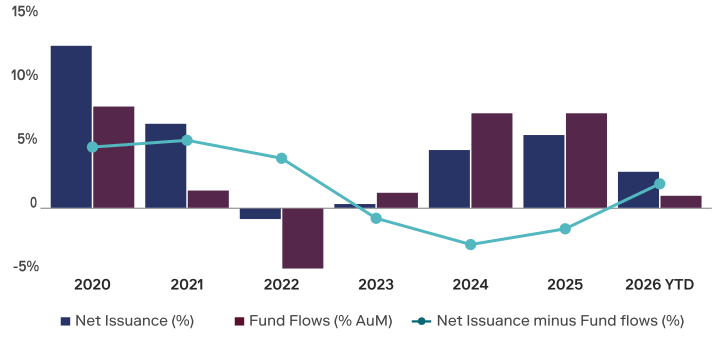
Source: Goldman Sachs, EPFR. Table shows EUR IG, EUR HY, USD IG and USG HY issuance. Data as of May 28, 2026.
- This divergence matters. With all-in yield now equal to a structurally higher risk-free rate plus a compressed credit spread, the majority of yield contribution this year has come from rates movement rather than credit. European IG has quietly evolved from a spread product into a yield product and that changes who is buying it, why, and at what levels they step in Fixed maturity funds, insurance buyers and all-in yield buyers.
Europe's Index Is No Longer Purely European
- On the surface European IG is having a remarkable year. Primary issuance has reached €458 billion, and on some days this year banks have reported the largest single-day order books in the market’s history. But the composition of the market has changed materially. U.S. issuers now represent approximately 22% of the EUR IG index, driven overwhelmingly by hyperscalers. The five largest technology companies alone issued more EUR IG debt in Q1 2026 than in all prior years combined.
- This is not just a EUR market phenomenon. Google's sterling issuance, including a 100-year GBP bond (a format with almost no precedent in this currency), has made it one of the largest single issuers in the GBP IG index almost overnight. The "new lens" this market requires may simply be accepting that European IG is now a global product with a European wrapper.
U.S Issuers Are On The Rise In Europe
Bloomberg Euro Corporate Bond Index (Total Return, EUR Unhedged) — Country Breakdown
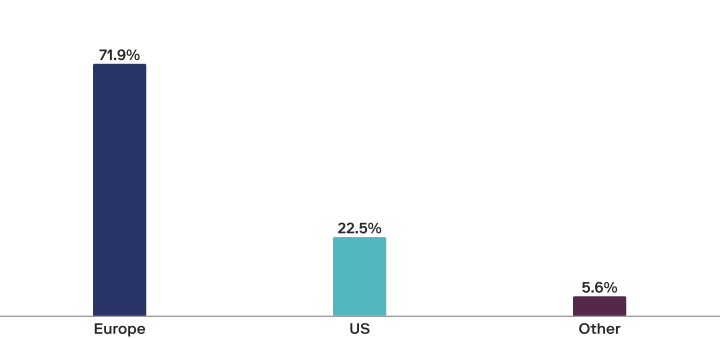
Source: Bloomberg. Chart shows the weighting of U.S, European and other issuers within the Bloomberg Euro Corporate Bond Index (Total Return, EUR Unhedged), as of June 14, 2026.
Corporate Hybrids: Now a Bigger and Broader Market
- EUR IG hybrid issuance has already surpassed €37.2 billion year to date, exceeding full-year totals for both 2024 and 2025. Issuance has spread well beyond the euro market into the U.S. dollar and, increasingly, the Australian dollar.
- The asset class has transformed. Once the preserve of European utilities telecommunications and energy sectors, hybrids now offer genuine sector and geographic diversity, giving investors a much broader menu than even three years ago.
- The appeal is structural on both sides of the trade. For issuers, hybrid coupons are tax-deductible like debt, while rating agencies assign 50% equity credit, preserving credit ratings and balance sheet capacity without diluting shareholders. It is the most capital-efficient financing tool available to investment grade corporates. For investors, even with sub-senior spreads compressed to cycle tights, hybrids still deliver a high-yield-type coupon from investment grade names. This is an efficient way to add carry without stepping down the credit quality ladder.
Risks Worth Watching
- The tail risk conspicuously absent from day-to-day credit conversations is the long-term fiscal trajectory. Governments across the U.S., U.K. and Europe are running persistent and growing deficits with no credible near-term consolidation path. This keeps longer-term sovereign bond supply structurally elevated which, over a three- to five-year horizon, means a higher risk-free rate floor underpinning all credit valuations, regardless of where spreads sit today. Near-term fundamentals are strong; the slow-moving fiscal deterioration sitting underneath them is not being priced.
- European IG in 2026 is structurally different from the one most investors built their frameworks on. It is no longer purely a spread product, but a yield product with a growing share of non-European issuers, driven by fundamentals rather than flows. Recognising that shift is the starting point for solid positioning. With record issuance and spreads near cycle tights, credit selection matters more than directional beta. We favour moving up the capital structure (preferring secured over unsecured) while finding attractive carry in short-dated, high-quality paper across both senior and subordinated debt.