Japan’s equity market appears to be entering the next phase of a two-decade structural transformation: Like a jumbo jet heading toward cruising altitude, we believe that ongoing growth-oriented governance and capital-management reforms may encourage Japanese companies to further improve return on investment and accelerate earnings growth.
This article explores why we believe further governance reforms may support long-term value creation and present potentially attractive opportunities for active equity managers.
Charting Japan’s Ascent
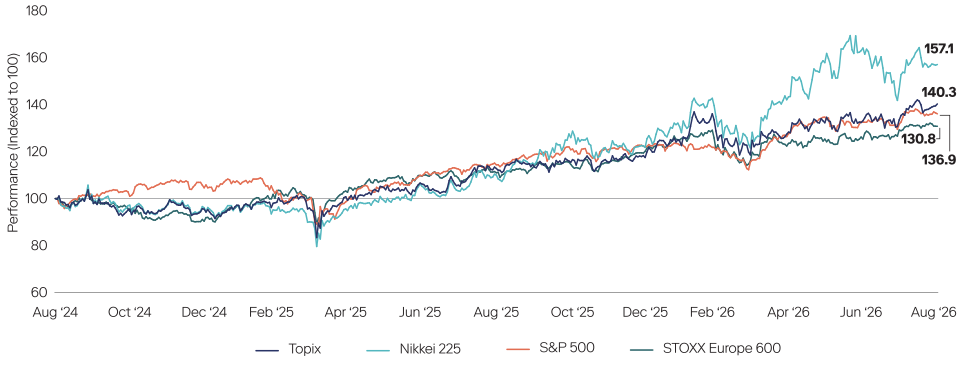
Japanese equities have been on an impressive run: Over the last 24 months, both the Topix Index and the narrower Nikkei 225 Index have outperformed their global peers (see Figure 1). While expectations of accelerated earnings growth from AI-related capex investment have stoked Japan’s momentum, we believe a more fundamental transformation—rooted in corporate governance and capital management reforms set in motion nearly two decades ago—is now well underway.
Figure 1: Japanese Equities Have Outperformed Global Peers Over the Last Two Years
Source: Bloomberg (USD, total return), data as of August 31, 2026.
Historical trends do not imply, forecast or guarantee future results. Due to a variety of factors, actual events or market behavior may differ significantly from any views expressed or any historical results.
We believe these growth-oriented reforms may drive a longer-term rerating of this overlooked, under-researched and undervalued equity market, similar to a jumbo jet reaching cruising altitude.
The taxiing phase of Japan’s ascent began during the early years of the late Japanese Prime Minister Shinzo Abe’s “Abenomics” policy. As part of its “third arrow” of reforms, the aim was to increase the effectiveness of corporate boardrooms and lay the foundations for further progress.
The takeoff phase began in early 2023 with the Tokyo Stock Exchange’s (TSE) Price-to-Book Guideline (PBR),1 which sought to address why many Japanese companies tended to trade at perennial discounts, often less than one times their book value.
One problem, the TSE found, was that too many companies did not fully consider their cost of capital when allocating resources. The PBR guideline advised that companies in the TSE Prime and Standards markets2 should conduct a thorough review of their capital allocation plans and publicly disclose their findings on an annual basis. (The idea: Better disclosure would invite pressure from investors and ultimately improve corporate performance.)
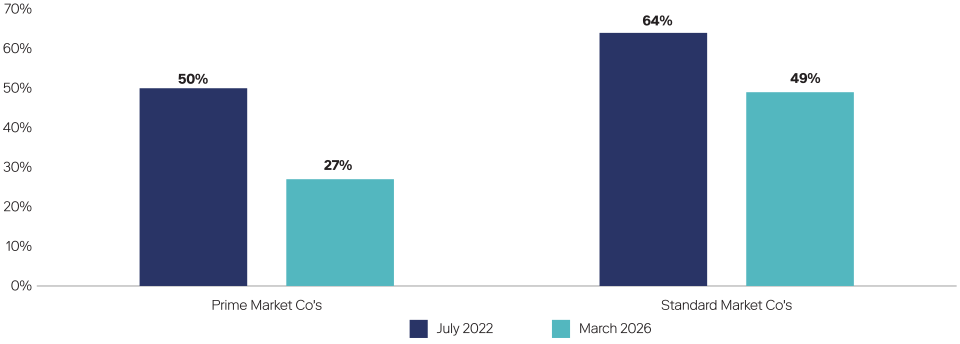
We believe this initiative catalyzed an increase in shareholder returns via more share buybacks and dividends, ultimately fueling a market rally starting in the second half of 2023 and significantly reducing the number of companies now trading below one-times book value (see Figure 2).
Figure 2: Recent Reforms Have Helped Reduce the Number of Japanese Companies Trading at Discounts
The Ratio of Companies Trading for Less Than 1X Book Value
Source: Tokyo Stock Exchange, data as of July 1, 2026. Historical trends do not imply, forecast or guarantee future results. Due to a variety of factors, actual events or market behavior may differ significantly from any views expressed or any historical results.
Now we believe Japan’s equity market is entering the “cruising altitude” phase of its transformation as companies look to increase shareholder value over the long-term.
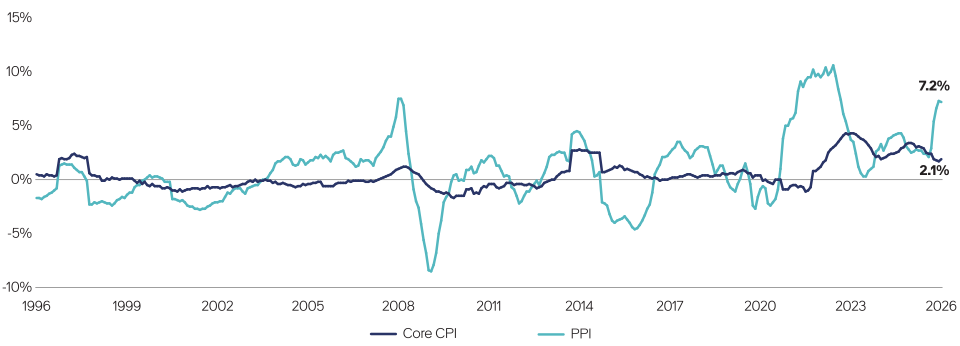
In this phase, we believe Japanese companies will seek to further improve return on equity (ROE) while accelerating earnings growth as the economy emerges from its “Lost Decades” of deflation. Over the last half-decade, Japan has faced cost-push price pressure from COVID-19 supply chain shocks and a weak, import-price inflating yen. Now demand-pull factors are kicking in as businesses of all sizes are hiking pay to secure workers, driving structurally higher inflation (see Figure 3) and raising concerns about future earnings growth.
Figure 3: Rising Structural Inflation Is Putting Pressure on Japanese Companies to Spur Earnings Growth
Year-over-year
Source: Japan Ministry of Internal Affairs and Communications and Bank of Japan; Bloomberg, data as of July 31, 2026. Historical trends do not imply, forecast or guarantee future results. Due to a variety of factors, actual events or market behavior may differ significantly from any views expressed or any historical results.
As a result, we find that many companies are reviewing their growth strategies and in some cases are overhauling their mid-term business plans to focus on accelerating both organic growth and investment activity, including M&A.
Japan Goes All In on Growth
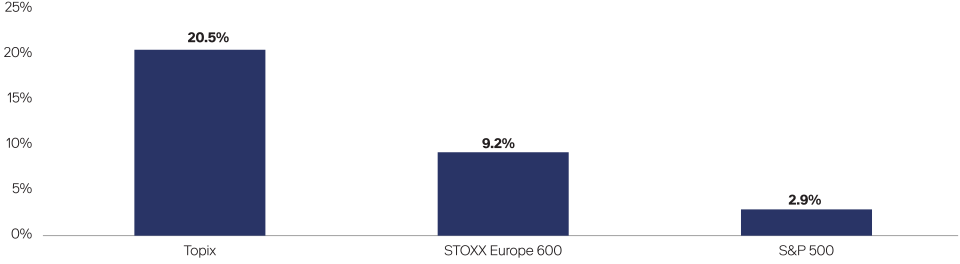
Early in 2026, recently elected Prime Minister Sanae Takaichi and her administration announced a public-private investment initiative that would aim to deploy 370 trillion yen ($2.3 trillion3) across 17 strategic sectors deemed critical from a growth and national security standpoint, including AI, semiconductor production and shipbuilding.4 The government sees private sector participation as critical to the success of this grand scheme and has eyed Japanese companies’ large cash hoard, the highest among developed markets, as a key funding source (see Figure 4).
Figure 4: Japanese Companies Tend to Hoard More Cash Than Global Competitors
Cash-to-Market Capitalization Ratio
Source: Bloomberg. Data as of August 29, 2026.
To date, Prime Minister Takaichi has repeatedly raised concerns about Japan’s low level of “growth investment”, including R&D and capex (see Figure 5), and has often cited underinvestment as a key reason for the nation’s diminishing technological superiority in key industries.
Figure 5: Japanese Companies Tend to Underinvest in Capex Relative to Global Peers
Capex Investment as % of Revenue
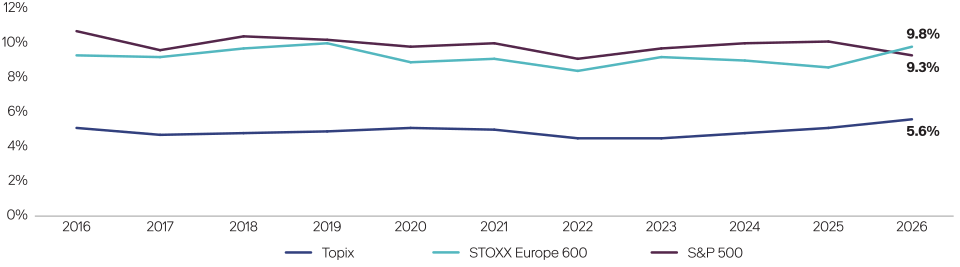
Source: Bloomberg. Data as of August 31, 2026. Historical trends do not imply, forecast or guarantee future results. Due to a variety of factors, actual events or market behavior may differ significantly from any views expressed or any historical results.
To encourage companies to better use their capital, Japan’s government has implemented sweeping updates to various corporate governance and capital management regulations.
Governance Reform: The Key to Unlocking Overcapitalized Balance Sheets
Perhaps one of the most significant changes was the revision to Japan’s Corporate Governance Code that came in the summer of 2026. Formulated by the TSE and the Financial Services Agency (FSA) in 2015, the Code is a set of fundamental principles for effective corporate governance that Japanese listed companies should abide by on a comply-or-explain basis.
While the Code has undergone several revisions over the last decade, this was arguably the biggest revamp, in which the TSE and FSA streamlined the number of Principles from 83 items to 30. Several shareholder-protection provisions, including those addressing anti-takeover measures, were reclassified from binding Principles to non-binding Interpretive Guidance, with no comply-or-explain requirement.5 While this move raised concerns among institutional investors that Japan was rolling back its corporate governance reforms,6 Japanese regulators contend—and we concur—that the remaining binding reforms will now carry even more weight, thereby supporting the overall transition from box-ticking compliance to high-quality governance.
In just one important update, still-binding Principles 4.1 and 4.2 (Roles and Responsibilities of the Board I & II) now strongly encourage boards to evaluate business strategies on their potential to increase earnings and allocate capital efficiently; these updates are necessary, in our view, given Japanese firms’ patchy track records in generating returns on their capital investments. According to the Ministry of Trade’s own estimates, roughly 65% of Japanese companies fail to clear their working average cost of capital, resulting in negative economic profit.7 The Ministry believes the negative spread between return and cost of capital is a drag on corporate value and recommends that companies seek to close it by restructuring their operations around core growth segments.
While there remain no legal penalties for non-compliance, we believe the updated Corporate Governance Code will indeed hold Japanese boards more accountable for seeking higher returns on investment capital. For example, the latest Code revision calls for a more strategic use of “real assets”, which in our view may include potentially valuable real estate used for “core” business purposes, such as corporate headquarters or manufacturing facilities. Companies that need capital have the option of managing these properties off their balance sheets by selling them to a REIT or other third-party vehicle. We believe selling those assets and leasing them back could generate growth capital while streamlining balance sheets—the very sort of efficient capital management encouraged by the Code.
As shown in Figure 6, Japanese companies hold an estimated 71 trillion yen ($451 billion)8 in real estate leased for capital gains purposes; meanwhile, commercial properties for core business operations (which have far limited disclosure in public securities filings) could be nearly double that amount, at 139 trillion yen ($890 billion),9 roughly equivalent to 10% of Japan’s entire market capitalization.10 We believe realizing hidden gains within corporate real estate properties could help Japanese firms free up a significant pool of capital for reinvestment in longer-term growth initiatives.
Figure 6: Realizing Hidden Value Within Core Real Estate Holdings Could Free Up Growth Capital and Streamline Corporate Balance Sheets
Value of Japanese Companies’ Real Estate Holdings
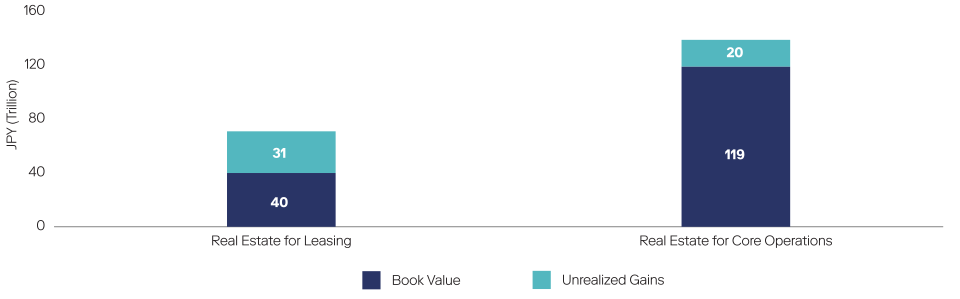
Source: Nikkei Newspaper. Data as of July 21, 2026.
Another key development is the TSE’s pending rebalance of the benchmark Topix Index in October 2026. To increase the equity market’s overall attractiveness to international investors, the TSE has been taking steps to implement stricter liquidity requirements for listed companies.
In the first stage of revisions, from April 2022 to January 2025, the TSE took aim at TSE Prime Market-listed companies with a tradable market capitalization of under 10 billion yen ($6 million).11 Weightings of those smaller issuers were reduced in stages, decreasing the number of index constituents from approximately 2,200 to 1,700.
In the next stage of the rebalancing, starting October 2026, the TSE will aim to broaden the Topix’s coverage area by offering potential inclusion to companies across Japan’s Prime, Standard and Growth markets; at the same time, the TSE plans to impose additional minimum-liquidity requirements that may further shave the total number of Topix constituents to less than 1,00012 by October 2028.13 Regular reconstitutions are set to happen once a year moving forward.
We believe index rebalancing will continue to drive capital efficiency enhancements and corporate governance improvements as Japanese companies look to unwind cross-shareholdings to meet the TSE’s free-float requirement and remain a Topix constituent. We have long advocated that these capital alliances have hindered much-needed corporate reforms (due to passive proxy voting in favor of incumbent management) and have led to a substantial amount of effectively trapped capital. In fact, capital alliances still equate to nearly 8% of the Topix Index’s total market capitalization (see Figure 7), and while that figure has fallen in recent years, we believe unwinding those positions could provide significant capital for reinvestment.
Figure 7: Further Unwinding of Cross-shareholdings—Still Nearly 8% of the Total Topix Market Capitalization—Could Unlock Additional Capital for Growth Reinvestment
Cross-shareholdings Among Japanese Companies, 2019 – 2026 (Fiscal)
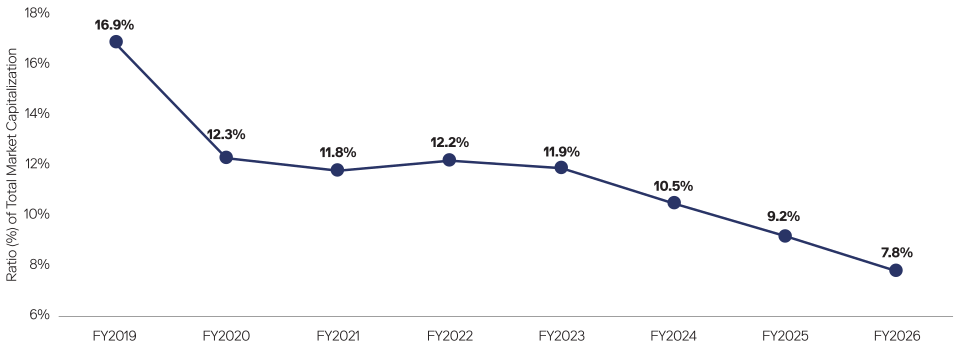
Source: SMBC Nikko Securities, data as of March 31, 2026.
Updating the Corporate Governance Code and rebalancing the Topix Index are just two ways the Japanese government is pushing to promote growth and attract investment. Other examples include the Ministry of Trade’s update on the “Fair M&A Guidelines”,14 as well as the Ministry of Justice’s ongoing revision of the Companies Act, which we believe would unlock even more shareholder value.
Board Quality: The Litmus Test for Sustainable Growth
As more Japanese companies strive to boost return on invested capital and achieve sustainable growth, we believe board independence and skillset diversity will play increasingly important roles as well. Despite good progress on the independence front, the percentage of Japanese companies that carry a majority of independent board members remains at a relatively low 18.5%.15
Furthermore, we observe that while many Japanese boards are filled with internal directors skilled in specific operational areas like manufacturing or sales, they tend to lack directors who have experience in traditional finance and management. One recent survey of leading Japanese companies found significant disparities in management and finance experience among board members at Japanese companies versus those in the U.S. and U.K. (see Figure 8). In our view, this relative dearth of experience may continue to hamper returns on invested capital and the market’s overall ability to generate shareholder value.
Figure 8: Japanese Boards Have Relatively Fewer Members with Finance and Management Experience
% of Board Members with Traditional Finance and Management Experience
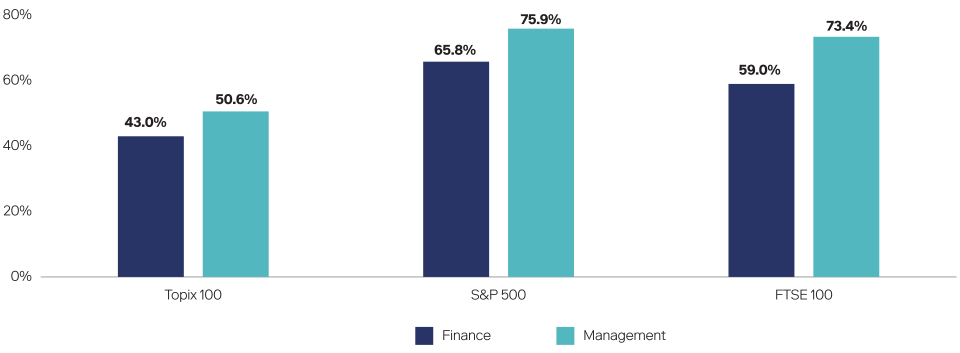
Source: Japan Research Institute, Nikkei Newspaper. Data as of July 21, 2026.
On the other hand, more businesses, lobbyists and lawmakers contend that past reforms have disproportionately favored minority shareholders, leading to chronic underinvestment in long-term growth. This chorus argues instead that regulators should seek to strike a better balance between shareholder rights protection and management discretion.
To that end, Japan’s ruling Liberal Democratic Party has called for changes to Japan’s Companies Act and Financial Instruments and Exchange Act, including revisions aimed at the shareholder proposal process, replacing the long-standing “300 voting units or more” requirement16 with a straight 1% ownership stake.17 Example: Under the current legal framework, a shareholder of a $100 billion market cap company trading at $10 per share would need to hold $300,000 of stock for more than six months to bring a proposal; under the new requirement, that same shareholder would need to hold 1% of total voting rights, which may equate to $1 billion.
Supporters of this and other proposed revisions believe the new rules would boost overall capital efficiency and ultimately put Japan on more of an “equal footing” relative to regulations in developed markets in the U.S. and Europe. Furthermore, they argue that curbing demand for short-term capital returns would help channel capital into longer-term growth investments. We expect amendments to the Companies Act, now in deliberation within the Ministry of Justice, to be submitted during the ordinary Diet session in 2027.
Japanese Equities: Case Studies in Active Management
We believe the Japanese equity market continues to create potentially attractive opportunities for active managers able to distinguish companies that are prioritizing strategic growth and strong governance from those that may still be struggling to navigate the transition. Here are just two recent examples.
Company A: Discount Drugstore Company Makes a Dubious Pivot
“Company A”, a discount drugstore with significant market share in one region, had delivered above-industry-average profitability for decades thanks to strong pricing power and rigorous cost controls. Many investors believed that strengthening its pharmacy business, which shared synergies with the core drugstore operation, would generate solid growth over the medium term.
However, in early 2026, the company made a surprise announcement to expand into the unrelated field of hotel development. Management said it would deploy several billion yen to this new pillar of growth yet didn’t provide any return projections or implementation timeline.
We worried that potentially large capital outlays and depreciation expenses could threaten the company’s return on equity and hurt its valuation. The sudden change in strategic direction also raised questions about how the company’s board of directors had vetted such a deal. Of the six board members, just two were company outsiders and both had legal and accounting experience but no management or corporate finance background.18 Since making the announcement, the firm’s shares have fallen by 9%, underperforming the Topix Index by 24%.19
Company B: Electronics Products & Equipment Conglomerate Plans Strategic Expansion
Over the last decade, Company B gradually shifted its focus from consumer to industrial electronics while generating strong growth by manufacturing batteries for electric vehicles (EV). Yet in recent years revenue began to wane as global EV demand slowed.
Management responded by making the bold-yet-strategic decision to apply its battery-production expertise to the niche-but-growing field of energy management for AI data centers. In 2025, the firm announced it would commit several hundred billion yen to develop data center components over the next three years. Company B claims it has secured customer commitments for all back-up battery units it produces through 2029 and, according to one projection, its strategic investment could return more than 30% within that period.20
Unlike Company A, we concluded Company B had a potentially more effective board with a broader range of skills in critical areas that supported management’s decision making. Of its 13 members, seven came from outside the firm, with four having an international business management background and three with corporate finance experience.21 Since the company officially announced its expansion into the data-center component business, its shares have gained 130%, outpacing the Topix Index by 100%.22
Conclusion
Like a jumbo jet in ascent, we believe Japan’s equity market is entering the cruising-altitude phase of a two-decade structural transformation. In this next phase, we believe ongoing growth-oriented governance and capital-management reforms will encourage Japanese companies to further improve return on investment, accelerate earnings growth and ultimately deliver sustainable value over the longer term.
At the same time, not all companies are created equal, in our view. Against a potentially challenging backdrop of structurally higher input costs and interest rates, we believe companies with pricing power and strong corporate governance may be poised to take market share and expand margins at the expense of inferior peers. It is these winners, in our view, that have the greatest potential to manage through the current economic and geopolitical turbulence to reach cruising altitude.