Historical trends do not imply, forecast, or guarantee future results.
Source: JP Morgan, Bloomberg and S&P Global Market Intelligence. Data as of October 16, 2026. Please see the Disclosures and Risk Considerations at the end of this presentation.
As corporate credit spreads have widened modestly in recent weeks in response to higher government bond yields, relative value dynamics have evolved within traditional corporate credit markets.
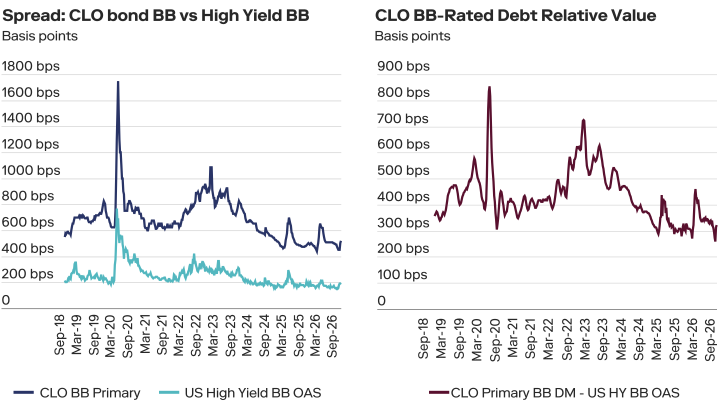
- Even with wider spreads across credit, BB-rated CLO debt spreads on these tranches continue to provide an attractive spread premium relative to comparably rated corporate credit. As of mid-October, we estimate the spread basis vs. BB-rated high yield bonds is approximately 320 bps – broadly consistent with the long-term historical average – which implies fair relative value, in our view.
- From an all-in yield perspective, BB-rated CLO tranches benefit from being a floating rate instrument. On a year-to-date basis, base rates (using three-month Secured Overnight Financing Rate or SOFR for illustrative purposes) have increased by approximately 45 bps, with the forward SOFR curve implying average SOFR levels over the next ~3-5 years approximately 50-75 bps higher than current levels. This has contributed to today’s BB-rated CLO yield (with forward curve) of approximately 10.6% – the highest since April 2025. By comparison, BB-rated high yield bonds yield about 7.1% today.
- Notwithstanding the spread and yield premium, BB-rated tranches also benefit from structural protections, which mitigate the impact of credit losses in the underlying collateral. For example, according to S&P, only 1.2% of BB-rated tranches have defaulted on a cumulative basis, which equates to an annualized default rate of 0.04%;1 equivalent to single-A rated corporate bonds.
- While the above yield and structural advantages may pique the interest of investors, there is no “free lunch” in CLO debt. There are three key factors creating the spread and yield premium versus comparably rated corporate credit:
- A complexity premium. CLOs are inherently complex structured products compared to corporate bonds or leveraged loans.
- A liquidity premium. The BB-rated CLO market is much smaller, for example, than the high yield bond market and therefore bid/ask spreads must be wider.
- A mark-to-market volatility premium. In our view this represents the core reason for the premium.
More specifically, in times of macro-shock events, we would expect BB-rated tranches to experience a greater drawdown versus high yield bonds or leveraged loans. However, given the strong structural protections in CLOs through their ability to mitigate the impact of credit losses in the underlying collateral, we would expect temporary shock events to not translate into elevated BB-rated tranche defaults (consistent with historical credit cycles).