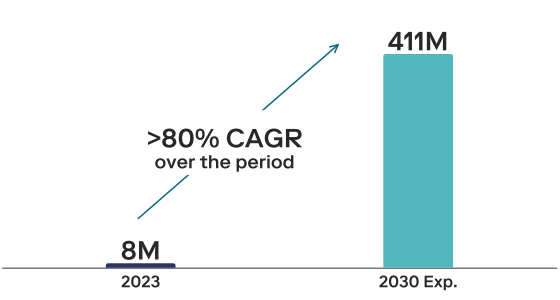
Global Satellite Direct-to-Device (D&D) services, monthly active users
Subscribers (Million, Users)
For the first time in history, a standard smartphone, not a specialist device or new hardware, can connect directly to a satellite. This represents a fundamental rewiring of global connectivity.
- Commercial momentum is building fast. SpaceX's Starlink launched its T-Satellite service commercially with T-Mobile in July 2025, using over 650 satellites functioning as cell towers in space to provide messaging, voice and data coverage across more than 500,000 square miles of territory beyond the reach of any ground-based network. Crucially, it requires no new hardware, with most modern smartphones connecting automatically when terrestrial signal drops. AST SpaceMobile is taking this further: its BlueBird satellites enable full voice calls, video, messaging and broadband data on unmodified smartphones via AT&T and Verizon's existing networks, with 5G speeds demonstrated from orbit. AST SpaceMobile has secured over $1.2 billion in contracted revenue commitments already.
- Over 3 billion people remain without reliable mobile coverage. Direct-to-device satellites eliminate the need for ground infrastructure entirely and the expansion of constellations and coverage will allow more communication service providers to deliver ubiquitous connectivity.
- Smartphone direct-to-device subscribers are forecast to exceed 400m by 2030, growing at well over 50% annually and up from a base of only 8m in 2023.
- Beneficiaries span the entire value chain, from satellite operators building the constellations (AST SpaceMobile), to launch providers deploying them into orbit (Rocket Lab), to telecom operators monetising the coverage (T-Mobile), and to defense firms (Kratos) and sovereigns utilizing these new secure communication arenas.
Source: Omdia and Novaspace. Data as of March 2026.
2030 figures are estimates. CAGR: Compounded Annual Growth Rate.