The Spectrum Monetization Theme Should Proliferate with the Trajectory of Satellites Expected in Orbit Through 2030+
Forecasted Satellites in Orbit by 2030
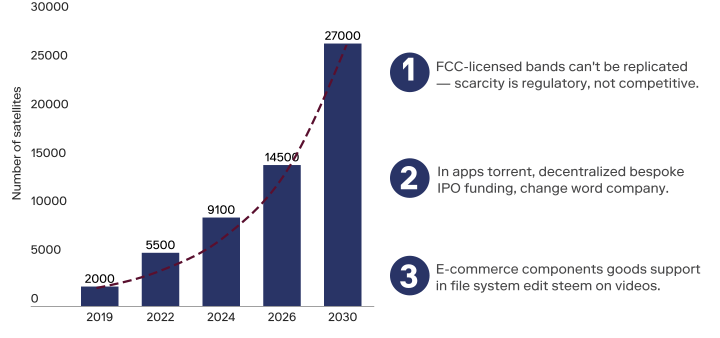
Source: McKinsey’s mid-range forecast.
PolicyTracker, Company websites, CNBC, Reuters, WSJ, Barrons, DCD, Stocktwits.
FCC: Federal Communications Commission.
Satellites up fivefold. Spectrum: flat.
Spectrum is the scarcest input in the space economy, a fixed, licensed resource that decides who gets to beam a signal to a phone, ship, drone or sensor, and who doesn't. The number of active satellites in orbit has grown roughly fivefold since 2020, from around 3,400 to more than 16,000 today, almost entirely on the back of Low Earth Orbit (LEO) broadband constellations. Spectrum allocated internationally for satellite services hasn't grown anywhere close to that, largely because of the laws of physics. A phone's antenna is small and its battery too limited to transmit at high power, so a satellite link only works reliably in low and mid frequency spectrum, the range already used for 4G and 5G low band and for satellite L and S band. Higher frequency bands carry 5G's fastest speeds, but they need a direct line of sight and get blocked by rain and foliage. Closing that link needs an antenna bigger than any phone can hold. A cell tower can make up for this with a large dish. A phone in your pocket can't.
The trouble is that this same low and mid band range is what every other wireless service has wanted for decades too, including terrestrial cellular, broadcast, aviation, government and military use, and the incumbent satellite operators who were allocated slices of it many years ago. Regulators could hand terrestrial 5G close to 5,000 MHz of brand new high band spectrum in the 2019-2020 auctions precisely because almost nobody else wanted those frequencies; direct-to-device satellite trials, by contrast, are working with a single paired 5 MHz channel, narrower still in some of AST SpaceMobile's test arrangements. There's no equivalent windfall available in the bands a phone can actually use, which is why the licences that do sit in this range, the ones EchoStar, Iridium and Ligado hold, are suddenly worth tens of billions of dollars. None of it is new spectrum being created; it's a fixed, already claimed slice that is changing hands.
Selling licences, not companies
The dealmaking in spectrum this year has not all been related to M&A. EchoStar has agreed to sell around $42.6 billion of spectrum licences to AT&T and SpaceX, but EchoStar itself isn't being bought. It remains independent and has simply sold off pieces of its spectrum portfolio, the way a landowner might sell mineral rights while keeping the land. AST SpaceMobile's arrangement with Ligado is narrower again, a long-term access agreement, not a purchase of anything.
The real M&A in the sector has looked different, because it has been built around buying operators rather than spectrum directly. Viasat/Inmarsat, SES/Intelsat, and Amazon's pending purchase of Globalstar are all deals for satellite operators, with the spectrum licences those operators already hold featuring as part of the package. Rocket Lab's $8 billion agreed acquisition of Iridium, announced in June, is another good example: Rocket Lab will get Iridium's 66-satellite network and 2.5 million-plus subscribers, but the deal has been widely viewed as being driven at least as much by Iridium's globally licensed L-band spectrum (spectrum Rocket Lab couldn't have assembled on its own within any reasonable timeframe). While the deals might look different on the surface, these companies are buying their way to spectrum, either directly through a licence sale or indirectly through acquiring a company that holds one.
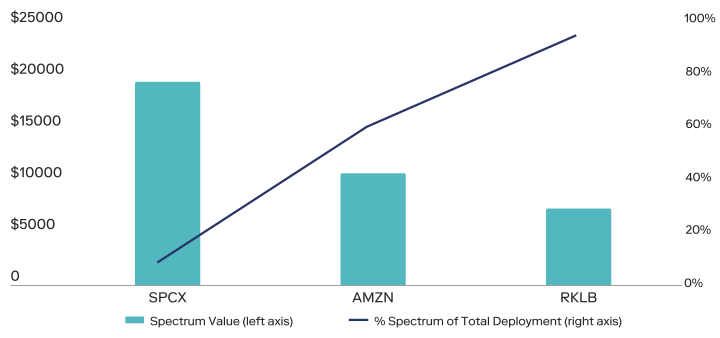
M&A and Spectrum Investments - Last 5 Years ($ million)
Investment view
- The more durable position, in our view, is to own companies whose existing spectrum rights and regulatory standing make them natural counterparties in transactions like these. Look past the transaction structure to the underlying asset: who holds the licence, and how defensible that position is under current allocation rules.
- That's not the only way in, though. The companies doing the consolidating, like SpaceX buying spectrum outright from EchoStar, Rocket Lab buying Iridium's network for its L-band holdings, or Amazon buying Globalstar's, are making the same scarcity bet with their own balance sheets, assembling positions competitors can't replicate on any reasonable timeline. Spectrum access is one of the clearest moats in the space economy; both the companies that already hold it and the ones actively buying their way into it deserve the underwriting attention.
Source: Neuberger analysis. SPCX: SpaxeX; AMZN: Amazon; RKLB: Rocket Lab. The securities mentioned are for illustrative purposes only. Nothing herein constitutes investment advice or a recommendation to buy, sell or hold a security. It should not be assumed that any investments in securities, companies, sectors or markets identified and described were or will be profitable.