The war in Iran has been a focal point for markets since the February start of Operation Epic Fury. To make up for losing the Strait of Hormuz’s 20% of global oil and liquefied natural gas (LNG) supply, countries tapped strategic reserves, producers expanded use of pipelines around the Strait, and China consumed less. Meanwhile, customers in Europe and Asia looked for other sources, with oil tankers lining up at U.S. ports to carry oil and fuel abroad and U.S.-generated LNG seeing a wave of new demand.
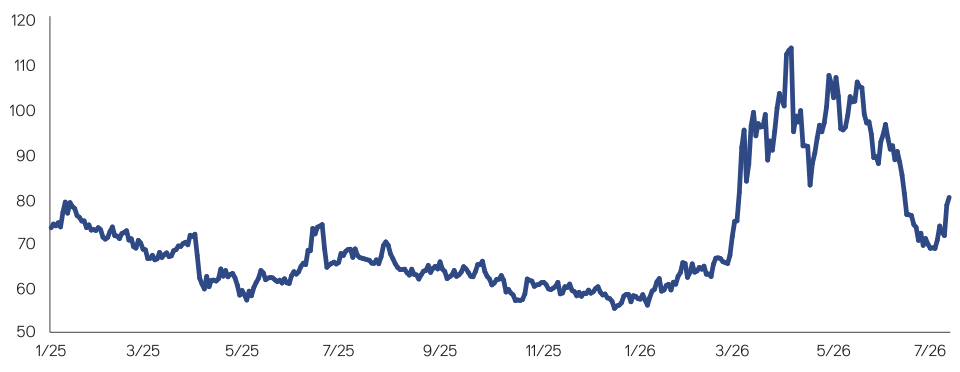
From a price perspective, things could have been worse. After an initial spike to close to $120 per barrel, WTI oil prices settled in the $85 – $100 range, while forward prices for late next year remained in the $70s. U.S. natural gas prices, while briefly shooting above $5 per MMBtu have since traded in essentially their pre-crisis range of $2.50 – $3.50. The muted response can be attributed to overflowing inventories leading into the crisis, some of the mitigation tactics just referenced and market confidence in a swift resolution to the war. The announcement of a preliminary peace deal and partial reopening of the Strait moved oil prices into the high $60s, although the resumption of hostilities sent them back up to around $80 – $90 in July, with much depending on whether further negotiations over Iran’s nuclear program, the Strait and other issues prove successful.
Oil Prices Surged With the Conflict, but Stayed Below Expectations
WTI Oil Price ($ per Barrel)
Source: Bloomberg. Data as of July 14, 2026.
What could be in store for the energy markets? Assuming a clean (not partial) opening of the Strait, we think that energy prices could decline again in the short to intermediate term as more tankers move to their destinations. On the other hand, it seems unlikely that oil will drop back to the over-inventoried pre-crisis upper-$50s range as we believe some risk premium should remain in the price.
In our view, buyers have become hyperconscious of security threats to their energy supply. Therefore, many will likely take concrete steps to limit their exposure to the Strait or any other global chokepoints by broadening their sourcing of fossil fuels and reinforcing energy diversification to power their economies.
With that focus on energy security in mind, here are seven near- and longer-term themes we believe could gain traction across the energy sector:
- Restocking Will Be a Priority. On a global basis, oil-consuming nations have drawn down strategic and commercial reserves to offset the Strait supply disruption. The end of the war could signal an opportunity to restock after those drawdowns and assess building new stockpiles. Europe desperately needs to bolster storage of natural gas in advance of next winter, while the U.S. and Japan want to refill their Strategic Petroleum Reserves (SPRs). At the same time, countries with historically more limited reserves may look to augment them to reduce vulnerability to future crises. The combined additions to storage could at least partially offset the energy price impact of a spike in supply as the Strait reopens.
- OPEC+ Makeup Could Be in Focus. On May 1, the United Arab Emirates withdrew from OPEC+. While surprising to some, the move reflected continued strains around adherence to production quotas within the group. Given this departure, OPEC+’s post-war role and coherence will be a key factor in assessing oil markets. We expect Saudi Arabia, ostensibly the leader of the cartel, to exceed quotas itself once the crisis has passed—in order to show the world that it remains healthy and can continue to produce ample supply. The net effect—more volume from OPEC+ countries—could be to dampen prices somewhat in the immediate aftermath of the conflict.
- A New Energy Investment Cycle Could Emerge. A key impact of the focus on energy security and expanding reserves, as well as already strong secular demand for natural gas specifically, could be a new cycle of investment in oil and gas exploration and production (E&P). We are already seeing renewed interest in more challenging locations, offshore and Venezuela to name a couple. However, we do not expect companies to go overboard in new E&P efforts. Having learned the hard way that “growth at all costs” is a losing strategy, oil companies are likely to maintain capital discipline, even as they build on production gains of the recent past. In short, we expect a measured response from U.S. producers, which should continue to be primarily driven by price signals.
- U.S. Will Double Down on Energy Independence. Amid frustration over high energy prices, renewed interest has emerged in reducing U.S. exposure to global fuel prices. In March, the government suspended the Jones Act, which prohibits foreign tankers from transporting oil between U.S. ports, to make it easier for East and West Coast markets to access refined products from the U.S. Gulf Coast. If U.S. fuel prices move higher in a sustained way, the country may look to limit or ban oil and/or refined product exports, although we currently view this as a low-probability scenario. More likely is continued emphasis on deregulation to help expand domestic production capacity.
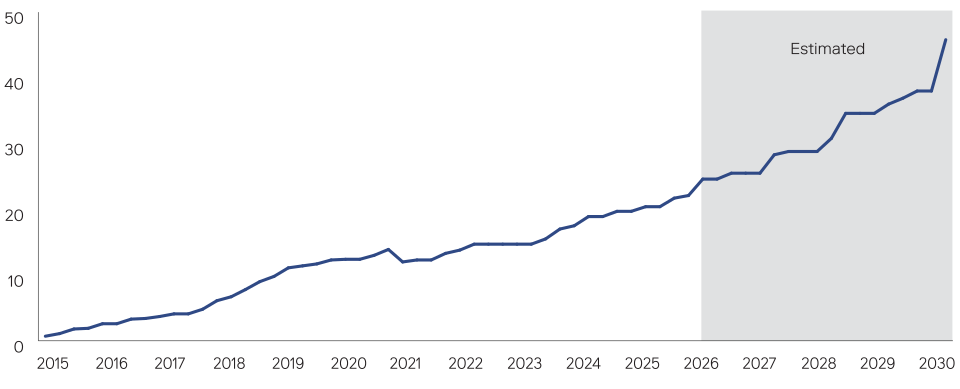
- LNG ‘Golden Era’ Will Likely Continue. U.S. exports of LNG were already seeing heavy demand overseas, particularly as Europe sought to reduce its dependence on Russian supply in the wake of the Ukraine conflict. With the closure of the Strait this year, the global need for these exports accelerated dramatically. We anticipate a permanent redirection of demand toward the U.S. as countries diversify their energy supply. Currently, the U.S. retains a reputation as a reliable supplier of LNG, potentially enabling it to capitalize on energy diversification over the long term.
U.S. LNG Capacity Should Expand Further to Meet Accelerating Demand
U.S. LNG Capacity (Billion Cubic Feet per Day)
Source: Raymond James. Data as of June 30, 2026. Nothing herein constitutes a prediction or projection of future events or future market behavior. Historical trends do not imply, forecast or guarantee future results. Due to a variety of factors, actual events or market behavior may differ significantly from any views expressed. Information is obtained from sources deemed reliable, but there is no representation or warranty as to its accuracy, completeness or reliability.
- Pipelines Keep Their Sweet Spot. With the massive buildout of AI data centers, utilities across the U.S. are benefiting from the increase in power demand while partnering with hyperscalers to avoid price increases for residential customers. In some cases, utilities are lowering costs to consumers as hyperscalers pay their “fair share.” Once viewed skeptically by many environmentalists, natural gas is now seen as a cornerstone of the energy supply mix. The Iran crisis and resulting export boom for LNG have only added to natural gas usage. In our view, key beneficiaries of this shift include pipeline companies, which are seeing increased gas demand and throughput. While regulatory delays and cancellations of mega-pipelines were once a major issue, pipeline operators are focusing on smaller, ancillary pipelines to expand capacity. Permitting reform, while delayed, could eventually make the process easier for a broad array of energy projects.
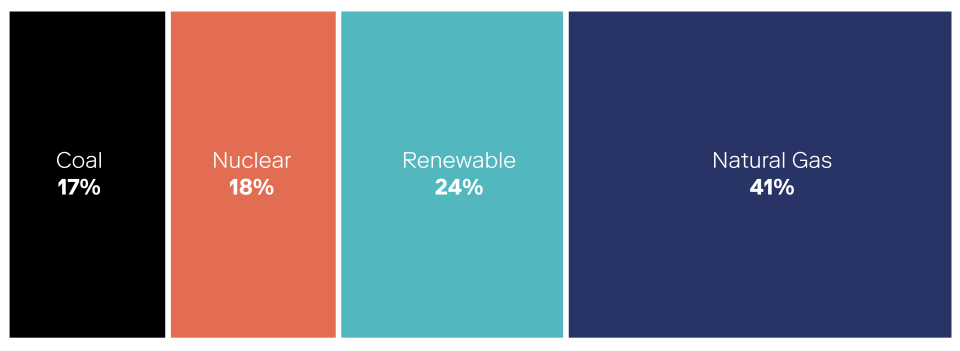
- Renewables Remain Part of the Power Solution. Despite current political headwinds in the U.S., we see substantial room for renewables as part of the energy mix: Given elevated electricity demand trends, the country simply has no choice but to deploy an “all of the above” generation strategy. What may be different now is that, rather than relying on subsidies, clean energy will need to earn its keep from an expense and diversification perspective. Higher fossil fuel costs should prove supportive for clean energy.
It bears noting that a multifaceted energy approach has historically received bipartisan support, with Texas and other Republican-dominated states being key beneficiaries of the clean energy trend. In other words, regardless of who runs the government, we believe renewables will be part of the solution, along with battery storage, natural gas and nuclear generation.
U.S. Energy Diversification Is a Strength
U.S. Power Fuel Mix
Source: EIA. Data as of December 31, 2025.
Integrating Policy and Market Forces
Recent military conflicts, receding globalism and spreading populism have all contributed to the reemergence of geopolitics as a key part of the economic landscape. But that does not mean that supply and demand dynamics have receded from view. The struggle over the Strait of Hormuz reflects how a conflict between rivals can alter market dynamics—and in this case, sharply reduce supply.
As we look toward a potential normalization of energy flows, the intertwined nature of policy and markets will remain in focus as nations look to secure and diversify their energy sources. At the same time, while political preferences across the energy sector may influence outcomes at the margin, market forces should ultimately dictate the path forward.
The good news for energy and power investors is that, barring further prolonged disruption to flows through the Strait of Hormuz, extreme price volatility or a material economic slowdown, markets are likely to remain broadly balanced, supported by steady secular demand growth. In this environment, differentiating between policy dynamics and market fundamentals—and assessing their impact on individual companies—will likely be critical to investment success.