Individuals have increasingly invested in private equity portfolios in recent years. The reasons to consider allocating to private equity have been well researched, from strong long-term performance to effective diversification. However, individual investors who hold private equity in non-qualified accounts often have an additional consideration that institutional investors do not: taxes.
We believe that by taking proactive measures, investors may mitigate the impact of taxes and help protect the bulk of their investment return on an after-tax basis. One way to do this is by pairing private equity investments with tax-managed separately managed accounts (SMAs).
How Tax-Managed SMAs Work to Save Taxes
Tax-managed SMAs that invest in publicly traded equities can provide a strategic approach to offsetting gains from private equity investments without compromising pre-tax public equity performance. This approach involves investing in a portfolio of individual stocks that is managed with a risk budget relative to a target benchmark or active model. Over time, the portfolio looks to systematically defer capital gains and actively harvest capital losses to help offset taxable gains across the investor’s broader investment portfolio and reduce their overall tax burden.
By leveraging tax-managed SMAs, investors can effectively manage their tax liabilities and enhance their after-tax outcomes. Industry research has calculated this benefit, referred to as tax alpha, as being upwards of 1 – 2% per annum.1
Simulation: Tax-Efficiency in Action2
To illustrate the benefits of pairing private equity with tax-managed SMAs, we simulated a one-time $10 million commitment to a representative private equity portfolio and a simultaneous $10 million investment into a U.S. Large Cap Core tax-managed equity SMA. For the private equity portfolio, we generated a 15-year simulation of the investment using our proprietary Presto model. The Presto model simulates cash flow and net asset value (NAV) of private equity, and is calibrated based on MSCI, Cambridge Associates and an internal database. For public equity, we generated a hypothetical backtest of a U.S. Large Cap Core tax-managed portfolio, also over 15 years. The U.S. Large Cap Core portfolio tracked the S&P 500 Index and rebalanced on a biweekly basis for risk and tax management. We then focused on analyzing the impact of taxes as measured by realized gains and losses. In order to combine the tax impact and cash-flow events, we made the following assumptions:
- Private equity distributions are made at the end of each year.
- Private equity distributions are not taxed as capital gains until all original capital has been returned.
- Capital gains from private equity distributions are subject to the highest federal long-term tax rate.
- Investment is made in a traditional private equity portfolio; tax implications of other vehicles may differ.
Based on Presto’s simulation, a one-time $10 million private equity commitment over 15 years yields a 12.3% internal rate of return on a pre-tax basis (based on blended historical returns of multiple private equity sectors, as described in the disclosures at the end of this article). This level of return results in $6.8 million in realized gains, with a taxable event not occurring until year eight. This assumes distributions are first treated as return of capital. At the highest federal long-term capital gain rate of 23.8%, the realized gains result in a $1.6 million tax liability.
However, if an investor has a corresponding investment in a tax-managed SMA, where positions are frequently evaluated for potential tax-loss harvesting, there may be opportunity to reduce this tax liability. We evaluated two scenarios to demonstrate this concept:
- 15-Year U.S. Large Cap investment: This scenario begins with a $10 million investment in a U.S. Large Cap SMA that is traded every two weeks for risk management and tax-loss harvesting. No additional cash is added to the portfolio over time. With this tax-management approach, the portfolio tracks the performance of the S&P 500 benchmark on a pre-tax basis within a 1% tracking risk, while generating $2.9 million in realized capital losses. These harvested losses can be used to offset gains from private equity distributions, resulting in $690,000 potential tax savings associated with private equity gains.
- 15-Year U.S. Large Cap investment with annual additions from private equity distributions: This scenario also begins with a $10 million investment in a U.S. Large Cap SMA that is traded every two weeks for risk management and potential tax-loss harvesting; however, any distributions from the private equity investment are then added to the tax-managed portfolio. These inflows increase the public equity exposure and provide fresh (higher) cost basis for additional tax-loss harvesting. This approach generates $4.3 million in capital losses, resulting in a $1 million offset to capital gains from private equity, providing $342,000 in additional savings compared to the previous scenario.
Pairing Private and Public Distributions and Losses Can Help Mitigate Tax Impacts
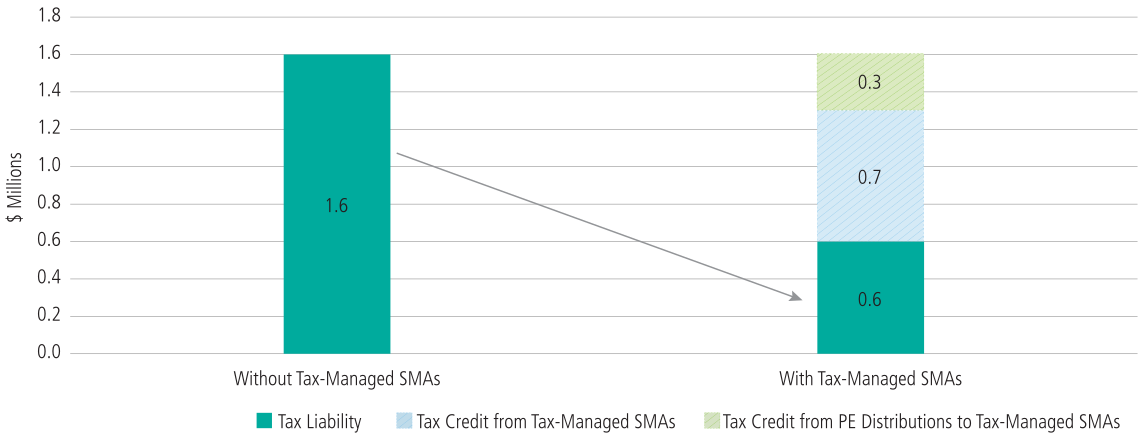
Source: Neuberger Berman. Assumes $10 million initial private and public market portfolios as outlined in the text.
A comparison of these two scenarios demonstrates that reinvesting distributions into the tax-managed SMAs offers enhanced opportunities for loss harvesting and a more substantial offset to taxable gains, potentially leading to significantly higher after-tax wealth. The optimal approach, however, depends on the investor’s liquidity needs, risk tolerance and overall wealth management objectives.
Conclusion: Unlocking Tax Benefits
Private markets play a pivotal role in wealth management and have been increasing in overall allocation. While this can enhance potential pre-tax returns, effective coordination between private market distributions and tax-managed SMAs can unlock significant after-tax benefits for taxable investors.