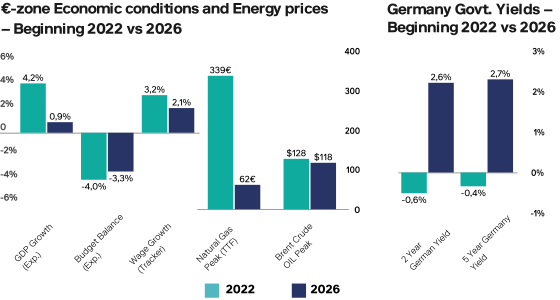
- Economic conditions - The Eurozone expected growth in 2022 was 4.2%, now is below 1%: the European economy is entering the current shock in a state of near-stagnation, with no cyclical buffer to draw on. In 2022, post-Covid demand was sustaining activity; today, PMIs, new orders, and confidence are already deteriorating, making the economy far more vulnerable to external shocks — even of a lesser magnitude. Eurozone wage growth stood at 3.24% in 2022 and was accelerating, fueling second-round pressures on core inflation; today it has fallen to 2.1% and is declining, reducing the risk of a wage-price spiral. The Eurozone fiscal balance was at -4.0% of GDP in 2022, reflecting a deliberately expansionary fiscal stance that supported demand and incomes; today the deficit stands at -3.3%.
- Energy prices - TTF Natural Gas peaked at €339/MWh in 2022; in 2026, the peak stands at €62/MWh — less than one fifth — dramatically reducing the direct impact on industrial and household energy bills, despite ongoing geopolitical risks. Brent Crude reached $128/barrel in 2022 versus $118/ barrel in 2026: oil price levels are broadly comparable, but the macro effect is different given a significantly weaker starting economy and less elastic demand.
- Inflation state - The 2022 shock acted as an amplifier of already-accelerating inflation; in 2026, the starting point is disinflationary, with core price dynamics already slowing.
- Fiscal and Monetary policies - In 2022, the coordinated expansion of public balance sheets and central bank support (QE still active at the start of the year) contributed to both growth and inflation; in 2026, with less room for fiscal stimulus, Europe cannot absorb the shock through large-scale energy subsidies as it did in 2022–23 — the impact on households and SMEs will be more direct.
- Bund yields were deeply negative in 2022 (2-year at -0.60%, 5-year at -0.42%): central banks had a lot of tightening room and did so aggressively, generating an interest rate shock that amplified the energy shock. In 2026, yields are already positive and we would argue restrictive (2-year Bund at 2.64%, 5-year at 2.75%), placing the ECB in a far more complex dilemma than in 2022.
In summary, in 2022 a massive energy shock hit an overheating economy with zero interest rates, rising wages, and active fiscal stimulus; in 2026, a more contained energy shock is hitting a stagnant economy with already-elevated rates, slowing wages, and limited fiscal space — the dominant risk is growth fragility, not inflation persistence.
Neuberger Investment view
- ECB: Market Too Hawkish, Duration Opportunity - At present, we believe the short end of the curve offers duration opportunities. The market has priced in approximately three ECB rate hikes by year-end — a view we consider overly restrictive. European inflation is expected to peak around 3.5% over the summer before declining back toward 2%, supported by a softening wage environment and an economy operating close to stagnation. We believe interest rate market is currently mispriced: if you consider for instance the 5-years German rates, they currently trade at 2.75%, which is above the highs reached in 2022 (i.e. 2.56%), when headline inflation exceeded 10%. The ECB's own adverse scenario at the March 19th meeting projected European GDP at +0.4%, a figure we already view as too optimistic, with recession risk non-negligible. A sequence of rate hikes risks choking growth at precisely the moment when easing would be warranted, the ECB will seek to avoid repeating past policy mistakes. The central bank is being pushed towards a pause, and potentially towards cuts later, making the addition of duration on the short end of the European curve an attractive portfolio positioning. In the event of persistent geopolitical uncertainty, war-related costs, rising defence spending and emergency fiscal measures could re-emerge as material concerns for fixed income investors.
- In this context, we prefer to avoid long-dated maturities, where term premium and fiscal risk remain underpriced. In the meanwhile, despite tight credit spreads, the uncertainty has created more sector dispersion and opportunities to trade more actively price/fundamentals discrepancies in liquid credits.
Source: Bloomberg, Neuberger analysis. Data as of 4 May 2026.