



Before the birth of the United States, individual colonies ran lotteries to pay for all manner of civic projects. For the next 250 years, difficult political decisions around gambling regulation remained the purview of the states. This generated a patchwork of regulation, with states like Nevada taking a more liberal view of gambling activity of all sorts than, say, Texas. However, technological advances, recent court rulings and a laissez faire presidential administration threaten to disrupt this landscape in important and far-reaching ways.
Court Win and Election Change the Betting Landscape
In 2024, upstart online “prediction market” operator Kalshi earned a court win that allowed it to offer “event contracts” on that year’s elections, with the court ruling that such contracts were financial swaps subject to federal Commodity Futures Trading Commission (CFTC) regulation, not gambling products subject to state regulation. As background, these contracts are freely traded between third-party market participants on an exchange, and pay either $1 or $0 depending on whether an event—say, the election of President Trump—occurs or not. The trading price can be interpreted as implied odds of an event occurring, with a 30-cent contract corresponding to 30% odds.
While 2024 court battles focused on political prediction markets, the arrival of an administration that is generally supportive of financial markets—including novel products in the crypto and prediction market spaces—created an opening for Kalshi and its competitors to test the limits of the “swap” definition. These companies now offer event contracts on sports outcomes and even events that resemble player “props” and “parlays” (for example, bets tied to the “event” of U.S. football quarterback Patrick Mahomes passing for more than 300 yards). In the eyes of the user, event contracts and their economics can look very similar to online sports bets offered by DraftKings or FanDuel, despite being governed by a completely different regulatory framework.
Differing Regulation Favors the Upstarts
Federal regulation of these markets has allowed their operation in all 50 states, including the roughly 20 states covering half of the U.S. population that have no or limited online sports betting. This has completely sidelined states with respect to important decisions around gambling legalization (including the number and type of operators), accessibility (prediction markets are available via online or mobile apps to anyone 18 or over, versus 21 or over for gambling), safety/responsible gaming and taxation (prediction markets avoid paying certain state taxes that are applicable to lottery and casino operators).
While we expect the U.S. Supreme Court to eventually rule on the difficult jurisdictional and definitional questions involved here, that decision may take many years. In the meantime, this nearly instantaneous nationwide legalization of a gambling-adjacent product threatens to disrupt existing gambling markets. It may also lead to a proliferation of gambling legalization across the country, as states compete to retain potential taxable revenues within taxable gambling products. Recent announcements by FanDuel and DraftKings to enter the prediction market space with hundreds of millions in start-up spending also seem to suggest they are chasing the large opportunities associated with significant market change.
New Competition Could Require Investor Vigilance
We believe non-investment grade issuers in the lottery space, which until now have enjoyed virtually no legal gambling competition in some jurisdictions, may be negatively affected. Meanwhile, the impact on regional gaming operators is likely to be mixed depending on their footprint and whether they can capitalize on any subsequent legalizations. For investors, this will require even greater investment vigilance and discretion. For the moment, all we can arguably predict is that disruption could be on its way.
Sports Betting in the USA
Where gambling on sports is allowed, and where it could be on the way
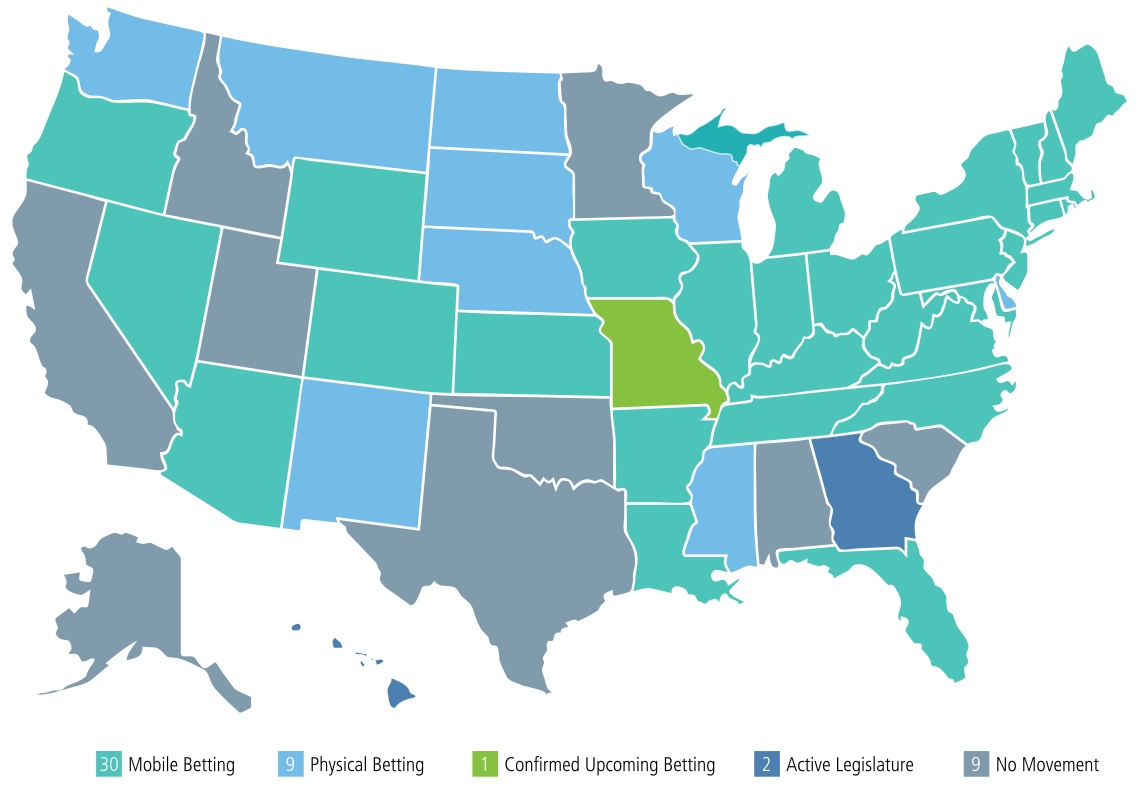
Source: USA Today, as of December 6, 2025.