


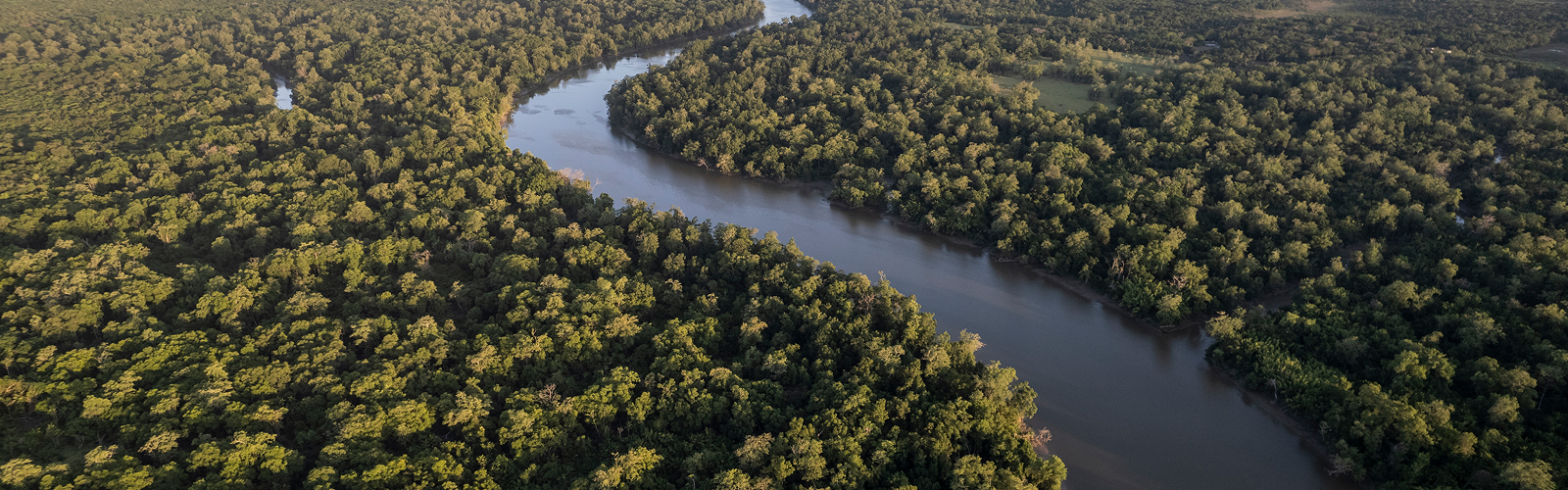
Today’s CIO Weekly Perspectives comes from guest contributor Sarah Peasey, who outlines the key areas of focus and what to look out for as the 30th session of the UN’s Conference of the Parties (COP30) gets underway in Belém, Brazil.
Symbolism vs. Practicality
Belém’s selection has been praised as historic—centering negotiations in the heart of the Amazon rainforest—but São Paulo’s superior hotels, venues, air links and capacity for large finance forums have been attracting many attendees, driving a geographic split between public negotiations and private investor gatherings.
Clean energy investment needs are stark: Sustaining a 1.5°C pathway demands roughly $4 trillion in annual climate finance. Yet capital is finite, and the biggest uncertainty is who foots the bill. With public balance sheets stretched and regional capacity to finance diverging, the trajectory points to a larger share of the burden-shifting to private markets. We believe it is notable that this incremental rise in global green capex demand is expected even amid policy headwinds such as potential reversals to U.S. incentives.
In this context, COP30’s geographic split—public actors gathered in Belém versus many private financiers convening 3,000 kilometers away in São Paulo—risks compounding the coordination challenge. Bridging the gap will require clearer pipelines, blended‑finance structures and policy frameworks that attract private capital at scale.
Global Goal on Adaptation
COP30 arrives as acceleration of climate impacts has been observed and adaptation takes center stage—shifting the focus from ambition to how countries, cities and communities will withstand extreme physical climate events and stresses.
Against this backdrop, COP30 is expected to finalize the Paris Agreement’s Global Goal on Adaptation, establishing indicators and targets such as universal early‑warning coverage and climate‑resilient agriculture that can drive measurable, collective progress.
For investors, adaptation is a multitrillion‑dollar opportunity, as economies around the world have to adapt to more extreme weather events induced by climate change.
The recent Category 5 Hurricane Melissa that impacted Jamaica—bringing 175mph winds, a near 13-foot storm surge and catastrophic flooding—and other Caribbean countries lays bare the climate vulnerability of small island states and underscores why calls are growing for COP30 to deliver scaled adaptation and loss-and-damage finance. Importantly, developed nations are not impervious; some 36% of U.S. economic growth this century can be linked to spending on recovering from disasters or preparing for the next one, according to Bloomberg Intelligence research.1
What to look out for: The finalization of a credible Global Goal on Adaptation with measurable indicators and material progress in unlocking finance and policy mechanisms that mainstream physical climate risk into investment, planning and disclosure.
Critical Deadlines and Credibility Tests
2025 is a pivotal year for climate policy: The 195 member countries of the United Nations Framework on Climate Convention must submit updated National Determined Contributions (NDCs) extending to 2035, and while few met the initial deadline, mounting UN pressure has prompted nearly 100 nations to signal new targets. The headline shift is China’s first economy‑wide 2035 goal—cutting net greenhouse gas emissions 7 – 10% below peak by 2035.2 This is cautious versus the 20 – 30% reduction consistent with a 1.5°C pathway, but a meaningful move from intensity‑based to more robust absolute targets.
Importantly, Beijing’s language of “striving to do better” matters; China often sets conservative goals and then outperforms—having hit its 1,200 GW renewables milestone six years early in 2024 and likely peaking emissions this year, five years ahead of its 2030 commitment.3
For COP30, the emerging wave of NDC updates—anchored by China’s evolution—will set the tone for credibility, ambition ratchets and the global investment signals for the next decade.
What to look out for: Expect a credibility test on ambition and execution concerning whether COP30 delivers stronger, finance‑ready NDCs to 2035—with clearer sector targets, implementation plans and accountability.
Mobilizing Finance at Scale
Climate finance will again be center stage at COP30. After COP29’s $300 billion‑per‑year pledge from developed countries—far short of the over $1 trillion annual needs by 2030—negotiators set an aspirational $1.3 trillion mobilization target for all actors to work toward, recognizing the actual investment needs of developing countries.
Brazil is now co‑leading the “Baku‑to‑Belém” roadmap to make that $1.3 trillion a year by 2035 real, aiming to unveil new instruments, leverage the balance sheets of multilateral development banks and actively engage investors. This underscores officials’ view that public funds alone cannot deliver and that finance could be “redesigned” to attract private investment across emerging markets.
In parallel, major emerging markets bondholders (including Neuberger Berman on behalf of its clients) are advancing disaster‑linked payment pause clauses—allowing countries to defer interest for up to a year after shocks (natural disasters, pandemics, conflicts), with added creditor protections and transparency, building on Caribbean precedents like Grenada’s hurricane‑triggered clause in 2024.
Together, these initiatives point to a pragmatic COP30 agenda: Engineer bankable, resilient capital flows at scale while safeguarding sovereign stability in a world of rising climate and macro shocks.
What to look out for: Expect clearer pathways to mobilize private capital through blended finance and de‑risking tools, robust project pipelines and transparent measurement of how revised NDCs translate into investable outcomes.
Striking an AI Balance
COP30 will put the nexus of AI and climate squarely on the agenda: Expect calls for faster permitting of clean capacity near data hubs, coordinated transmission buildout, and credible standards for “green compute” (renewable matching, 24/7 carbon‑free energy and marginal emissions accounting).
AI is also emerging as a core adaptation tool—powering early‑warning systems, wildfire detection, flood mapping and crop forecasting—linking directly to the Global Goal on Adaptation through measurable, locally deployed indicators. Rising AI‑driven load has the potential to bring in private capital to clean power and grids via hyper-scaler power purchase agreements, capacity payments and blended‑finance structures for transmission, with investors watching how NDCs and COP outcomes convert into bankable pipelines.
Yet the scale challenge is real: Data centers already use an estimated 1 – 2% of global electricity, and that could grow by roughly 165% by 2030 from 2023,4 with inference deployments likely sustaining elevated demand even as training becomes more efficient. In U.S. hotspots, household bills have surged, and the largest data center under construction is slated to consume power comparable to over two million homes—amid 50+ additional U.S. projects in the pipeline, new firm, low‑carbon generation will be indispensable.
Given strong support from the U.S. administration, next-generation nuclear (including small modular reactors) is emerging as a credible, around-the-clock, zero‑carbon power source to meet AI and data centers’ surging, high‑availability electricity demand while enhancing grid reliability and decarbonization.
The policy test for COP30 is whether governments can align digital expansion with climate integrity, balancing affordability, reliability and decarbonization, while channeling AI’s capabilities toward resilience.
What to look out for: Concrete moves to align AI’s surging power demand with climate goals alongside commitments to deploy AI for adaptation (early warning, risk mapping) with strong governance and transparency.
The ‘Implementation COP’
As COP30 gets underway, questions are mounting about whether the COP process is still effective in driving meaningful global climate action.
There is even a broader argument, put forward by prominent figures such as Bill Gates, that while climate change is serious, the bigger immediate priorities for low- and middle-income countries are disease, agricultural productivity and economic development. He urges shifting focus to economic development that strengthens adaptation and resilience, and backing emissions reductions alongside adaptation solutions that directly improve lives.
Such arguments are expected to gain traction amid a drive to achieve real outcomes.
Indeed, despite years of negotiations, the persistent gap between climate goals and actual commitments reflects a disconnect between summit declarations and real-world progress. Shifting political dynamics—such as major emitters withdrawing from agreements or resisting accountability—further complicate efforts to build coordinated momentum.
While COP30’s emphasis on “implementation over ambition” signals a shift toward delivery, it also underscores the deeper challenge: Can international climate diplomacy evolve quickly enough to meet the urgency of the climate crisis?
What to Watch For
- Tuesday 11/11:
- NFIB Small Business Index
- Thursday 11/13:
- U.S. Consumer Price Index
- Friday 11/14:
- Eurozone Q3 GDP (Second Preliminary)
- U.S. Producer Price Index
- U.S. Retail Sales