
Fixed Income Investment Outlook
For many fixed income investors, 2025 was a year when much went right. Gradually diminishing policy rates, moderate disinflation and a steady economic picture generally supported market rates and further narrowed credit spreads. Even the major disruption of the year—April’s tariff announcement—turned into a boon for many willing to buy into risk-off headwinds as market conditions later eased.
In our view, 2026 presents more challenges in seeking fixed income opportunity, with fewer rates tailwinds and continued narrow credit spreads on the back of resilient economic fundamentals. Still, we believe that central banks (outside of Japan) will generally foster an easing bias, with potentially more rate cuts in the U.S. if the labor market deteriorates. Relative U.S. fiscal uncertainty and political volatility may further weaken the dollar this year, reinforcing the benefits of global diversification.
Risk mitigation may be essential in the credit world, where narrow spreads leave little room for error and issuance from U.S. hyperscalers dominated recent investment grade supply. While less exposure to the AI trend may hinder Europe from a business perspective, it could help investors vary exposures and avoid repercussions if cracks in the AI story emerge.
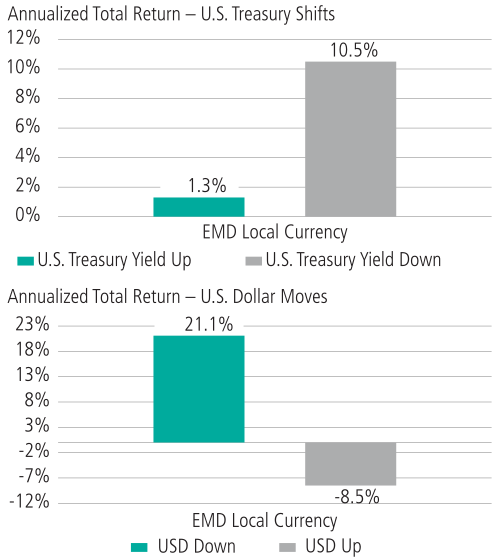
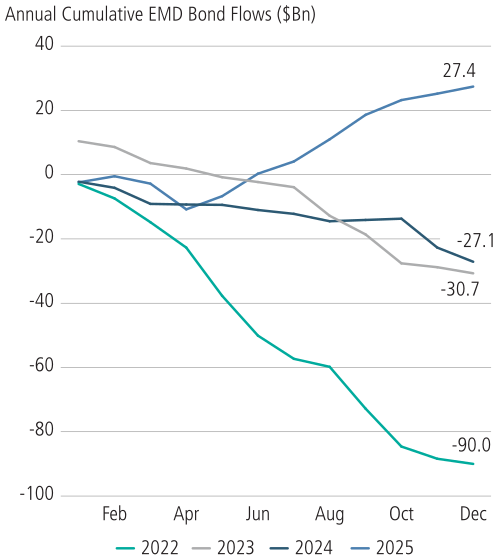
Continuing a theme from 2025, we believe that emerging markets appear poised for standout results, given their yield advantage, favorable local growth trends and a moderate inflation picture. Emerging markets debt has also historically outperformed in periods of U.S. monetary easing and dollar weakness—trends that are both currently in place.
Beyond geography and currency exposure, we see this as a year of hyperfocus on security selection and careful positioning, to extract value and avoid loss in a nuanced environment. We present our key investment themes on the pages that follow.

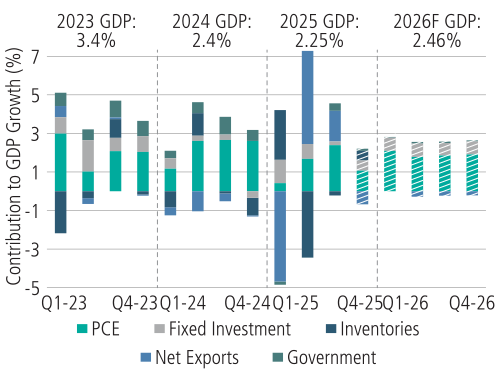
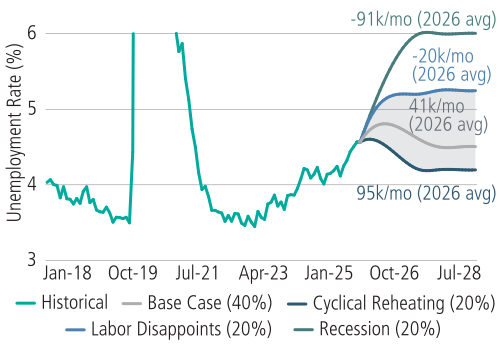
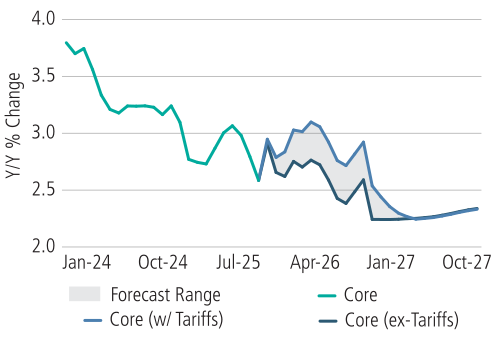
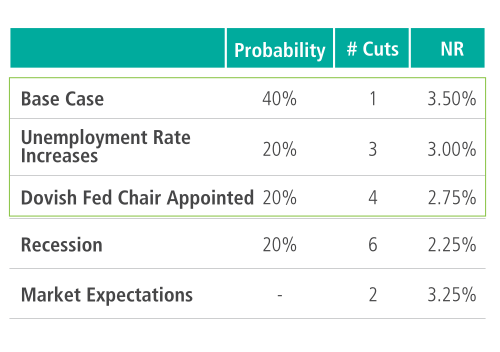
For the coming year, we believe that the U.S. will likely enjoy above-trend growth of close to 2.5%. Inflation levels should continue to improve, perhaps more than consensus, with a large impact from shelter disinflation. In this context, the Fed should maintain its cautious stance on rate cuts, easing one or two times, but could conceivably cut rates up to four times depending on what happens in the labor market. Our expectation is for a slight rise in the unemployment rate, but with risk of a sharper increase tied to adoption of artificial intelligence or, although not our base case, a meaningful slowdown.

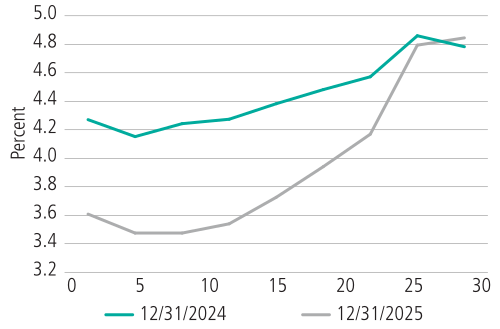
A key theme of the last couple years has been potential impact of fiscal overreach and excess debt on fixed income valuations. However, as noted in our Solving for 2026 outlook, long-term yields already appear to reflect known risks. With continued policy easing, the yield curve of the market has steepened, improving the relative carry profile of longer bonds. Moreover, issuance from the U.S. Treasury is emphasizing shorter-duration bills rather than long-maturity bonds, reducing upward pressure on long yields.
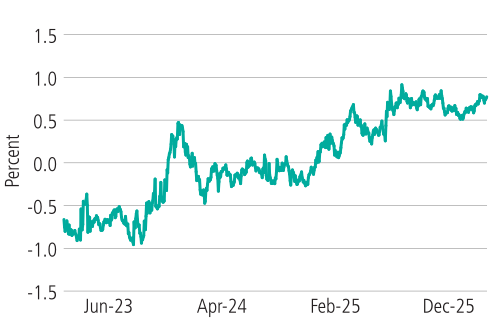
Overall, this has helped stabilize the term premium, suggesting that investors could benefit from extending duration this year to generate additional income, with relatively low risk of a further upward move in long bond yields.
U.S. Bills Outstanding ($ Millions)
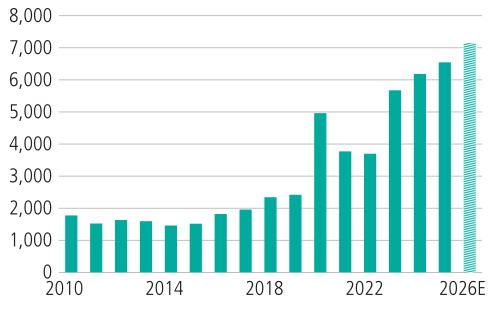
2 Source: U.S. Treasury, Neuberger estimates (we based 2026 Treasury Bills outstanding estimates on the median primary dealer 2026 deficit projection, the 2025 year-end SOMA portfolio and current Treasury coupon issuance assuming coupon increase in the November 2026 refunding meeting).
3 Source: Bloomberg. Data as of December 31, 2025.

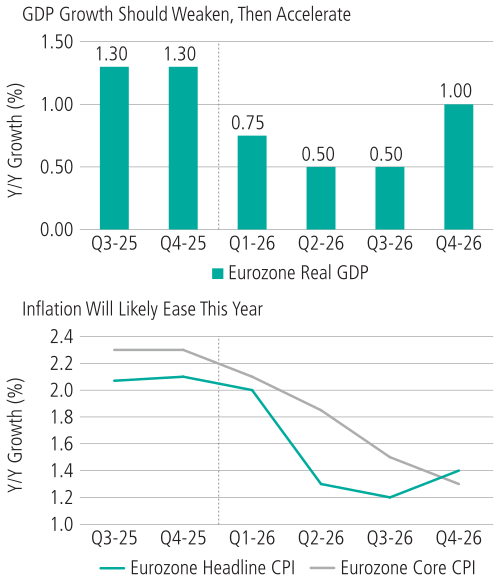
Economic growth remains tepid in Europe, with eurozone PMIs showing sluggish activity at the turn of the year. Firming inflation and optimism about improved growth have limited market expectations for a rate cut, which has been reinforced by the European Central Bank’s restrictive positioning. In contrast, we think too much is being made of a near-term consumer recovery given the pessimism reflected in high saving levels, while tariffs continue to impede production and capex. A delay in implementation of Germany’s infrastructure and defense plan is further postponing recovery, which should come late in the year.
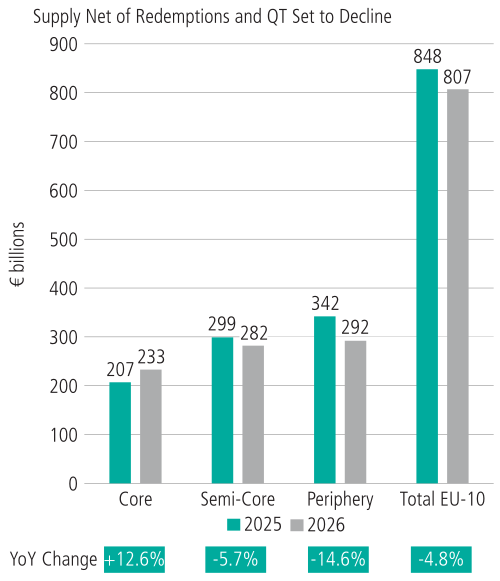
The net result could be a couple of ECB rate cuts in the first half of the year in anticipation of a decline in inflation later in 2026. That, along with reduced net redemptions and quantitative tightening in peripheral and semi-core markets, should augment opportunities in duration. In credit, we believe spreads generally appear expensive given weak growth and tariff sensitivity. Issuer selection could therefore be especially important in the coming months.
Overall, supply dynamics should prove balanced, with increasing German issuance offset by lower issuance from other countries, supporting duration and cross-country relative value opportunities.

The Japanese yield curve has steepened significantly on a combination of fiscal concerns and rate hikes by the Bank of Japan. However, fiscal expansion and has grown more cautious, allowing the Ministry of Finance to reduce its planned long-dated issuance in the current fiscal year, and even more in 2026 – 27.
Importantly, Japanese bonds appear to us to be attractively valued on a hedged basis. As shown in the display below/right, hedged yields for 30-year Japanese government bonds (JGB) offer a meaningful premium for dollar-based investors relative to alternatives in the high-quality sovereign space.
In our view, the combination of reduced issuance and favorable yields could potentially support long Japanese bonds in the coming months, leading to some flattening in the yield curve.


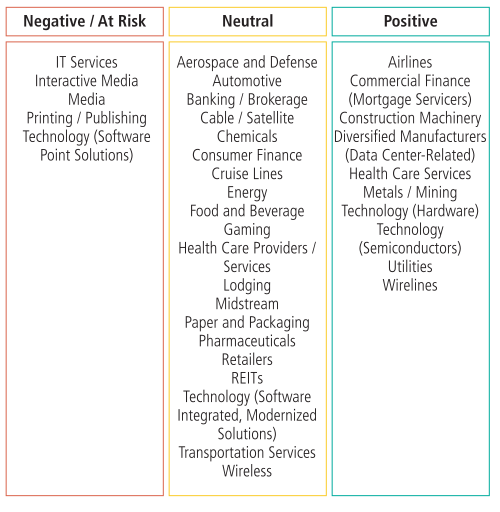
In the midst of narrow credit spreads and stable economic conditions, we believe that a focus on credit selection and flexibility to manage tail issues could be important to delivering results this year. In 2025, the avoidance of high-profile defaults was integral to generating alpha, a phenomenon that could repeat in 2026 given the wide disparity of fundamentals in what has been called a K-shaped economy. In some cases, it may be prudent to give up some yield in favor of more conservative segments, such as financials within investment grade credit.
With expectations for continued massive issuance from U.S. hyperscalers, positioning vis-à-vis AI-related credit has become an ongoing consideration, reinforcing the value of diversification across segments and geographies. Securitized markets, for example, may offer a low-risk yield upgrade from corporates even if valuations are less compelling than at their wides of last year. From a research perspective, attention to the fundamental impacts of AI remains crucial to determining potential prospects of companies across the supply chain, particularly when it comes to the high yield space.


In our view, emerging market fundamentals are holding up well going into 2026, with a growth pick-up of close to 2% for emerging over developed markets, supported by resilient exports, AI-related capital expenditures in Asia, and favorable conditions for various metals producers in Africa and Latin America. Credit fundamentals have been improving, as reflected in rating upgrades and low default rates.
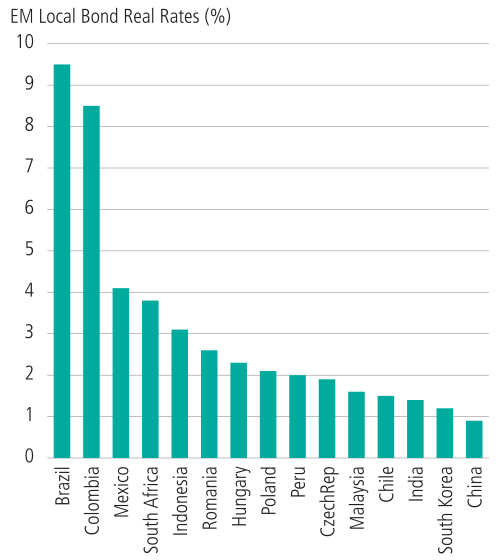
At the same time, average inflation in emerging markets has been converging toward developed levels, and we see room for various central banks to maintain a bias toward easing. Combined with near decade-high real yields, this should provide an attractive backdrop for local bonds.
While spreads have narrowed toward the bottom of their historical range, we expect value and spread compression opportunities across various improving credits with rating upgrade potential.
 Download Our Outlook