



In Short
- The U.S. launch of Operation Epic Fury against Iran in late February triggered the closure of the Strait of Hormuz, spiking energy prices and driving pressure on both equities and bonds as inflation expectations surged.
- Already fragile U.S. consumer confidence—weighed down by years of above-trend inflation, elevated rates and softening spending— faces a new threat from rising energy prices.
- We remain constructive on equities, particularly U.S. small/mid-caps and EM equities, while remaining less constructive in the short term on non-U.S. developed market exposure given energy insecurity; there may also be opportunities in certain industries within the U.S. large cap universe.
The Month in Markets
As the month of February closed, investors were still mired in the malaise resulting from the sell-off in software and services equities in light of new questions around how quickly businesses could be disintermediated by advances in AI. Credit, too, was under pressure, as investors cast doubt on the relative safety of the loans outstanding to these businesses, particularly given the threat to their cash flows. Focus shifted quickly, however, as the U.S. announced Operation Epic Fury on February 28, launching airstrikes on Iranian nuclear sites, missile infrastructure and military command centers; the Iranians, in turn, launched attacks on several sites in the Gulf region, and effectively closed the Strait of Hormuz, sending oil and natural gas prices soaring. These events cast the month of March as one in which investors were struggling to understand the impacts of higher energy prices on both inflation and growth.
This rapid shift in inflation expectations resulted in pressure on both bonds and equities. Bond markets had been positioned for stable to modestly more accommodative policy coming into 2026 from all the major central banks save the Bank of Japan; this positioning reversed quickly as energy prices spiked higher. Central banks, to their credit, tend to look through geopolitically driven energy price shocks; however, the slow progress made in moving back to long-term inflation targets coupled with high levels of energy insecurity in Europe, China and Japan combined in March to push yields much higher. The threat of interest rate hikes now looms large outside of the U.S., and even within the U.S., two to three rate cuts have now been priced out. Our view is that the bond markets have likely moved too far, too fast, and that, particularly in the short end of the yield curve, there may be opportunities to capture what we believe is a mismatch between fear and reality. The belief is grounded in the view that either the conflict will de-escalate, thus reversing a majority of the price spike, or the fatigue from higher prices will deliver demand destruction; either way, yields would likely move lower.
Federal Funds Rate – Actual & Market Expectations – Market Has Repriced from Two Cuts to No Cuts in 2026
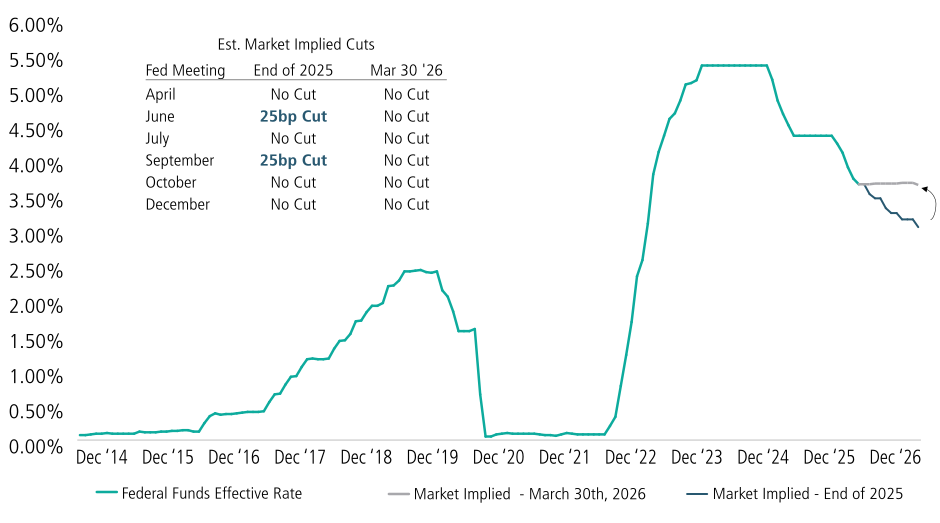
Source: Bloomberg, March 30, 2026.
Equities, too, were under pressure as investors feared a slowdown in economic growth on the back of several factors. Slowing consumption (discussed further below), the threat of higher interest rates, and a potential knock-on effect of deteriorating business confidence combined with fears of AI obsolescence resulted in broad-based declines across markets. Greater pressure was felt by companies operating in geographies that were more reliant on energy imports; this resulted in an unwind of the outperformance enjoyed by non-U.S. developed and emerging markets, as these stocks meaningfully underperformed U.S. names, with the S&P 500 posting only a -5% loss in the month versus -10.2% and -13%, respectively, for the MSCI EAFE and MSCI EM. Within the U.S., the broadening out which had boosted non-technology names over the past several months hit the proverbial wall; while energy was the only positive S&P 500 sector in March, technology and utilities held up better than health care, industrial and consumer names. U.S. small-cap stocks were off in the month as well, but closed March still up +0.9% year-to-date after a nice run in January and February.
Consumer Conviction
The potential for higher energy prices to weigh on consumer demand is real and represents a threat to our base case of +2.5% U.S. GDP growth in 2026. The impact of higher energy and food prices (a component of headline inflation) has longed been looked through by central banks in their assessment of inflation risks. This is in large part due to the volatility of these measures and, as discussed above, does not in our minds translate into a change in central bank posture. The threat of higher energy prices, however, does affect U.S. consumer sentiment at a time when it is already low. Despite growth in wages—which are still outpacing inflation, at least through the end of February—U.S. consumer confidence has continued to decline based on a combination of factors, not the least of which is sharp degradation in consumers’ views on buying conditions.
One could argue that this deterioration in confidence has done little to meaningfully impede consumer spending, and yet U.S. consumption was softer-than-expected in Q4 2025, decelerating to +2.0% from +3.5% the quarter prior. For lower income consumers in particular, the affordability challenge implied by several years of both above-trend inflation and elevated interest rates has hurt spending; this cohort is likely to be further disadvantaged by rising energy prices. Combined with a tighter labor market, a soft patch in consumer spending could be the most immediate and economically impactful result of the escalation in the Middle East, but the ripple effects could be even more seismic.
2026 is a midterm election year, and the evidence is clear: U.S. voters are led by their wallet. The Trump administration appears to have acknowledged that reality, touting the increase in tax refunds because of tax changes in the One Big Beautiful Bill Act, calling for a 10% cap in credit card interest rates, and maligning the sale of homes to institutional investors as home ownership remains out of reach for many U.S. households. Yet the recent increase in energy prices could upend these efforts. Even as consumers are receiving higher refunds, which were expected to act as a stimulative force, higher gas prices have increased non-discretionary spending. Should the conflict extend further past the end of April, companies outside of the energy sector are likely to begin factoring higher fuel costs into their end prices, and unlike energy prices, these end consumer prices are unlikely to come back down immediately following a potential de-escalation—marking the inflection between transitory and structural inflation.
In short, there is a lot riding on the duration of the current U.S.-Iran conflict. While geopolitical events generally have a short shelf life in terms of overall market and economic impacts, energy prices approaching $100 a barrel for oil, and more than $4 per gallon for gasoline, are difficult to digest for more than a few months. There has been damage, with the extent not yet known, to energy facilities in the Middle East, which could result in higher energy prices even if the Strait of Hormuz is reopened—implying that at least some of the “war premium” could remain in the price. The conclusion is that the U.S. consumer is in a tough spot—and navigating the response might prove a bit tricky, particularly if the conflict continues past the end of April.
U.S. Consumer Sentiment & Drivers (U Mich) – Affordability & Personal Finances Continue to Fuel Low Sentiment
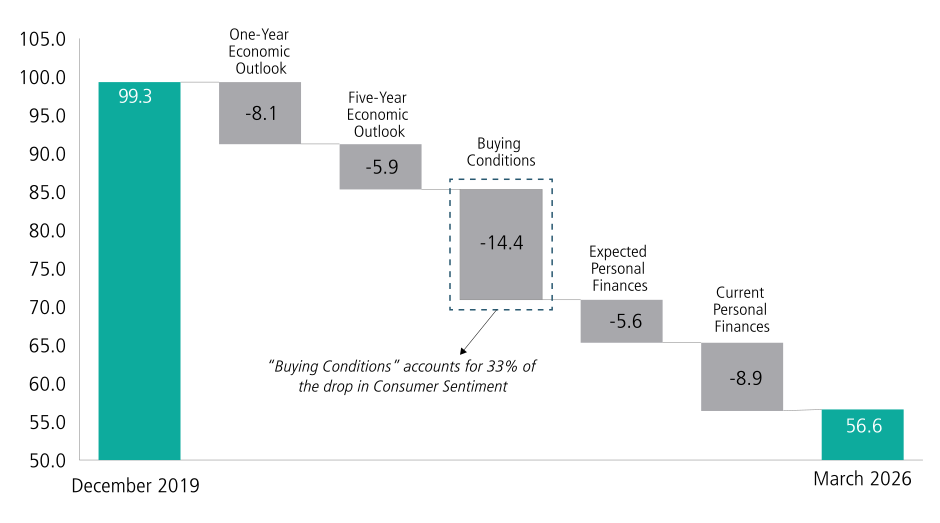
Source: Bloomberg, as of March 2026, University of Michigan Consumer Sentiment Survey.
Source: Bloomberg, March 30, 2026.
Portfolio Implications
Equities. We remain constructive on global equities, despite the near-term pressure. We continue to favor U.S. small and midcaps, citing the encouraging economic and earnings data released prior to the escalation in the Middle East, and despite the perceived threat of slower growth and/or higher interest rates. We maintain a constructive view on emerging markets, with particular emphasis on India and Brazil, while acknowledging the challenges China is facing as falling real estate values and higher energy costs combine to dampen consumption. We recently reduced non-U.S. developed markets to an “at target” view; this is further supported by the near-term challenge of energy insecurity in Europe and Japan. Recent selling has compounded drawdowns resulting from last month’s software weakness, creating opportunities in a broader universe of U.S. large-cap stocks.
Fixed Income. A strong 2025 and a slowing rate-cutting cycle largely underpinned our downgrade of U.S. government securities, investment grade corporate credit and high yield, while municipal bonds remain at target. However, the sharp movement in the short end of the yield curve have created opportunities in short-term Treasuries; we also remain overweight in non-U.S. developed market bonds. Emerging market sovereign bonds have performed well, given their appealing yields and economic fundamentals. Multi-sector bond funds may be an appropriate vehicle to consider, given the levers a manager can opportunistically pull across sector, duration profile and region; municipals also remain attractive when compared with the broader universe of U.S. investment grade issues. We believe this is particularly important in this environment, as spreads widen and opportunities are created to invest in still fundamentally strong credits.
Private Markets. While we maintain our positioning across real and alternative assets, including overweights to commodities, private equity and private real estate, we have upgraded our view on absolute return strategies to “at target” from underweight, reflecting more dynamic market conditions. Private debt remains “at target,” although rising credit risk and growing investor concerns requires vigilance and particular focus around structure and diversification within the underlying loan pools. Within private equity, liquidity and capital solutions providers will likely remain important to work through the substantial backlog of legacy investments, even as the pace of distributions accelerates against the backdrop of a revitalized M&A environment.
Index Returns as of March 2026
| Mar-26 | YTD | 2025 | |
|---|---|---|---|
| Equities | |||
| Major U.S. Indices | |||
| S&P 500 Index | -4.98% | -4.33% | 17.88% |
| Nasdaq Composite | -4.68% | -6.96% | 21.14% |
| Dow Jones | -5.20% | -3.19% | 14.92% |
| U.S. Size Indices | |||
| Large Cap | -4.97% | -4.18% | 17.37% |
| Mid Cap | -5.33% | 1.29% | 10.60% |
| Small Cap | -5.00% | 0.89% | 12.81% |
| All Cap | -4.97% | -3.96% | 17.15% |
| U.S. Style Indices | |||
| All Cap Growth | -5.21% | -9.54% | 18.15% |
| All Cap Value | -4.77% | 2.23% | 15.71% |
| Global Equity Indices | |||
| ACWI | -7.18% | -3.20% | 22.34% |
| ACWI ex US | -10.79% | -0.71% | 32.39% |
| DM Non-U.S. Equities | -10.19% | -1.12% | 31.89% |
| EM Equities | -13.03% | -0.10% | 34.36% |
| Portfolios | |||
| 50/50 Portfolio | -3.65% | -2.26% | 11.06% |
| Mar-26 | YTD | 2025 | |
|---|---|---|---|
| Fixed Income Currencies & Commodities | |||
| Major U.S. Indices | |||
| Cash | 0.29% | 0.85% | 4.18% |
| U.S. Aggregate | -1.76% | -0.05% | 7.30% |
| Munis | -2.32% | -0.18% | 4.25% |
| U.S. Corporates | |||
| Investment Grade | -1.98% | -0.54% | 7.77% |
| High Yield | -1.20% | -0.42% | 8.78% |
| Short Duration (1.9 Yrs) | -0.43% | 0.32% | 5.39% |
| Long Duration (12.8 Yrs) | -3.63% | -0.76% | 6.65% |
| Global Fixed Income Indices | |||
| Global Aggregate | -3.07% | -1.07% | 8.17% |
| EMD Corporates | -2.02% | -0.36% | 8.74% |
| Commodities | |||
| Commodities | 11.50% | 24.41% | 15.77% |
| U.S. Treasury Yields | |||
| U.S. 10-Year Yield | 0.38% | 0.15% | -0.40% |
| U.S. 2-Year Yield | 0.42% | 0.32% | -0.77% |
| FX | |||
| U.S. Dollar | 2.41% | 1.67% | -9.37% |
Source: Bloomberg, Total returns as of March 31st, 2026. S&P 500 Index is represented by S&P 500 Total Return Index. Nasdaq Composite NASDAQ-Composite Total Return Index. Dow Jones is represented by Dow Jones Industrial Average TR. Large Cap is represented by Russell 1000 Total Return Index. Mid Cap is represented by Russell Midcap Index Total Return. Small Cap is represented by Russell 2000 Total Return Index. All Cap is represented by Russell 3000 Total Return Index. Large Cap Growth is represented by Russell 1000 Growth Total Return. Large Cap Value is represented by Russell 1000 Value Index Total Return. Small Cap Growth is represented by Russell 2000 Growth Total Return. Small Cap Value is represented by Russell 2000 Value Total Return. ACWI is represented by MSCI ACWI Net Total Return USD Index. ACWI ex US is represented by MSCI ACWI ex USA Net Total Return USD Index. DM Non-U.S. Equities is represented by MSCI Daily TR Gross EAFE USD. EM Equities is represented by MSCI Daily TR Gross EM USD. Cash is represented by ICE BofA US 3-Month Treasury Bill Index. U.S. Aggregate is represented by Bloomberg US Agg Total Return Value Unhedged USD. Munis is represented by Bloomberg Municipal Bond Index Total Return Index Value Unhedged USD. Munis Short Duration is represented by Bloomberg Municipal Bond: Muni Short (1-5) Total Return Unhedged USD. Munis Intermediate Duration is represented by Bloomberg Municipal Bond: Muni Intermediate (5-10) TR Unhedged USD. Investment Grade is represented by Bloomberg US Corporate Total Return Value Unhedged USD. High Yield is represented by Bloomberg US High Yield BB/B 2% Issuer Cap Total Return Index Value Unhedged USD. Short Duration is represented by Bloomberg US Agg 1-3 Year Total Return Value Unhedged USD. Long Duration is represented by Bloomberg US Agg 10+ Year Total Return Value Unhedged USD. Global Aggregate is represented by Bloomberg Global-Aggregate Total Return Index Value Unhedged USD. EMD Corporates is represented by J.P. Morgan Corporate EMBI Diversified Composite Index Level. EMD Sovereigns – USD is represented by J.P. Morgan EMBI Global Diversified Composite. Commodities is represented by Bloomberg Commodity Index Total Return. Commodities ex Energy is represented by Bloomberg Ex-Energy Subindex Total Return. U.S. 10-Year Yield is represented by US Generic Govt 10 Yr.