
A New Inflection Point
For the past two years, GLP-1 medications have been a fixture of consumer trend analysis, discussed by everyone from CNBC to sell-side strategists to management consultants. Most of that coverage has centered on the same behavioral observations: People eat less, lose weight, buy new clothes, drink less alcohol.
That framing, while directionally accurate, misses the more consequential question for credit investors: Which issuers are structurally positioned for a world with significantly more GLP-1 users, and which are carrying debt premised on volume assumptions that may no longer hold?
That question has become more urgent. In December 2025, the FDA approved the first oral semaglutide pill for chronic weight management, with a full U.S. launch underway in early 2026 at a self-pay price of $149 per month. The injection barrier, one of the most cited constraints on GLP-1 adoption, has been removed. With current U.S. penetration at approximately 5% of adults and consensus estimates pointing toward 10%,1 the adoption curve is likely steeper from here than the existing literature assumes. Consumer credit exposures priced on the old curve deserve a second look.
GPL-1 Use Is Expected to Rise Further
Off-Label GLP-1 Use for Weight Loss, U.S. Patients in Millions
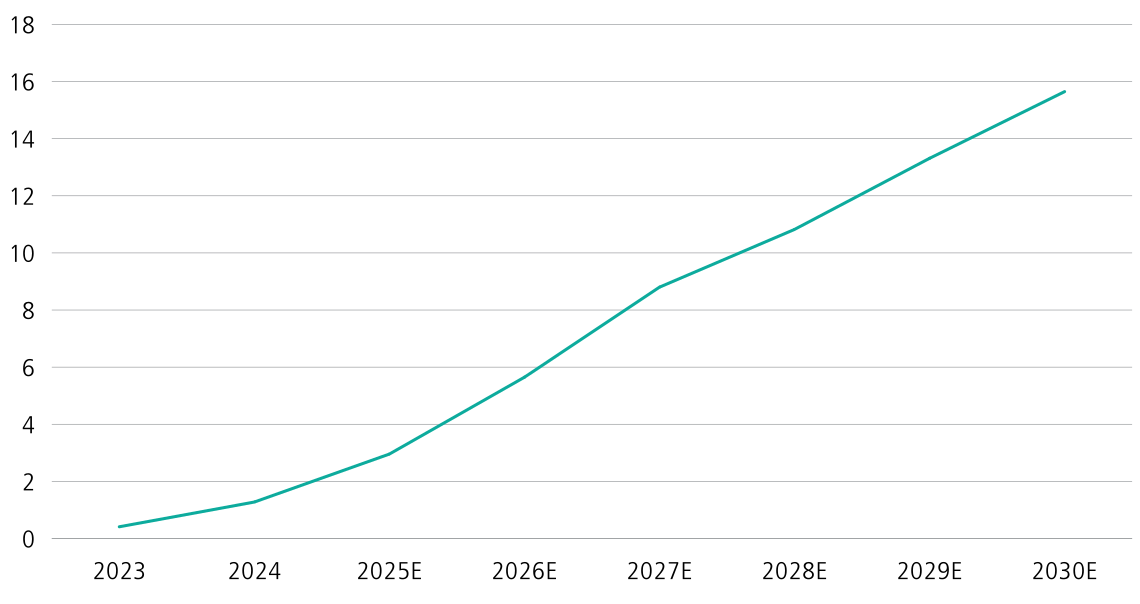
Source: Goldman Sachs as of December 8, 2025.
Reformulation as a Credit Differentiator
The food sector response to GLP-1 adoption is well documented in broad strokes: Users reduce caloric intake by an estimated 16 – 39%, and companies are responding with higher-protein, smaller-portion and more nutrient-dense products. What is less discussed is the credit dimension of that response. Reformulation at scale is capital-intensive. It requires R&D investment, supply chain reconfiguration and extended timelines before incremental revenue materializes. Food issuers with strong balance sheets can better absorb that cost structure. Overleveraged credits, however, particularly those in the snack and processed food categories most exposed to GLP-1-driven volume pressure, are expected to face a more difficult path.
The result is a credit differentiator hiding inside what looks like a uniform industry trend. Two issuers can face the same behavioral headwind, but only one has the financial flexibility to respond to it in a way that protects long-term cash flows. In this environment, credit investors should focus on credits with meaningful protein and less-processed food category exposure; and we scrutinize closely those whose volume projections assume stable consumption behavior in categories that GLP-1 adoption is quietly eroding.
Apparel and Beauty: Which Credits Capture the Upside?
Real apparel expenditure outperformed total consumer spending by approximately 400 basis points per month on average in 2025, a trend our analysis attributes in part to GLP-1-driven wardrobe replacement.2 The credit selection question, however, is more granular than the trend itself. The 400bps outperformance figure is an aggregate; it does not distribute evenly across the issuer landscape. Strong brands with pricing power and loyal customer bases are more likely to capture GLP-1-driven wardrobe replacement spending. In beauty, the GLP-1-adjacent opportunity (skin care, nutritional supplementation, body contouring) concentrates among a number of issuers with the brand equity and distribution scale to address it credibly.
The Behavioral Wild Card, a Long-Horizon Risk Worth Monitoring
Perhaps the most structurally novel risk in the GLP-1 story is the one furthest from consensus: Emerging research from Stanford suggests that, compared to non-users, GLP-1 users show a 40% reduction in opioid cravings, as well as 40 – 50% reductions in opioid overdose and alcohol intoxication rates. Researchers are now investigating whether the same neurological mechanism, a dampening of dopamine-driven reward behavior, may also reduce compulsive and impulse purchasing.
This is early-stage research and should be treated as such. There is no spending data yet that confirms a GLP-1 effect on retail purchase behavior at scale. We are not drawing a conclusion here; we are flagging an open question that credit investors in consumer-facing categories should be monitoring. If the behavioral effect proves durable and generalizable, it has implications for categories built on habitual or emotional purchasing. Some of the debt carried by issuers in those categories is underwritten against volume assumptions that implicitly assume stable consumption psychology. That assumption is worth examining.
Diageo has already acknowledged modest moderation in drinking behavior as a GLP-1 headwind.3 That acknowledgment, by one of the largest and most analytically resourced players in the spirits industry, is a signal worth taking seriously—even if the magnitude of the effect remains unclear.
A Framework, Not a One-Time Call
The most important thing we can say about GLP-1s and consumer credit is not a specific trade recommendation. It is a methodological point: GLP-1 adoption should be treated as an ongoing stress test applied to consumer-facing credit exposures, not as a discrete event to be assessed once and filed away. Opportunities are available to identify issuers that are favorably positioned given their product portfolio, positioning in the market and balance sheet capacity/flexibility to reposition if needed.
The oral pill launch likely means the population of GLP-1 users will grow materially over the next several years. Adoption rates, real-world efficacy data and issuer-level responses are all evolving. A credit framework that evaluates issuers on their reformulation capacity, brand resilience, volume dependency and behavioral exposure to dopamine-driven purchasing (and updates that evaluation as adoption data improves) is, we believe, more durable than any point-in-time sector call.