



Multiple updates were made to Solvency II regulation throughout 2025. Based on the draft of proposed changes to Solvency II Delegated Acts, we highlight four that we believe hold the most significant implications for insurers’ investment strategies.
1.Easier Application of Long-Term Equity Investments
The European Commission (EC) committed to amend the Solvency II framework to promote insurance companies’ long-term investments without affecting financial stability and policyholder protection. In the draft Delegated Acts, published in July 2025, the EC updated requirements on insurance companies in treating part of their equity exposure as long-term equity investments (LTEI). In comparison to previous requirements, the application is much easier and clearer from an insurance company’s perspective.
Under the expected new regulation, insurance companies would be required to demonstrate their ability to avoid forced sales under two different methodologies:
Method 1: Methodologies to Avoid Forced Sales
For life insurance liabilities, the insurer must demonstrate that the liabilities they want to apply LTEI to should have longer than 10 years of modified duration and that mortality/lapse risk Solvency Capital Requirement (SCR) is less than 5% of Best Estimate Liabilities (BEL).
Out of all typical life insurance product lines, annuities and group life insurance policies are, in our view, the two lines of business where it is easiest to apply LTEI.
For non-life liabilities, the insurer would need to demonstrate that they have a liquidity buffer higher than 105%. It is calculated as follows:
Liquidity buffer = Vliquid assets / BELnet
The denominator refers to the best estimate of non-life technical provisions net of reinsurance.
The numerator corresponds to the value of the portfolio of liquid assets corresponding to non-life insurance activities. Haircuts are applied to both assets and reinsurance in this calculation.
Method 2: Forced Selling Test
Under this method, the insurer would be required to demonstrate that they are able to generate cash inflows that are higher than cash outflows over a five-year time horizon, both on an ongoing basis and under stressed conditions during each of the five-year testing periods.
For cash inflows, the test sets out measures to incorporate prudence in counting cash inflows for both ongoing and stressed conditions. Prudence measures include only allowing cashflows from certain asset classes of certain ratings and deriving reinvestment returns from a risk-free interest rate, allowing for volatility adjustments.
Under stressed conditions, cash outflows are increased by adding an additional outflow equal to the aggregation of capital requirements stemming from the specific risk modules that the insurer is exposed to. The calculation of this additional cash outflow differs between the first projection year and remaining projection years.
2.Lower Securitised Capital Charges
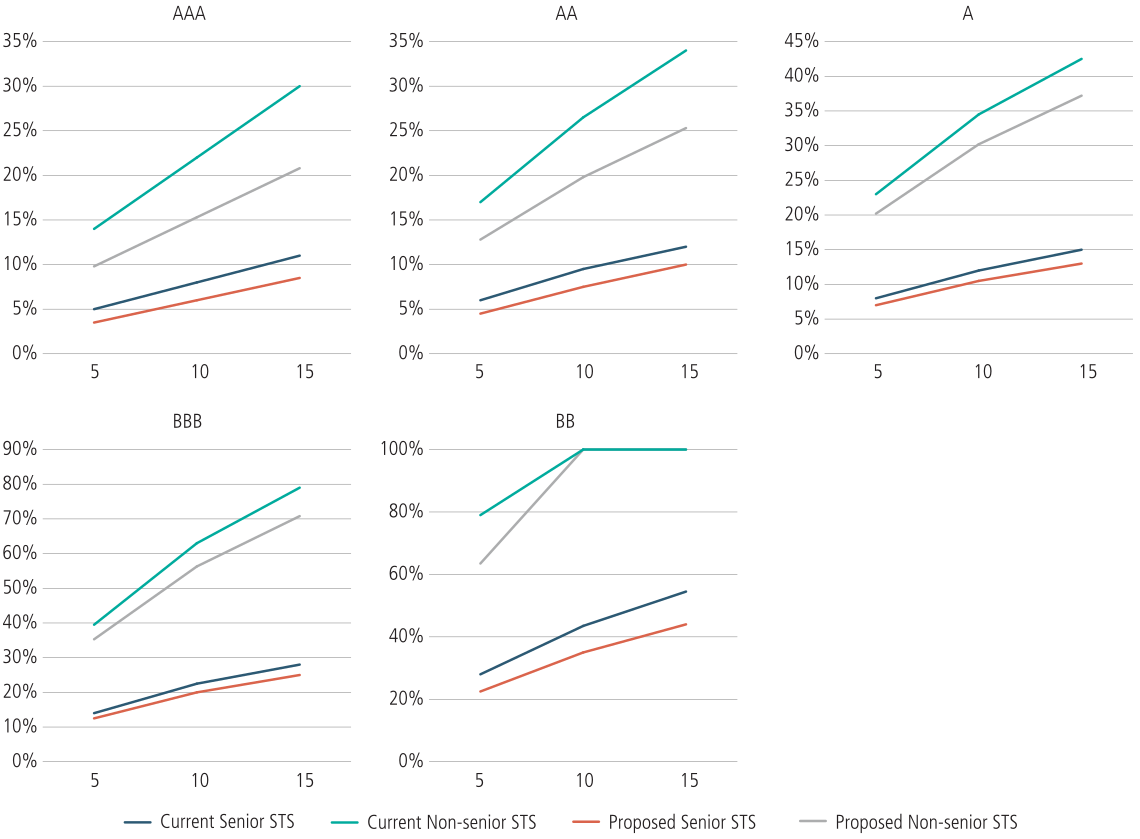
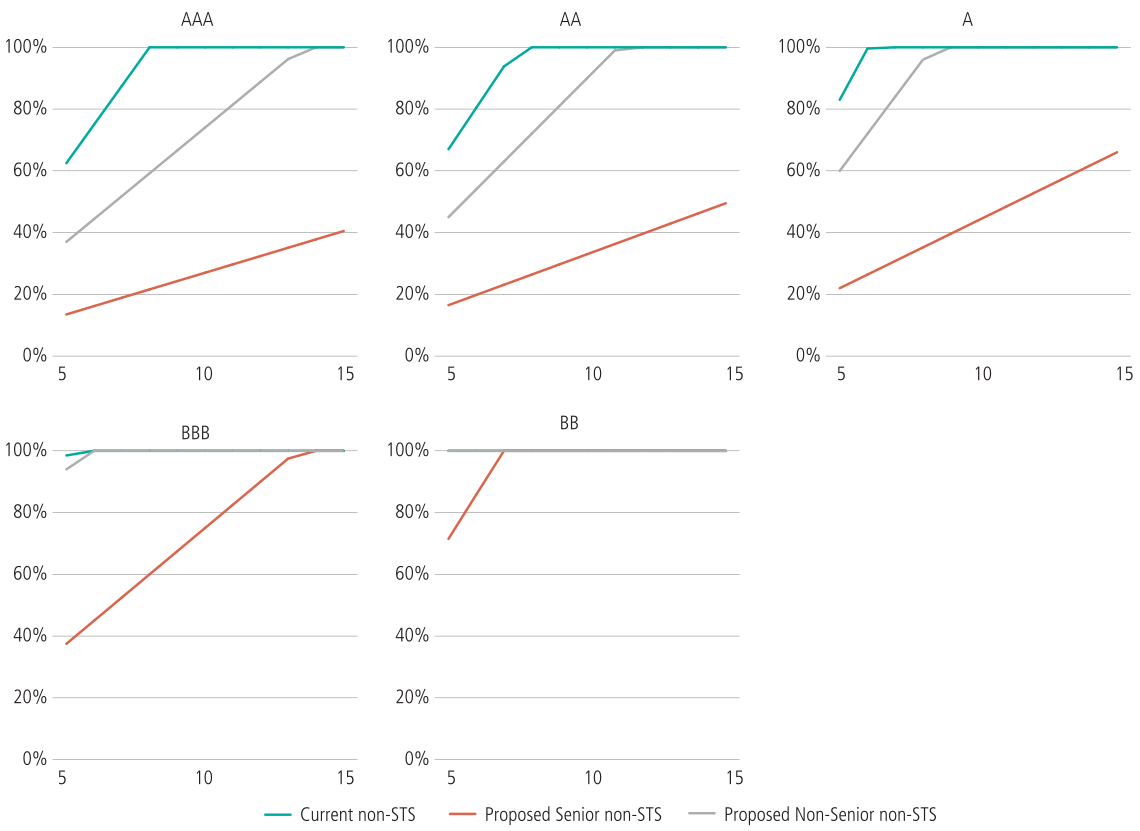
To simplify bank lending capacity by allowing originating credit institutions to transfer risk outside the banking sector (in line with the securitisation package presented on June 17, 2025), draft provisions of the Solvency II Delegated Acts reduce credit risk factors on simple, transparent and standardized (STS) and non STS securitisations.
For non-STS securitisations, a new set of lower risk factors is introduced for senior tranches, while the risk factors for non-senior tranches are better aligned with banking rules. For STS securitisations, the prudential treatment of senior tranches is aligned with that of covered bonds, and the treatment of non-senior tranches is adjusted by the same extent as senior tranches.
Under the draft, senior tranches of both STS and non-STS securitisations would see reduced spread risk charges for all ratings. The graphs below illustrate the change in Spread SCR.
Figure 1. Spread SCR comparison for STS
Source: EIOPA, SCR calculation is based on Neuberger’s interpretation of Solvency II
Figure 2. Spread SCR comparison for Non-STS
Source: EIOPA, SCR calculation is based on Neuberger’s interpretation of Solvency II
Collateralized loan obligations (CLOs) stand out as an asset class which looks more attractive under the planned updates, as we discussed in an earlier article published in late October last year. In addition, private asset-backed securities is another asset class of interest for insurers, as they look to harvest additional illiquidity and complexity premia.
3.Decreasing Liability Valuation Volatility
The updated Delegated Acts has introduced a few changes to both calculation and application of volatility adjustment (VA). Macroeconomic VA would be applied in replacement of country VA to avoid the “cliff-edge” effect of the current methodology. For example, macro VA is not triggered for Netherlands, but it is triggered for Italy. Macro VA would kick in if the risk corrected country spread is more than 30% higher than the risk corrected euro spread.
In addition, overall application ratio has increased from 65% to 85% and credit spread sensitivity ratio (CSSR) is introduced to allow for asset-liability management of the insurer. However, this is only assessed based on overall asset liability duration matching.
A country-specific adjustment was added to the macroeconomic VA calculation. The country-specific adjustment depends on the risk-corrected country spread multiplied by the percentage of investments in debt instruments relative to the total assets held by insurance companies in the specific country.
Both absolute and relative hurdles to trigger macroeconomic VA are lower than country VA. However, the actual macroeconomic VA would be lower than country VA when triggered. This update can help decrease liability valuation volatility.
4.New Factors to the Interest Rate Capital Charge
Under current rules, the standard formula of interest rate risk assumes that positive interest rates cannot become negative and that negative interest rates cannot decrease further by applying proportional shock factors to a risk-free rate, assuming no downward shocks to negative interest rates.
However, historical data shows that such assumptions may underestimate exposures to interest rate risk. The euro swap curve, for instance, was negative between 2019 and 2021. Therefore, the standard formula is amended to appropriately reflect the risk of low or negative interest rates.
The updated interest rate shock adds a fixed stressed factor in addition to a proportional shock factor to risk-free rates for both up and down stressed scenarios. Additionally for a downward shock, a term-dependent floor is introduced. Total shocks for both up and down stresses have increased based on current interest rate environment.
For insurers currently with a duration mismatch in their balance sheet, this will result in higher capital charge under Interest Risk SCR submodule. In light of this change, insurers should take the opportunity to review their asset-liability matching, adjust their asset allocation or use derivatives to close match their asset and liability sensitivities to interest rate.
U.K. Specific Change
Introduction of Matching Adjustment Investment Accelerator
We have seen many Matching Adjustment (MA) developments in the past few years under Solvency U.K. This is not surprising considering its importance in the U.K. life insurance space, particularly in the Bulk Purchase Annuity (“BPA”) market, as c.£1.4 trillion in defined benefit assets look to buy-in/out. Last year, we looked at the introduction of the highly predictable bucket under the MA framework.
In May 2025, the Prudential Regulation Authority (PRA) introduced the Matching Adjustment Investment Accelerator (MAIA) framework to enable faster, more capital-efficient deployment of assets by BPA participants. Firms already with MA approval can apply for MAIA permission that allows the MA firm to include a limited quantity of self-assessed MA-eligible assets in an MA portfolio without requiring PRA approval in advance.
Following investment in a new asset class, the BPA then has 24 months to submit an MA application for these new assets. The limit is set to be the lower of:
- 5% of the BEL of the MA portfolio (net of reinsurance); or
- an amount, proposed by the firm, which is no greater than £2 billion.
In October 2025, the PRA concluded on the consultation process and issued PS 17/25 on this topic. The regulator has also provided clarifications on reporting, reinsurance recapture into MA portfolio on MAIA assets and contingency plan for assets later deemed ineligible. There is no material structure change to the draft policy.
In terms of implementation timeline, the policy took effect on October 27, 2025. Firms are able to apply for an MAIA permission from this day onward. The PRA did not give an explicit timeline for MAIA approval process, but indicated that all MAIA applications will be reviewed “promptly”.
Find out more about our Insurance Solutions.