



- Insurers in Europe and the U.S. are increasingly allocating to residential real estate debt, tapping distinct and evolving opportunities in each market.
- In Europe, the focus is on investing in residential mortgage financing, offering stable long-duration income, diversification, attractive spreads, and favorable Solvency II treatment; in the U.S., the emphasis is on directly providing residential mortgage loans.
- Across both regions, residential real estate debt is emerging as a strategic portfolio pillar, aligning with insurers’ liabilities while delivering income, diversification, and capital efficiency.
European insurance companies have traditionally invested in commercial real estate debt and equity, but have more recently been increasingly investing in residential real estate debt, the main component of which is mortgages.
There are several reasons why we are seeing this, including the asset class offering stable, long-term income streams, diversification benefits, and favorable regulatory capital treatment under Solvency II. In addition, residential debt tends to have low historical default rates and trades at attractive spreads.
So far, insurers have mostly invested in the asset class via covered bonds, publicly traded securities secured by a cover pool of mortgage loans or public sector debt to which investors have a preferential claim in the event of default.
More recently, however, we have also seen a trend for investing in securitised bonds backed by Dutch prime mortgages (given their strong legal protection) and other local mortgages. In total, there was about €120 billion of European residential mortgage-backed securities (RMBS) issuance in 2025, a volume we broadly expect to see again this year.
Looking ahead, such supply will play an important role in further supporting the demand side trend for residential real estate debt through 2026.
Insurers clearly need access to long-duration assets; a need partly met by increased residential securitisation issuance from banks as they continue to seek balance sheet relief under Basel IV. In addition, the reasonable yield pick-up the asset class offers in contrast to government bonds and advantageous treatment under Solvency II should continue to boost insurers’ interest, potentially further expanding overall portfolio allocations to residential real estate debt this year.
Importantly, residential mortgages can be treated in two ways under Solvency II:
1) Using Spread Risk in a Market Risk Module1:
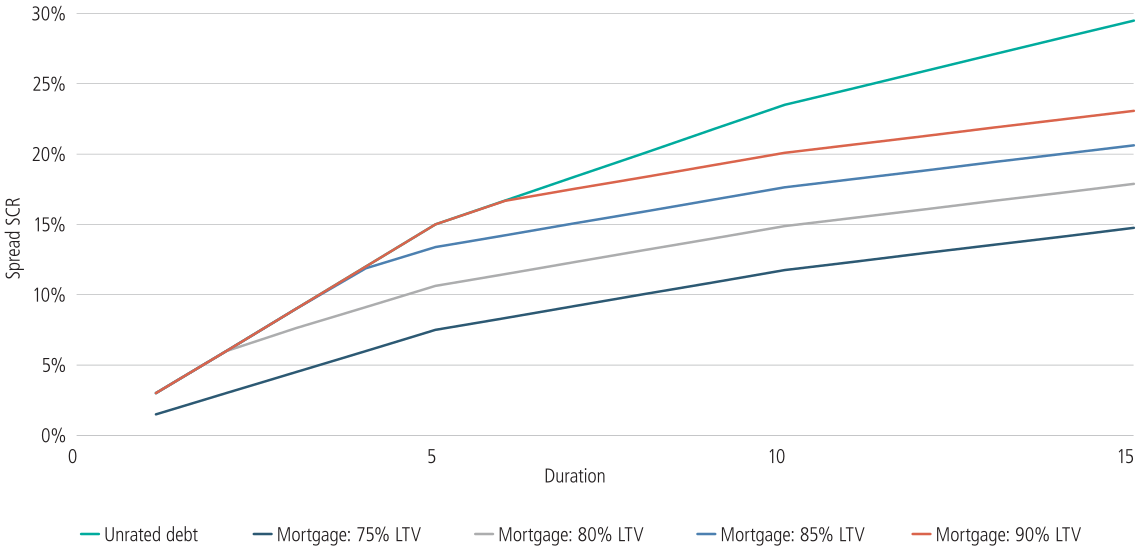
- Unrated debt, like any other loan: the Solvency Capital Requirement (SCR) becomes larger with duration (see figure 1.)
- A reasonable loan-to-value (LTV) can also lower the SCR
Figure 1. Spread SCR with various LTV
Source: EIOPA, SCR calculation is based on Neuberger’s interpretation of Solvency II
2) Using the type II Counterparty Risk Module2:
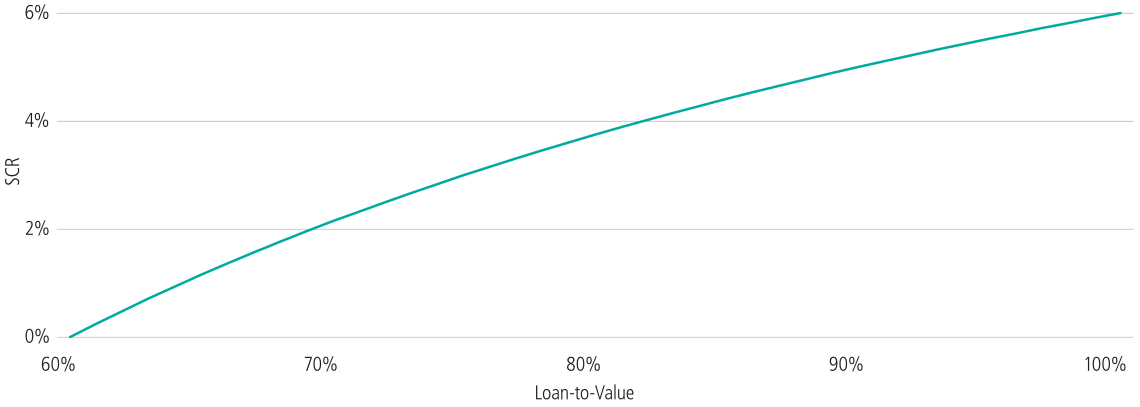
- This approach moves away from the Market Risk Module (and its associated volatility) and focuses on the default risk of the borrower. It is based on Probability of Default and Loss Given Default (see figure 2)
- The approach also includes specific requirements regarding the nature of the borrower, size of the loan, type of loan (owner occupied), etc.
Figure 2. Mortgage Loans Counterparty Default Risk SCR
Source: EIOPA, SCR calculation is based on Neuberger’s interpretation of Solvency II
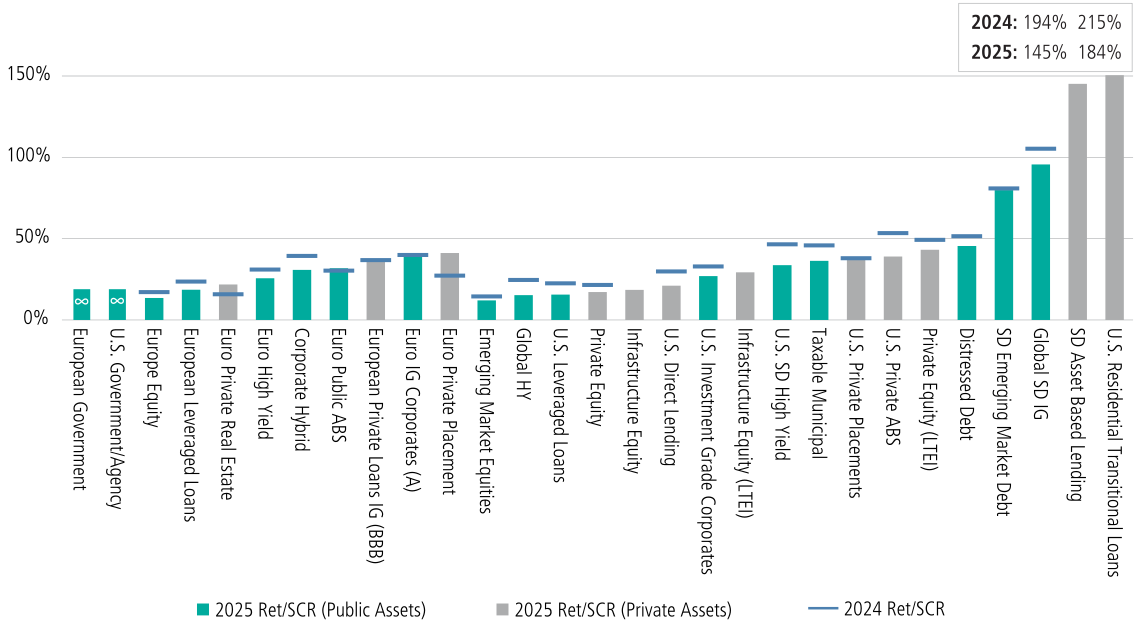
As a result of these beneficial treatments, short-dated residential mortgage loans (specifically residential transitional loans) are probably one of the most efficient asset classes when it comes to Return on SCR (see figure 3).
Figure 3. Residential Transitional Loans Look Attractive
Source: Neuberger, Bloomberg-Barclays, J.P. Morgan, Morningstar LSTA, FTSE Nareit, NCREIF, Burgiss, infraMetrics. Analytics as of June 30, 2025. The performance and risk projections/estimates are hypothetical in nature and reflect the Neuberger Berman’s Capital Market Assumptions. The estimates do not reflect actual investment results and are not guarantees of future results. Actual returns and volatility may vary significantly. Asset classes are represented by benchmarks and do not represent any Neuberger Berman investment product or service Investing entails risks, including possible loss of principal.
Opportunities in the U.S.
While the opportunity in Europe to invest in residential real estate debt is mostly contained within standard mortgage financing, the opportunity in the U.S. is different, largely owing to the state of the market.
The U.S. is facing a housing crisis; the construction of new homes has failed to keep pace with demand, particularly in high-growth cities. This has been further exacerbated by a mix of regulatory failures such as burdensome permitting processes, outdated zoning regulations, as well as other issues including increased construction costs and continued bank disintermediation.
As a result, home values have nearly doubled over the last decade, far outpacing income growth, making homeownership unaffordable for millions of Americans. Recently high mortgage rates have also created a lock-in effect, where homeowners with low-interest mortgages are reluctant to sell, further limiting housing supply.
Addressing the near five-million-unit housing gap requires a multipronged approach focusing on the construction of new dwellings as well as the reactivation of older housing stock through renovations, both of which have capital requirements.
Traditional finance providers do not have the infrastructure or the expertise to serve the requirements of this market, which creates an opportunity for experienced private debt finance providers to address the strong demand for short duration construction and renovations loans.
Insurers can, in our view, step-in to fill the void, locking in opportunities to deploy debt capital into high-quality assets where they can earn an illiquidity premium. This pairing can be clearly seen to be taking hold in the statutory filings of U.S. life insurers. Since 2021, residential mortgage holdings of these insurers have been doubling every two years, making residential mortgage whole loans the fastest-growing allocation in the industry.
Indeed, in recent years, U.S. life insurers have made greater net investment into residential mortgages than commercial mortgages. Even within the mortgages that are categorized as commercial, an increasing share is classed as multifamily.
This rapid growth in residential mortgage loans has happened despite cumbersome structuring requirements to fit residential mortgages into the appropriate regulatory capital bucket, but recent updates from the National Association of Insurance Commissioners (NAIC) suggest that the reporting and structuring will be simplified in 2026. This should facilitate continued growth in U.S. insurers’ deployments into residential mortgage whole loans
A Strategic Allocation
In our view, residential real estate debt is becoming a core solution for insurers seeking long-duration, resilient income with prudent capital efficiency.
In Europe, robust covered bond markets and sustained RMBS issuance—supported by Basel IV balance sheet dynamics—should continue to provide scalable access to high-quality mortgage collateral, reinforcing diversification and attractive spread profiles under Solvency II.
In the U.S., the structural housing shortfall is catalyzing a durable private credit opportunity in short duration construction and renovation lending, where experienced lenders can capture illiquidity premia against strong asset backing. Importantly, the regulatory setting is also supportive in both markets: SCR treatment in Europe and NAIC streamlining in the U.S. are aligning with insurers’ liability needs and risk frameworks.
Taken together, these developments suggest that 2026 could mark an inflection point—where residential debt transitions from a side allocation to a strategic pillar within insurers’ portfolios, delivering income, diversification and capital efficiency.
Find out more about our Insurance Solutions.