
Emerging Markets Equity
A globally diversified contrarian strategy that pursues long-term capital growth by searching for out-of-favor opportunities across countries, sectors and market cap
- Benchmark Agnostic Unconstrained Investment Style
Absolute return focus for both risk and return - Stock Selection in the Lowest Valuation Quintile
Selectively target overlooked areas of the investment universe (bottom 20% of our valuation) - “Five-buckets” Approach to Portfolio Construction
Allocate investment opportunities diversified across Fallen Angel, Cyclical, Special Situations, Structural Challenges, Hidden Growth - Risk management
Dual portfolio manager ownership of oversight of an extensive risk checklist




Key Risks
Market Risk: The risk of a change in the value of a position as a result of underlying market factors, including among other things, the overall performance of companies and the market perception of the global economy.
Liquidity Risk: The risk that the portfolio may be unable to sell an investment readily at its fair market value.
Emerging Markets Risk: Emerging markets are likely to bear higher risk due to a possible lack of adequate financial, legal, social, political and economic structures, protection and stability as well as uncertain tax positions which may lead to lower liquidity. The value of a portfolio may experience medium to high volatility due to lower liquidity and the availability of reliable information, as well as due to the strategy's investment policies or portfolio management techniques.
Stock Connect Risk: The Shanghai/Shengzen-Hong Kong Stock Connect are relatively new trading programmes, where many of the relevant regulations are untested and subject to change at any moment as well as not as active as exchanges in more developed markets which may affect the ability to trade.
Counterparty Risk: The risk that the portfolio may be unable to sell an investment readily at its fair market value.
Operational Risk: The risk of direct or indirect loss resulting from inadequate or failed processes, people and systems including those relating to the safekeeping of assets or from external events.
Currency Risk: Investments in a currency other than the base currency of the portfolio are exposed to currency risk. Fluctuations in exchange rates may affect the return on investment. If the currency of the portfolio is different from your local currency, then you should be aware that due to exchange rate fluctuations the performance may increase or decrease if converted into your local currency.
Overview
Investment Philosophy
- Macro-aware not Macro-led
- Follows a contrarian approach to investing
- No outsourcing of risk responsibilities
- Emerging Markets offer a variety of opportunities and carry elevated risk
- Pursues alpha on position initiation, scaling and exit
Investment Process
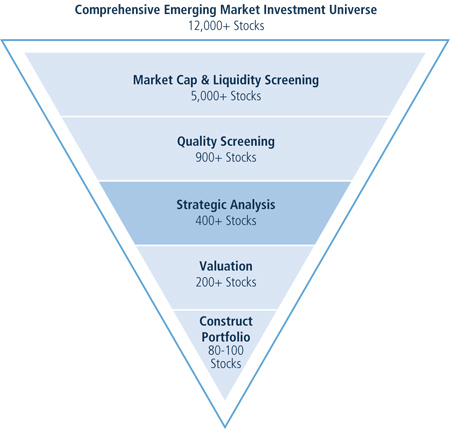
Investable Universe
- Companies with market capitalization greater than $500mn and minimum average daily volume of $1.4mn
Value Analysis
- Primary Valuation Metric: 10yr CAPE
- Secondary Valuation Metrics: EV/NOPAT, Dividend Yield, Free Cash Flow Yield, Price/Book
Financial Modeling and Research Template
- Preference for 10 years of financial history
- Automated data capture tools
- Identify factors we have found exhibiting a historical correlation to value traps
- Seven-question checklist, systematic red flag check
Investment Cases Diversified Across “Favors”
- Build a portfolio that consists of investment cases across different flavors of value, including: Fallen Angels, Cyclicals, Special Situations, Structural Challenges, Hidden Growth
Additional Diversification and Risk Scores
- Mix of region/country, sector, value type designed to add extra layer of portfolio diversification (in addition to situations mix)
- Each stock is given a risk score to evaluate risk profile, which can range from financial health to macro challenges
- Security-level “Required Upside” determined in order to hold shares and incur risks defined by risk score
Portfolio Construction
- 30-70 stocks
- Weighting decisions informed by risk score, from 1.2% to 4.5%
- Seek five to eight high-risk/ high-return holdings at the lower end (1.2% weight)
- Macro support designed to ensure bottom-up models reflect regional risk
Management

Vera German

Juan Torres
Related News & Insights

Can India Keep Up the Pace?
- Perspectives on the India success story and where it can go from here.

Emerging Markets Equity: Active Opportunities, Beyond Benchmarks and ETFs
- Active management of emerging markets equity portfolios has the potential to offer demonstrable advantages over ETF investing in terms of performance and long-term strategic positioning, among other consideratons.

Disruption Outlook: Trade War & Tariffs
- (20:57) In emerging markets, it is critical for investors to separate signals from the noise as uncertainty around trade policy continues.