



We believe emerging markets appear well positioned to benefit from the artificial intelligence trend—at least in the near term. The reason? The ongoing, massive buildout of AI data centers and related infrastructure will likely require extensive natural resources that can be provided by emerging market economies. Within the debt markets, this could support both local currency-denominated debt and hard currency commodity issuers over the next 12 to 18 months.
However, the subsequent phase—out another five to 10 years—could prove more challenging, as AI productivity gains are likely to be realized in service sectors rather than the manufacturing that largely dominates emerging markets. Factors including limited research and development (R&D), and issues around infrastructure and AI private investment could pose a challenge in exploiting the full potential of AI.
Near-Term Tailwinds…
For now, we see clear benefits from AI to many major emerging market economies, mainly due to the commodity intensity of the technology. Rising demand for AI hardware (data centers, chips, sensors) could boost consumption of copper (power, cabling), aluminum (enclosures, cooling), nickel and cobalt (battery chemistries for backup/storage), silver and gold (high-end electronics), and rare earths (magnets for cooling fans and precision motors). Countries that supply these materials are likely to see increased foreign direct investment, and many of these are in emerging market hard and local currency indices. In particular, metal-rich creditors (Chile, Peru, Indonesia, South Africa, Zambia, Kazakhstan) are already experiencing terms-of-trade tailwinds—and this could continue, tightening their credit spreads and supporting their currencies during future AI hardware up-cycles.
Given that AI data centers are power-intensive, incremental electricity demand could potentially lift natural gas, liquid natural gas (LNG) and coal prices for markets with thermal-heavy grids, while accelerating investment in renewables and grid upgrades. Gas-exporting markets (Qatar, Nigeria, Mozambique) may see stronger LNG demand; power-importing markets could face price pressures and grid reliability issues if investments lag; and grid upgrades tend to benefit copper.
Manufacturing hubs in emerging markets are also poised to benefit from capital expenditures related to data center and electricity grid upgrades. By some estimates, data center investments could use up 50% of imported components.[1] The current data center investment boom relies heavily on the imports of graphics processing units (GPUs), computers, parts and other electronic equipment from countries including Taiwan, Mexico, Vietnam, South Korea and Maylasia, with these imports rising rapidly and showing no signs of abating.
Despite the claimed incentives for reshoring from U.S. tariff policy, computers and computer parts represent the largest exemption from tariffs. This exemption paves the way for increased imports of these critical components, particularly from emerging markets. While the electrical grid equipment imports are tariffed, electricity price increases and increased demand may also potentially lead to moderation of their tariffs in the near future to reduce bottlenecks.
On the other hand, rising global demand for electrical grid equipment may also potentially increase prices, and make these investments less affordable for emerging markets. Energy importers with weak grids (mostly in frontier countries such as Pakistan, Bangladesh and Egypt) face the risk of electricity price spikes and reliability issues if demand outpaces investment.
Standout Beneficiaries From Potential Commodity Demand
Top EM Net Exporters by Commodity (Ranked by Net Exports as % of GDP, 2024)
| Gold | Silver | Copper | Oil & Gas | ||||
| Suriname | 22.8 | Bolivia | 0.3 | Zambia | 30.0 | Iraq | 45.5 |
| Ghana | 13.7 | Kazakhstan | 0.2 | Chile | 6.0 | Oman | 43.1 |
| Uzbekistan | 6.1 | Mexico | 0.1 | Kazakhstan | 1.3 | Angola | 33.6 |
| Peru | 4.3 | Poland | 0.1 | Serbia | 1.2 | Azerbaijan | 29.0 |
| Mongolia | 3.8 | Peru | 0.1 | Peru | 1.2 | Gabon | 25.6 |
Source: JPMorgan, ITC Trademap. Based on FY 2024 data.
…Longer-Term Headwinds?
Further down the road, we believe that AI is more likely to support developed markets growth than emerging markets. This is evident in the Stanford HAI AI Vibrancy Index, which employs 42 indicators across eight categories (including research and development, “responsible” AI, economy, education, diversity, policy, public opinion and infrastructure) to compare the AI ecosystems of 36 countries.
According to this index, the U.S. and China lead in AI progress, far surpassing other advanced economies like the EU, Japan and the U.K., but they also outrank some emerging markets including South Korea, the UAE and Singapore. However, India ranks fourth on the overall list due to its strong research, large talent pool and rapidly expanding AI sector.
For most emerging markets outside of China and India, the “Talent” category, which includes metrics such as AI skill penetration and AI jobs postings, is the largest contributor to the AI Vibrancy score. Other factors are relatively low for emerging markets, including R&D (i.e., AI patents, academic publications), Infrastructure (internet speed, computing capacity, semiconductor exports) and Economy (total AI private investment and newly funded AI companies). It is hard to see such factors turning around quickly without a meaningful increase in investment.
The U.S. and China Stand Apart in AI Development
Stanford HAI Global AI Vibrancy Rankings (2024)
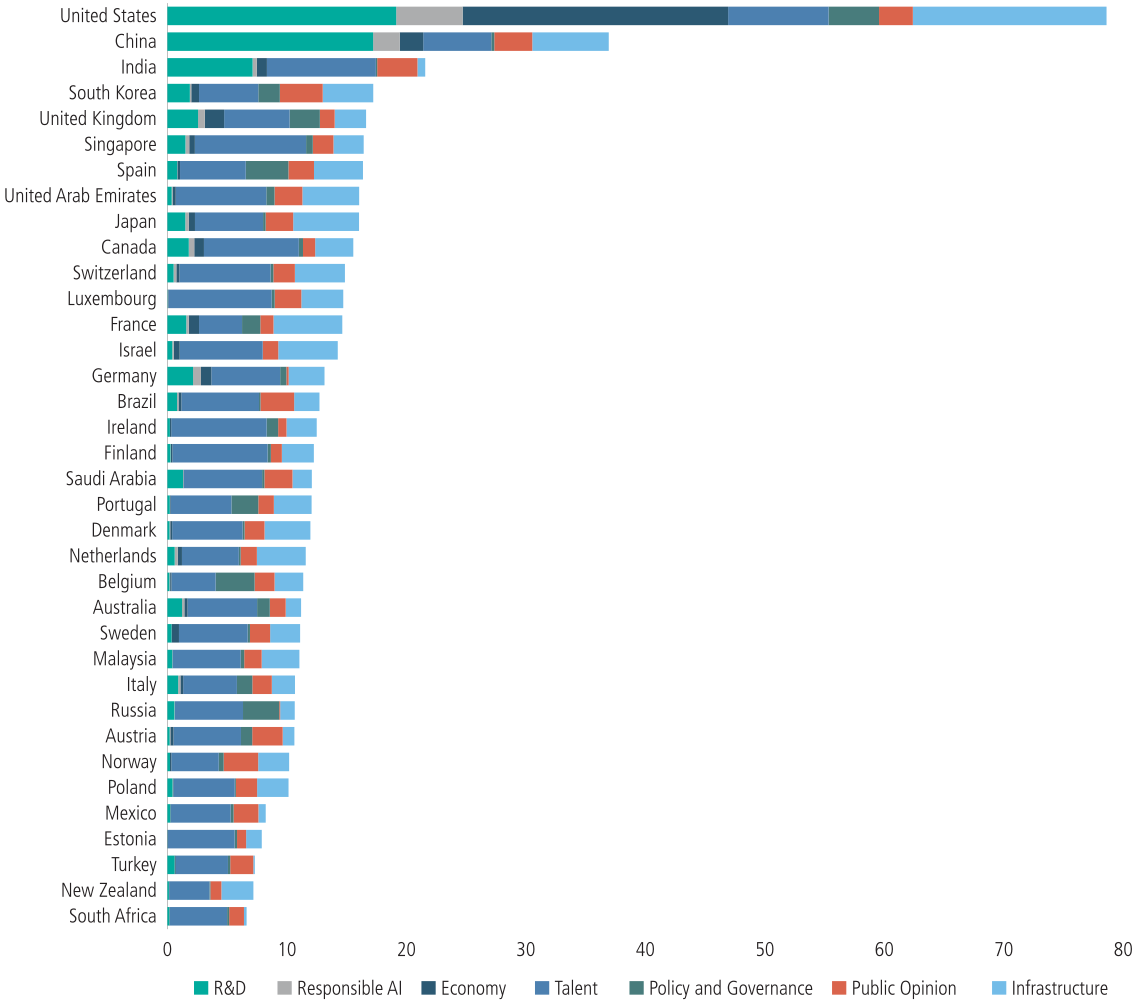
Source: Stamford University, 2024 (https://hai.stanford.edu/ai-index/global-vibrancy-tool). The Stanford HAI AI Vibrancy Index employs 42 indicators across eight categories (including research and development, “responsible” AI, economy, education, diversity, policy, public opinion and infrastructure) to compare the AI ecosystems of 36 countries.
Among countries in the EMBI and GBI Emerging Market,2 only China, India and some higher-income emerging countries such as UAE, South Korea, Singapore and Israel are ahead in the rankings, while higher-yielding markets only show up at the lower end, with significant dispersion relative to the front-runners.
Similarly, a recent International Monetary Fund (IMF) research paper3 found that AI-driven productivity could boost global GDP by up to 4% over the next 10 years, but that developed economies might see gains that double those of low-income nations. For example, U.S. output could rise by 5.4%, the EU by 4.4%, Latin America by 3.2% and Asia (excluding China) by 3%. China’s improvement in productivity due to AI is projected to grow 3.5% over the next 10 years. Underlying this research is the assumption that AI productivity gains are to be realized mostly in service sectors rather than the manufacturing that largely dominates emerging markets.
Investment Takeaways
The direct providers of artificial intelligence tools are primarily found within the corporate debt universe. At the moment, these entities currently represent only around 10% of the emerging corporates index as measured by the technology, media and telecommunications (TMT) sector, though we believe their market share will grow over time. In our view, sectors such as industrials, and metals and mining, are likely to benefit most from the AI infrastructure buildup.
Overall, we believe sovereign bonds stand to gain from AI through improved terms of trade, which can be monitored using traditional macroeconomic analysis. At present, AI considerations are being incorporated into our assessments indirectly, particularly as they influence the terms of trade for commodity exporters, weighed alongside factors such as debt-to-GDP ratios, fiscal budgets, market positioning and valuation metrics. Notably, we see value in countries like South Africa, Chile, Mexico and Brazil, where local yields remain attractive relative to expected inflation and central banks still have room to cut rates. Furthermore, if the global AI-driven investment cycle, along with easy global financial conditions tied to an easing Fed, results in a weaker U.S. dollar, this environment potentially favors both local and hard currency debt—but local more so. While hard currency spreads are at historically low levels, we believe local currency markets still offer appealing currency and rate valuations.
Conclusion: Variation in Adoption and Impact Over Time
While the initial investment cycle is largely a developed market phenomenon, the knock-on effects of AI-related investments and activities have the potential to benefit emerging markets via their supplier role in energy, metals and mining. Over time, the results could be more ambiguous, given the emphasis in developing economies on manufacturing rather than services, as well as the presence of bottlenecks in infrastructure, R&D and private AI investment; and while the talent factor is present in emerging markets, it is uncertain whether that talent pool can be exploited efficiently. Overall, there may be a significant dispersion of impacts over time, as countries adopt AI to varying degrees. We will be looking closely at the effects of AI on overall valuations and prospects as the technology gains adherence across the globe.
To read our series of insights related to this topic, How AI Is Reshaping Credit Markets, please click here.