
In Short
- S&P 500 eked out a seventh straight monthly gain (+0.2% in November; +17.8% year-to-date), with breadth improving as the equal-weighted index outperformed.
- Early signs of strong holiday shopping were muddied by underlying consumer trends and weaker sentiment, but we remain optimistic in the medium term.
- For remainder of the year, the focus will likely be on the December Federal Reserve meeting; consider year-end rebalancing following a strong year for asset classes.
The Month in Markets
Investors may give thanks for the month-end rally that allowed the S&P 500 to narrowly capture its seventh-straight month of gains, up 0.2% in November and up 17.8% year-to-date. For reference, the index was down 5% at one point during the month, which marked the end of what was an exceptionally resilient equity rally with only a few shallow pullbacks (of less than 3%) since April.
The negative price action in early November reflected a more “risk-off” mood and can be linked to general economic uncertainty, in part related to a lack of U.S. government data, more-hawkish-than-expected Fed sentiment during the prior meeting, and some cooling of artificial intelligence-related optimism. This caused market leadership to shift from growth and momentum-driven assets (which have driven market returns for the last few years) into more defensive pockets of the market, boosting the quality factor over momentum to its highest relative level since the tariff-induced shocks in March and early April. For stocks, this meant strength in sectors such as health care, but at the broader asset class level, fixed income and commodities held up well in November.
U.S. Quality vs. Momentum Factors Relative Performance – Monthly Spread & 12M Rolling Spread
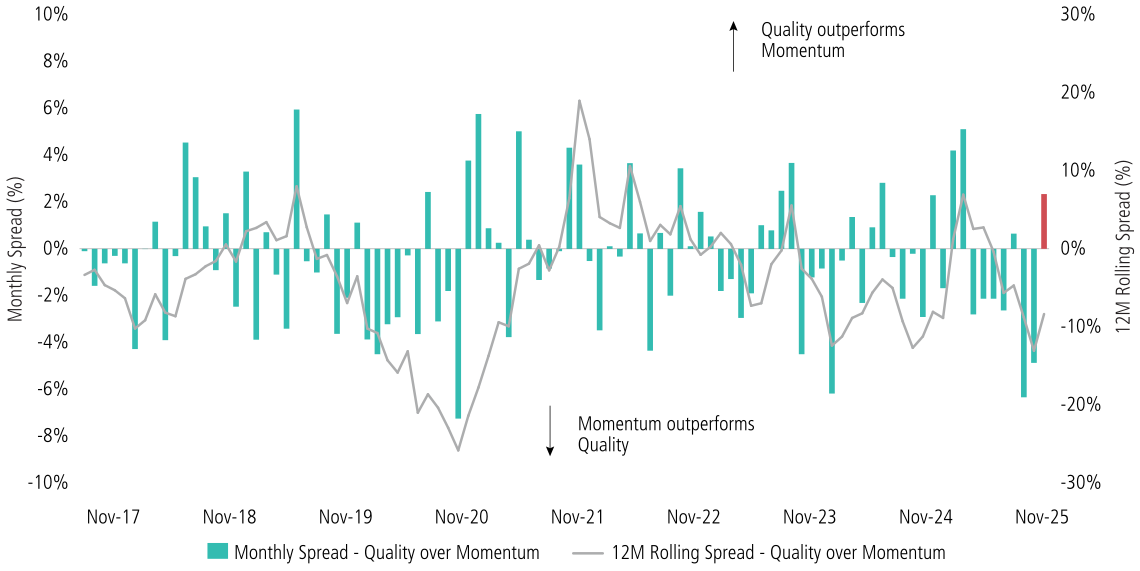
Source: Bloomberg, as of November 30, 2025. Quality and Momentum factors are defined by Bloomberg’s “Factors to Watch” methodology. These are represented as Long-Only baskets in this illustration.
The losses were then erased by the end of the month, apart from the technology-focused Nasdaq Composite, which ended with a loss of 1.4%, though down as much as 7% at one point during the month. The reversal in sentiment was largely tied to renewed hopes for a Federal Reserve rate cut in December, with a now roughly 80% chance of a quarter-point cut; in the depths of the pullback, the odds were below 25%. The S&P 500 rallied 3.7% during Thanksgiving week, marking its best performance during the shortened trading week since 2008, driven primarily by the Magnificent 71 stocks, apart from Nvidia, which was the biggest detractor from the index. Notably, though the top stocks in the index rallied, the equal-weighted index slightly outperformed the market-weighted index, showing some broadened strength within the S&P 500. In fact, November was the first month of the year in which the 10 largest stocks in the index detracted from total returns, while the bottom 490 propelled it into positive territory.
S&P 500 Monthly Returns Decomposition – Top 10 Largest Stock vs. Bottom 490

Source: Bloomberg, as of November 30, 2025
Still, there is little doubt that the Fed is in a tricky position coming into its December 10 meeting. The belatedly released September U.S. nonfarm payrolls report, with cumulative revisions of -33,000, coupled with an upward tick in jobless claims, has signaled that hiring is slowing, and the Fed is loath to sit idle and watch low hiring become fast firing. It is important to note that this is the last official jobs data the Fed will receive before the meeting, as a combined October and November payrolls report is slated to drop on December 16.
Tale of Two Consumers
Meanwhile, inflation appears to be on a downward trajectory, particularly given recent downward pressure in housing prices. However, the picture is less clear with the Fed’s preferred metric, Personal Consumption Expenditure (PCE), delayed due to the government shutdown. Though September’s Consumer Price Index (CPI) proved lighter than expected, investors won’t get a glimpse of fresher figures until later in December. Inflation concerns are the other part of the Fed’s dual mandate, and it is part of the reason why the “K-shaped economy” has been popularly referenced as of late.
Simply put, the upper part of the “K” refers to higher-income households seeing incomes and wealth rise while the lower part points to lower-income households struggling with weaker income gains. We’ve seen that inflation is still a meaningful concern, particularly for lower-income households. For example, in November, President Trump announced a decision to roll back tariffs on coffee, beef, bananas and orange juice to alleviate upward pressure on food prices. However, as Fed Chair Jerome Powell mentioned in the July Fed rate decision press conference, the impact of tariff action on inflation could take some time to translate.
We can look to businesses for insight into how the U.S. consumer is faring. The third-quarter earnings season showed continued strength, with S&P 500 reporting blended earnings growth of 13.4% as of November (over 97% of companies have reported). If this is the actual growth rate for the quarter, it will mark the fourth consecutive quarter of double-digit earnings growth for the index. Two big-box retailers illustrating some divergence in consumer behavior were Walmart and Target. Walmart, known as a discounted retailer, raised its sales outlook for the year and commented on an influx in business from higher-income households. Meanwhile, Target lowered its sales outlook and cited softness in demand on some discretionary items.
Consumer sentiment has stumbled recently. The University of Michigan’s consumer sentiment index came in below forecasts to a near-record low of 50.3, down 30% from a year ago. November consumer confidence dropped to 88.7, at its lowest level since April. Meanwhile, early data for Black Friday showed consumers shopping at encouraging levels, although underlying spending patterns are painting a muddier picture. While these aren’t the only datapoints to consider, consumer spending accounts for about two-thirds of economic activity, and the holiday season is considered a barometer of how shoppers are faring in the current economic climate.
As 2025 nears its end and holiday season continues, investors may look to take some gains and rebalance portfolios to long-term targets. The S&P 500 is on track for a third consecutive year of double-digit returns, a phenomenon that has only occurred six times since 1939. As we look ahead to 2026, we remain confident in the medium-term outlook, supported by several factors, including the next phase of monetary easing, fiscal stimulus, ongoing economic resilience and inflation, which has proven broadly better than feared.
In our view, it is especially important now that investors ensure portfolios are diversified across multiple asset classes, providing a balance of exposures across public and private markets that blend attractive sources of risk-adjusted returns. While artificial intelligence still has room to run as a tailwind for technology stocks, investors should use year-end as an opportunity to rebalance risks and ensure diversification.
Portfolio Implications
Equities saw some dispersion, with value outperforming growth, small and midcaps outpacing large caps, and developed non-U.S. outpacing U.S. stocks. We maintain an overweight to small and midcaps on the expectation that these companies will continue to benefit from rate cuts, deregulation and pro-business policies. Developed non-U.S. equities should continue to benefit from the rotation as well, although there are opportunities to be more tactical on signs of economic divergence. Otherwise, we maintain an “at-target” view across equities. Admittedly, short-term political volatility may create some pressure. However, any larger pullbacks (10% or more) could be an appropriate trigger to add risk, especially for those holding excess cash. In this more challenging environment, we favor employing active management to select companies with high earnings visibility.
Fixed Income was higher and performed well during the month’s volatility. We remain constructive on investment-grade fixed income, but see opportunities to deploy cash tactically, adding and/or shortening duration based on the movement of rates. While geopolitical and tariff risks persist, we maintain that the worst-case scenarios seem less likely, and that outcomes should not significantly affect credit markets. Further expected cuts of U.S. policy rates by the Fed should continue to boost performance of U.S. fixed income, but the One Big Beautiful Bill Act has added some uncertainty, as investors may continue to demand higher term premiums to compensate for the risk of holding long-term government bonds at a time when large federal deficits are creating uncertainty about future economic stability. Multi-sector bond funds may be an appropriate vehicle to consider, given the levers a manager can opportunistically pull across sector, duration profile and region.
With a fading liquidity drought and a recent pickup in mergers and acquisitions and other deal activity, we believe significant opportunities still exist within Private Markets, as investors should expect new buyout activity and an unlocking of distributions. That said, liquidity and capital solutions providers will likely remain important to work through the substantial backlog of legacy investments. As a result, we continue to see compelling opportunities across secondaries, midlife co-investments and capital solutions. We are cautious on core private real estate, but this is offset by what we see as abundant market-dislocation opportunities in the value-add and opportunistic sectors and, particularly, real estate secondaries. Neuberger’s deep relationships and unique position within the private equity ecosystem have translated into record levels of deal flow across our platform.
Index Returns as of November 2025
| Nov-25 | 3M | YTD | |
|---|---|---|---|
| Equities | |||
| Major U.S. Indices | |||
| S&P 500 Index | 0.2% | 6.3% | 17.8% |
| Nasdaq Composite | -1.4% | 9.1% | 21.7% |
| Dow Jones | 0.5% | 5.1% | 13.9% |
| U.S. Size Indices | |||
| Large Cap | 0.2% | 6.0% | 17.4% |
| Mid Cap | 1.3% | 1.3% | 10.9% |
| Small Cap | 1.0% | 6.0% | 13.5% |
| All Cap | 0.3% | 6.0% | 17.2% |
| U.S. Style Indices | |||
| All Cap Growth | -1.7% | 6.9% | 18.8% |
| All Cap Value | 2.7% | 4.7% | 15.0% |
| Global Equity Indices | |||
| ACWI | 0.0% | 5.9% | 21.1% |
| ACWI ex US | 0.0% | 5.7% | 28.5% |
| DM Non-U.S. Equities | 0.6% | 3.8% | 28.0% |
| EM Equities | -2.4% | 9.0% | 30.4% |
| Portfolios | |||
| 50/50 Portfolio | 0.2% | 5.1% | 11.0% |
| Nov-25 | 3M | YTD | |
|---|---|---|---|
| Fixed Income Currencies & Commodities | |||
| Major U.S. Indices | |||
| Cash | 0.3% | 1.0% | 3.8% |
| U.S. Aggregate | 0.6% | 2.4% | 7.5% |
| Munis | 0.2% | 3.8% | 4.2% |
| U.S. Corporates | |||
| Investment Grade | 0.7% | 2.6% | 8.0% |
| High Yield | 0.7% | 1.8% | 8.1% |
| Short Duration (1.9 Yrs) | 0.5% | 1.1% | 5.0% |
| Long Duration (12.8 Yrs) | 0.5% | 4.5% | 8.1% |
| Global Fixed Income Indices | |||
| Global Aggregate | 0.2% | 0.6% | 7.9% |
| EMD Corporates | 0.3% | 1.6% | 8.2% |
| Commodities | |||
| Commodities | 3.2% | 8.5% | 16.1% |
| U.S. Treasury Yields | |||
| U.S. 10-Year Yield | -0.1% | -0.2% | -0.6% |
| U.S. 2-Year Yield | -0.1% | -0.1% | -0.8% |
| FX | |||
| U.S. Dollar | -0.3% | 1.7% | -8.3% |
Source: Bloomberg, Total returns as of November 30, 2025. S&P 500 Index is represented by S&P 500 Total Return Index. Nasdaq Composite NASDAQ-Composite Total Return Index. Dow Jones is represented by Dow Jones Industrial Average TR. Large Cap is represented by Russell 1000 Total Return Index. Mid Cap is represented by Russell Midcap Index Total Return. Small Cap is represented by Russell 2000 Total Return Index. All Cap is represented by Russell 3000 Total Return Index. Large Cap Growth is represented by Russell 1000 Growth Total Return. Large Cap Value is represented by Russell 1000 Value Index Total Return. Small Cap Growth is represented by Russell 2000 Growth Total Return. Small Cap Value is represented by Russell 2000 Value Total Return. ACWI is represented by MSCI ACWI Net Total Return USD Index. ACWI ex US is represented by MSCI ACWI ex USA Net Total Return USD Index. DM Non-U.S. Equities is represented by MSCI Daily TR Gross EAFE USD. EM Equities is represented by MSCI Daily TR Gross EM USD. Cash is represented by ICE BofA US 3-Month Treasury Bill Index. U.S. Aggregate is represented by Bloomberg US Agg Total Return Value Unhedged USD. Munis is represented by Bloomberg Municipal Bond Index Total Return Index Value Unhedged USD. Munis Short Duration is represented by Bloomberg Municipal Bond: Muni Short (1-5) Total Return Unhedged USD. Munis Intermediate Duration is represented by Bloomberg Municipal Bond: Muni Intermediate (5-10) TR Unhedged USD. Investment Grade is represented by Bloomberg US Corporate Total Return Value Unhedged USD. High Yield is represented by Bloomberg US High Yield BB/B 2% Issuer Cap Total Return Index Value Unhedged USD. Short Duration is represented by Bloomberg US Agg 1-3 Year Total Return Value Unhedged USD. Long Duration is represented by Bloomberg US Agg 10+ Year Total Return Value Unhedged USD. Global Aggregate is represented by Bloomberg Global-Aggregate Total Return Index Value Unhedged USD. EMD Corporates is represented by J.P. Morgan Corporate EMBI Diversified Composite Index Level. EMD Sovereigns – USD is represented by J.P. Morgan EMBI Global Diversified Composite. Commodities is represented by Bloomberg Commodity Index Total Return. Commodities ex Energy is represented by Bloomberg Ex-Energy Subindex Total Return. U.S. 10-Year Yield is represented by US Generic Govt 10 Yr.