



In August, President Donald Trump issued an executive order directing the Department of Labor and Securities and Exchange Commission to relieve regulatory burdens and litigation risks that impede the inclusion of alternative investments in defined contribution plans. The DOL was given 180 days to reexamine its guidance on ERISA fiduciary’s duties tied to alternatives.
The agency promptly rescinded Biden-era guidance to exercise heightened caution in the use of private equity, leaving in place the more friendly stance maintained by the first Trump administration in 2020. The latter essentially requires that plans use the same standards in private assets as they would for any other category. Now, the retirement community awaits policy details that may provide greater comfort in considering a range of assets, including cryptocurrency, real estate, private credit and private equity.
An Opportunity to Prepare
By our math, the new guidance is due by February 2026, but whether the lengthy government shutdown delays that release is anyone’s guess. That said, we believe that the current pause provides an opportunity for plan sponsors to prepare for the new regime, educating themselves about the private assets that may be available for inclusion.
Among the points to consider:
Deployment. How would the assets become part of the plan? Do you currently offer custom target-date funds that could incorporate it? Now may be a good time to speak with your glide path manager about how that process could work. If you use off-the-shelf TDFs, you should understand what the asset manager is planning to include, if anything. For managed accounts, determine if and how your managed account provider could include private assets.
Demographics. Think about the demographics of your plan. Do your employees tend to remain for the long haul, or do you have a more transitional workforce? This can have implications for the inclusion of private assets, where benefits come from pairing longer-term investments with participants who have longer investment timelines.
Access. When it comes to private investments, it is important to understand how investments are allocated across clients—not all allocation policies are the same. Look for a manager that allocates investments pro rata across all funds and client accounts.
Valuation. Most private assets are valued quarterly and will require a valuation methodology to strike a daily NAV. As a fiduciary, you need to fully understand how these methodologies were built, how they work and if there is a third-party valuation agent involved in the methodology to put at arm’s length from the manager.
Liquidity. You should understand the limitations of your potential private asset offerings with respect to liquidity for participant or plan sponsor activity. Participants are typically free to shift investment allocations on a regular basis; sponsors may be under more constraints where there are large redemptions due to corporate events. Private assets are inherently illiquid and, although they are offered in semi-liquid structures for DC plans, it is important to fully understand the liquidity rules.
Fees. Naturally, attention to expenses is an important part of DC plan management. Fees for private offerings tend to be higher and more complex, often at multiple levels—the vehicle/portfolio, the underlying fund, and, where applicable, the underlying investment—with some details only disclosed in supplemental materials or fine print. As a fiduciary, you need to understand how fees are calculated and what they include.
Communications. Now may be a good time to think about how you might approach participants regarding the addition of private assets to the plan. Education that meets the sophistication level of different employee cohorts may help smooth the way to acceptance.
Final Thoughts
In our view, increased openness to alternative assets could ultimately benefit many participants in seeking to achieve their long-term investment goals and help plan sponsors in executing their fiduciary obligations. That said, the addition of private investments to DC plans is not to be treated lightly; it requires a thorough understanding of the alternatives space and access to competent partners who can facilitate steps needed to effectively integrate them into a plan. (The Defined Contribution Alternatives Association has created a set of Principles for consideration and use of private market investments. Visit www.DCALTA.org for details.)
Preparing now should ultimately help make the process of adoption smoother and potentially generate better outcomes for all concerned.
Coming to a Decision on Alternatives
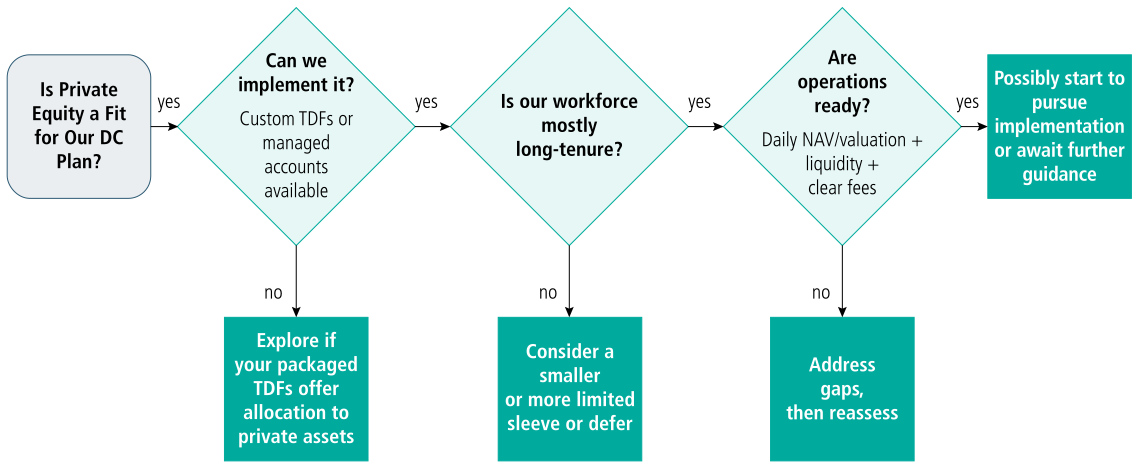
Source: Neuberger Berman. For illustrative purposes only.