
In Short
- Stocks and bonds alike rallied in August, driven by strong earnings and rate cut expectations. Small caps notably outperformed large-cap tech stocks by a wide margin.
- Political drama and concerns about U.S. economic data reliability added volatility, but government agencies remain credible. The main areas of focus right now are the labor force and inflation heading into the Federal Reserve’s September meeting.
- Diversification and a long-term focus are a recommended defense against seasonal, political and macro overhangs.
The Month in Markets
As August slipped away, the major indices climbed higher, once again reaching all-time highs. The S&P 500 had its best summer since 2020, posting its highest cumulative return from June through August, up +9%. Bonds moved higher, too, as yields came down and rate cut expectations mounted. Q2 earnings season for the S&P 500 drew to a close, with 98% of companies reporting earnings at a blended growth rate of +11.9% as of the end of August, boosting full year 2025 earnings growth expectations; 2026 expectations held steady. Meanwhile, the Magnificent 7 companies reported a blended earnings growth rate of +26.6%, with both the “Mag 7” and broader index handsomely beating expectations coming into the quarter (+13.9% and +4.8%, respectively).
S&P 500 Index Consensus Estimated Earnings Growth (YoY%) by Calendar Year
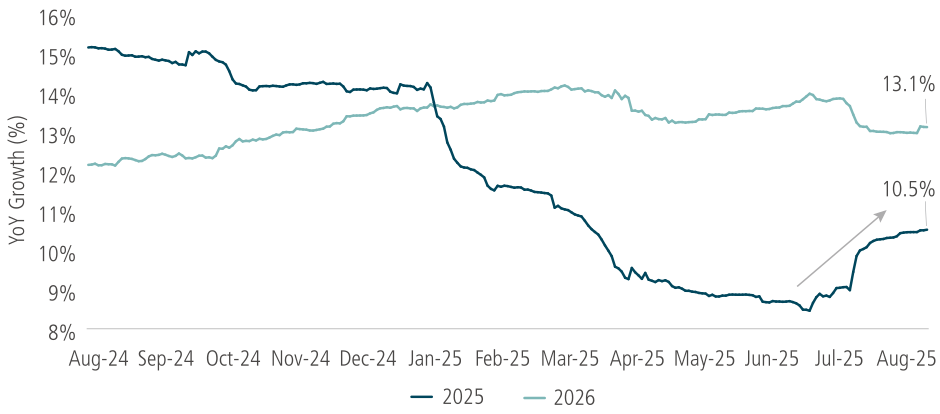
Source: FactSet, as of August 31, 2025.
Much of the chatter in August circled around the Federal Reserve, as concerns about a softening labor market began to materialize after a disappointing July jobs print. There was some tumult within the central bank, too, as one governor resigned, and another faced an attempted firing by President Donald Trump. All these factors culminated in Fed Chair Jerome Powell’s speech at Jackson Hole toward the end of the month, where he opened a wider door to a possible interest rate cut in September while remaining committed to keeping the Fed removed from day-to-day political noise. As of the end of August, the probability of a rate cut during the September 17 meeting was nearly 90%.
Unsurprisingly, there have been some concerns about the politicization of economic data following President Trump’s firing of the Bureau of Labor Statistics Commissioner Erika McEntarfer. The President questioned the accuracy of the labor data—which has recently been plagued by large revisions—opening a dialogue on the reliability of an independent, nonpartisan agency that has been around for more than 140 years. There remain some worries that economic data could be manipulated or withheld in the future, but as it currently stands, government economic data appears to be an accurate and available source of information.
Tailwinds May Continue for Small Caps
Amid the deluge of corporate earnings and Fed-related drama in August, a clear trend emerged within U.S. equities: the rotation out of expensive tech stocks and into cheaper small caps. The Russell 2000 index rallied over +7% in August, more than triple the monthly return for the S&P 500. In fact, the Russell 2000 has outperformed the S&P 500 since April’s market bottom by +5%. The last time this level of outperformance occurred was following the November election. Simply put, the “Trump trade” strongly reemerged; the big question is whether it can continue.
One reason why it could continue is a wide gap in valuations, as small-cap stocks are still at historically low discounts relative to large caps. While expectations of increased efficiency following record levels of artificial intelligence-related capital expenditure may help justify current prices for mega-cap tech stocks, there is concern about historically high valuations, especially for the Magnificent 7 stocks.1 In addition, analysts are projecting higher-quality small-cap earnings growth (as measured by the S&P 600 Index) of about +19% in 2026, outpacing the S&P 500 by roughly 6%.
Finally, a rate-cutting cycle would likely benefit small-cap stocks. Lower rates could support the U.S. economy, which bodes well for domestically oriented smaller companies. Small caps as a group also have higher levels of floating-rate debt, so they can get a more direct boost from lower interest expenses. Further deregulation and pro-business elements within the White House and Congress could help small-cap performance, too. However, lower rates would not just be good news for small caps. A rising tide of liquidity and investor sentiment could lift all boats, including the Magnificent 7 and even fixed income due to the inverse relationship between prices and yields.
U.S. Federal Funds Rate: Historical and Expected Path
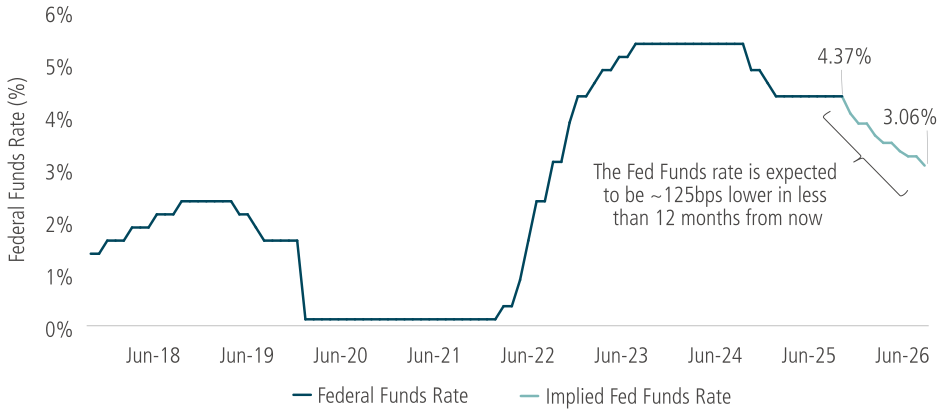
Source: Bloomberg as of September 5th intra-day, Mid-point Fed Funds Rate is being used for the illustration to match futures OIS pricing.
Clearly, all eyes will be on the Fed in September. The big macroeconomic events to watch over the next month following August’s weaker-than-expected employment report (+22,000 jobs added vs. +75,000 consensus) are August’s CPI inflation data, and then, of course, the Fed's policy decision on September 17; the central bank will have to consider both the jobs and upcoming inflation data. While we acknowledge that the risks appear to be somewhat less balanced after the last two nonfarm payrolls reports, we remain of the view that the Fed will cut twice this year and will likely continue to cut rates for a cumulative 100 basis points through the first half of 2026. It is also important to remember that September is a seasonally weaker month for equities, so investors should be ready for some potential bumps in the road. Overall, with uncertainties still on the horizon, we recommend adhering to long-term asset allocations and believe that diversification across asset class, sector, size and style, and utilizing active management where appropriate may help mitigate downside risks during periods of volatility.
Portfolio Implications
Equities were higher across the board, led by domestic small-cap stocks. We maintain an overweight to small- and midcaps as we anticipate a rotation to continue through the remainder of 2026 against a backdrop of lower policy rates, deregulation and pro-business elements from the U.S. tax and spending law. Developed non-U.S. equities should continue to benefit from the rotation as well. Otherwise, we maintain an “at-target” view across equities. Admittedly, short-term political volatility, coupled with historical volatility in September due to seasonality factors, may create some pressure. However, any larger pullbacks (10% or more) could be an appropriate trigger to add risk, especially for those holding excess cash. In this more challenging environment, we favor employing active management to select companies with high earnings visibility.
Fixed Income was higher as rate cut expectations mounted. We are more constructive on investment-grade fixed income as yields are close to fair value, with shorter-dated bonds in particular presenting little downside risk, in our opinion. With the spread of bond yields over cash rates likely to widen further, we see opportunities to deploy cash tactically, adding and/or shortening duration based on the movement of rates. Expected cuts of U.S. policy rates by the Fed in the second half should help boost performance of U.S. fixed income, but the “One Big Beautiful Bill Act” has added a level of uncertainty to the mix, as investors may continue to demand higher term premiums to compensate for the risk of holding long-term government bonds at a time when large federal deficits are creating uncertainty about future economic stability. Multi-sector bond funds may be an appropriate vehicle to consider, given the levers a manager can opportunistically pull across sector, duration profile and region.
With a fading liquidity drought and a more recent pickup in mergers and acquisitions (the number of M&A deals completed, pending and proposed year-to-date is now 13% higher than at the end of August 2024) and other deal activity, we believe significant opportunities still exist within Private Markets, as investors should expect new buyout activity and an unlocking of distributions. That said, liquidity and capital solutions providers will likely remain important to work through the substantial backlog of legacy investments. As a result, we continue to see compelling opportunities across secondaries, midlife co-investments and capital solutions. We are cautious on core private real estate, but this is offset by what we see as abundant market-dislocation opportunities in the value-add and opportunistic sectors and, particularly, real estate secondaries. Neuberger Berman’s deep relationships and unique position within the private equity ecosystem have translated into record levels of deal flow across our platform.
Index Returns as of August 2025
| Aug-25 | 3M | YTD | |
|---|---|---|---|
| Equities | |||
| Major U.S. Indices | |||
| S&P 500 Index | 2.0% | 9.6% | 10.8% |
| Nasdaq Composite | 1.6% | 12.4% | 11.6% |
| Dow Jones | 3.4% | 8.2% | 8.3% |
| U.S. Size Indices | |||
| Large Cap | 2.1% | 9.7% | 10.8% |
| Mid Cap | 2.5% | 8.3% | 9.4% |
| Small Cap | 7.1% | 14.9% | 7.1% |
| All Cap | 2.3% | 9.9% | 10.6% |
| U.S. Style Indices | |||
| All Cap Growth | 2.3% | 9.9% | 10.6% |
| All Cap Value | 3.4% | 7.7% | 9.8% |
| Global Equity Indices | |||
| ACWI | 2.5% | 8.5% | 14.3% |
| ACWI ex US | 3.5% | 6.7% | 21.6% |
| DM Non-U.S. Equities | 4.3% | 5.1% | 23.3% |
| EM Equities | 1.5% | 9.9% | 19.6% |
| Portfolios | |||
| 50/50 Portfolio | 1.4% | 5.5% | 5.6% |
| Aug-25 | 3M | YTD | |
|---|---|---|---|
| Fixed Income Currencies & Commodities | |||
| Major U.S. Indices | |||
| Cash | 0.4% | 1.1% | 2.8% |
| U.S. Aggregate | 1.2% | 2.5% | 5.0% |
| Munis | 0.9% | 1.3% | 0.3% |
| U.S. Corporates | |||
| Investment Grade | 1.0% | 3.0% | 5.3% |
| High Yield | 1.2% | 3.3% | 6.3% |
| Short Duration (1.9 Yrs) | 0.9% | 1.5% | 3.8% |
| Long Duration (12.8 Yrs) | 0.7% | 2.8% | 3.5% |
| Global Fixed Income Indices | |||
| Global Aggregate | 1.5% | 1.8% | 7.2% |
| EMD Corporates | 1.3% | 3.7% | 6.5% |
| Commodities | |||
| Commodities | 1.9% | 3.9% | 7.1% |
| U.S. Treasury Yields | |||
| U.S. 10-Year Yield | -0.1% | -0.2% | -0.3% |
| U.S. 2-Year Yield | -0.3% | -0.3% | -0.6% |
| FX | |||
| U.S. Dollar | -2.2% | -1.6% | -9.9% |
Source: Bloomberg, Total returns as of August 31, 2025. S&P 500 Index is represented by S&P 500 Total Return Index. Nasdaq Composite NASDAQ-Composite Total Return Index. Dow Jones is represented by Dow Jones Industrial Average TR. Large Cap is represented by Russell 1000 Total Return Index. Mid Cap is represented by Russell Midcap Index Total Return. Small Cap is represented by Russell 2000 Total Return Index. All Cap is represented by Russell 3000 Total Return Index. Large Cap Growth is represented by Russell 1000 Growth Total Return. Large Cap Value is represented by Russell 1000 Value Index Total Return. Small Cap Growth is represented by Russell 2000 Growth Total Return. Small Cap Value is represented by Russell 2000 Value Total Return. ACWI is represented by MSCI ACWI Net Total Return USD Index. ACWI ex US is represented by MSCI ACWI ex USA Net Total Return USD Index. DM Non-U.S. Equities is represented by MSCI Daily TR Gross EAFE USD. EM Equities is represented by MSCI Daily TR Gross EM USD. Cash is represented by ICE BofA US 3-Month Treasury Bill Index. U.S. Aggregate is represented by Bloomberg US Agg Total Return Value Unhedged USD. Munis is represented by Bloomberg Municipal Bond Index Total Return Index Value Unhedged USD. Munis Short Duration is represented by Bloomberg Municipal Bond: Muni Short (1-5) Total Return Unhedged USD. Munis Intermediate Duration is represented by Bloomberg Municipal Bond: Muni Intermediate (5-10) TR Unhedged USD. Investment Grade is represented by Bloomberg US Corporate Total Return Value Unhedged USD. High Yield is represented by Bloomberg US High Yield BB/B 2% Issuer Cap Total Return Index Value Unhedged USD. Short Duration is represented by Bloomberg US Agg 1-3 Year Total Return Value Unhedged USD. Long Duration is represented by Bloomberg US Agg 10+ Year Total Return Value Unhedged USD. Global Aggregate is represented by Bloomberg Global-Aggregate Total Return Index Value Unhedged USD. EMD Corporates is represented by J.P. Morgan Corporate EMBI Diversified Composite Index Level. EMD Sovereigns – USD is represented by J.P. Morgan EMBI Global Diversified Composite. Commodities is represented by Bloomberg Commodity Index Total Return. Commodities ex Energy is represented by Bloomberg Ex-Energy Subindex Total Return. U.S. 10-Year Yield is represented by US Generic Govt 10 Yr.