




“Uncertainty” has been the operative word when describing the status of environmental, social and governance (ESG) investing within defined contribution plans—something that was highlighted dramatically with Congress’s action to overturn new Department of Labor rules governing the treatment of ESG in DC plans. President Biden subsequently vetoed the legislation, although a federal lawsuit against the DOL rule filed by 25 state attorneys general is still pending.
Looking at the big picture, plan sponsors have grappled with questions as to under what circumstances they may consider ESG-integrated strategies as plan options, and to what degree they may take into account issues beyond the traditional risk-reward framework that tends to drive fiduciary decision-making. Political tensions have muddied the waters, as elected officials and regulators have grappled with the competing dynamics of climate change and potentially reduced capital deployment to carbon-intensive industries, culminating in the recent Washington, DC, standoff.
Under the Trump administration, the Department of Labor took a fairly restrictive view of ESG options in DC plans, limiting the use of “non-pecuniary” factors in selecting investments, particularly when it came to qualified default investment alternatives. Tie-breaking decisions between similarly situated funds could take into account such factors, but required heavy documentation.
With President Biden’s election in 2020, the DOL revisited regulations around ESG and DC plans, releasing the new set of rules, which now judge ESG more like other investments, within a risk-return framework. The rules provide more flexibility around “tie-breaking” decisions between similarly situated funds and reduce associated paperwork that some believe discouraged use of ESG investments; they explicitly note that “risk and return factors may include the economic effects of climate change and other environmental, social or governance factors.”
With the revised framework in place, we see a key advantage in that it lets ESG operate on a level playing field with other investment choices—based on underlying economic fundamentals affecting investment prospects—while acknowledging the potential preferences of participants.
We hope the new rules will help sponsors move past recent politicization, which has obscured some key nuances. In particular, ESG investing doesn’t have to seek non-economic outcomes. The ESG integration employed by select asset managers, looks to ensure that financially material ESG factors are considered, alongside other factors, in traditional investment analysis. In contrast, exclusions, “sustainable” investing and “impact” investing are strategies that may pursue a specific nonfinancial outcome, either in a portfolio or in the real world, alongside managing financial risk and return. In our view, both can have a home in DC plans consistent with the new rules and the fiduciary obligations of plan sponsors as long as the differences are clearly defined.
Theoretically, some plan sponsors might prefer to skirt ESG entirely in light of the controversy. However, we believe that ESG analysis provides real advantages when it comes to identifying long-term risks and opportunities, such that avoidance of ESG disciplines could, in itself, be a problem from a fiduciary perspective. In addition, employee engagement remains a key challenge for plan sponsors. Given the interest that younger workers have displayed in ESG investing, we believe that including potential plan options that effectively check the ESG box could encourage participation and the health of DC plans in the process.
Thus, from both fiduciary and practical standpoints, we believe that sponsors would do well to consider seriously the characteristics associated with ESG strategies in making decisions regarding plan menus.
A Potential Way to Increase Engagement
Likelihood of Switching Employers for Better Retirement Benefits
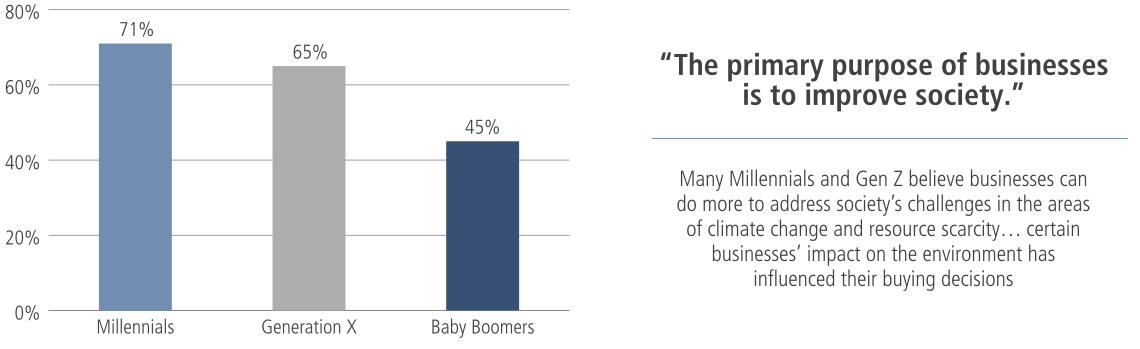
Source: chart: Transamerica 20th Annual Retirement Survey of Workers, May 2020; text: Deloitte, The Deloitte Millennial Survey, January 2014; The Deloitte Global 2021 Millennial and Gen Z Survey, June 2021. For illustrative and discussion purposes only.