




This year marks the 50th anniversary of the Employee Retirement Income Savings Act of 1974, the landscape-altering legislation catalyzed by the 1963 Studebaker-Packard pension failure, in which underfunding left many plant employees without their nest eggs. The product of a decade of reform efforts, ERISA offered safeguards and regulation around traditional pension plans, but, importantly, also paved the way for the defined contribution plans that today dominate the employee investment landscape.
Clearly, DC plans have received mixed reviews over the years, as participants faced challenges in understanding why they should enroll, how much they should save and what investment options they should select. In an effort to improve, we’ve seen various efforts focused on educating participants, expanding and then streamlining investment options, and providing online account access. The passage of the Pension Protection Act in 2006 led to auto-enrollment, auto-escalation and default investment options—all changes that have made a positive difference in participation and savings rates.
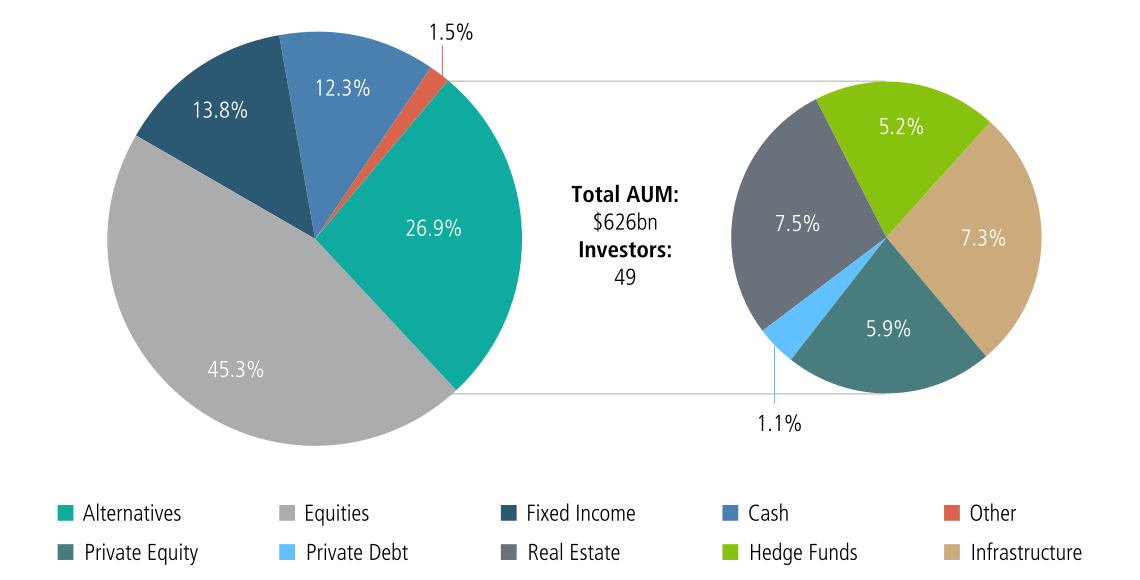
That said, the retirement community continues to explore ways to improve participants’ retirement outcomes—including looking to overseas programs with enviable success rates, such as Australia’s superannuation system. Introduced in 1992 when Australia was facing severe retirement shortfalls, this program takes a comprehensive approach to retirement, including both defined benefit and defined contribution plans. Companies are required to withhold 11% of employee pay for retirement (12% next year), while workers can contribute additional funds if desired. In addition, funds have more flexibility as to investment options, with about a quarter of fund assets in alternative investments—slightly more than U.S. defined benefit plans, but far exceeding the roughly 1.1% weighting within U.S. target-date funds and 1.9% for balanced fund options.1 Overall, Australians likely have more retirement savings per capita than any other country.2
What Translates?
To what degree is this success translatable to the U.S. system? Australia’s key distinction of required contributions seems to be a heavy lift, given our country’s general preference for personal control over assets, and the inevitable hit to take-home pay that would occur with mandatory withholdings. Seeking to limit “leakage” of U.S. retirement assets for other purposes might prove beneficial, but is seemingly contrary to recent trends toward release of those funds for emergencies and more.
In our view, a more relevant lesson involves alternative investments and finding ways to jump-start what has thus far been a halting progress toward their acceptance, despite general enthusiasm about their return and risk characteristics. Although Australian superfunds have an advantage in centralization and expertise that may allow for greater exposure to the more work-intensive arena of private markets, the U.S. has an impressive record of innovation when given the opportunity. Plans’ emphasis on transparency and daily liquidity make the more opaque and illiquid private portfolios hard to translate into the DC space, but providers have been developing products that can provide transparency and as-needed cash generation. Especially within target-date funds, the potential to expand alternative options seems meaningful.
How can the U.S. accelerate the stagnant pace of acceptance? In part, this may come via changes in regulation. While the Department of Labor has provided increased clarity as to where and how alternatives may be appropriate for DC plans, broader safe-harbor treatment could do wonders in helping plan sponsors think less about litigation risk and more about the potential benefits of alternatives to long-term outcomes. Assuming an influx in alternative assets, this could give portfolio managers the ability and motivation to enhance the structure of alternative portfolios—creating a “virtuous circle” to benefit participants over the long haul.
Alternative Investments Are Integral to the Australian Retirement System3
Superannuation Schemes’ Weighted Average Asset Allocation in 2023
1 Source: Plan Sponsor, December 4, 2023.
2 Source: Bloomberg, March 26, 2024.
3 Source: Preqin.