
The AI capex boom is creating a compelling fixed income opportunity, as leading tech firms increasingly fund investments through sizeable AI‑linked bond issuance, offering investors an alternative way to gain AI exposure beyond equities.
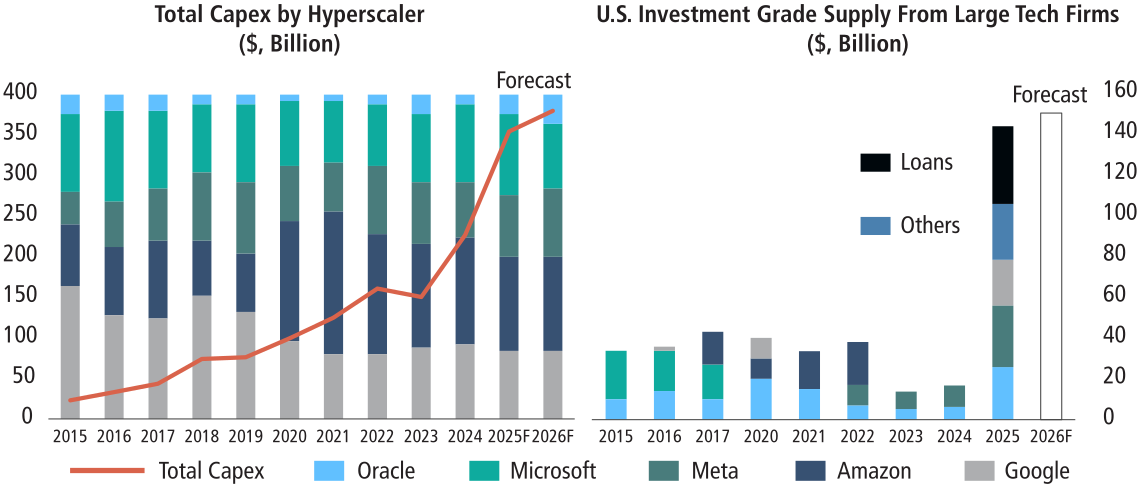
The AI investment boom is likely to continue as enterprise adoption broadens. However, it will be important for investors to assess developments quarter by quarter rather than focusing solely on long-term aspirations. Given the current euphoria around AI, there are likely to be pockets of weakness along the way. AI has transformative potential, but ultimately it must prove to be value‑adding for enterprises in order to justify the current level of investment.
- Historically, most capex has been internally funded. Technology companies have largely financed capital expenditures from free cash flow. However, the fourth quarter of 2025 marked an inflection point, as companies turned to increased debt issuance to fund capex. This trend is likely to continue, with issuance remaining elevated for the next several years.
- Recently, massive offerings of AI‑related debt have come to market. Roughly 93 US billion dollars, or more than 5 percent of investment‑grade debt issuance in 2025—nearly triple the sector’s average annual issuance of 32 US billion dollars between 2015 and 2024, according to Bank of America. The borrowers are a “who’s who” of hyperscalers, such as Meta, Alphabet and Oracle, looking to build out data centers while seeking to secure captive energy sources to keep them running. There is also potential for more US companies (Oracle) to issue in euros.
- AI capex supply. While capex is expected to rise further in 2026, profits are also set to grow. In aggregate, these companies should still be able to fund their capex with operating cash flow, even after dividends and share buybacks. However, the cushion is narrowing and, for some issuers, capex will exceed earnings in 2026. This likely helps explain why they raised 93 US billion dollars (US‑dollar issuance only) between September and November 2025, including the RPLDCI transaction (which refers to Beignet Investor LLC, an affiliate of Blue Owl Capital that owns 80 percent of a joint venture with Meta to develop the Hyperion data center project in Louisiana). Given the scale of planned spending and the significant balance sheet capacity of most issuers, the risk to hyperscaler supply is skewed to the upside in 2026.
- Fundamentals and credit quality. Credit quality should modestly deteriorate going forward as free cash flow generation is constrained by continued capex needs. We anticipate companies will remain active in returning value to shareholders through dividends and share repurchases. Although starting from a low base, we expect leverage to trend higher.
- Neuberger’s view. We believe the hyperscalers are generally well positioned to expand their debt loads, with greater risk affecting smaller players. Dynamics across industries will vary; companies with scale, entrenched competitive positions, strong management teams and more advanced AI integration should be best positioned to navigate this shift. Overall, we have a constructive long‑term view of the technology sector, given the generational growth opportunity presented by AI, a positive outlook for IT spending and multiple sector growth drivers. We are tactically cautious on the sector heading into 2026, however, given elevated spending levels, which pressure free cash flow generation and are expected to lead to high levels of net new supply. Investor sentiment will be driven by the AI‑bubble narrative, the supply overhang and activity from high‑profile issuers such as Oracle.
Source: Neuberger Berman, JPM. Chart left.
Source: Neuberger Berman, BofA Global Research. Data through November 11, 2025. “AI big tech firms” include Amazon, Google, Meta, Microsoft and Oracle. “Loans” refers to a 38 US billion dollar data‑center construction loan currently in the market. Chart right.
Other (RPLDCI): Beignet Investor LLC is an affiliate of Blue Owl Capital that owns 80 percent of a joint venture with Meta to develop the Hyperion data‑center project in Louisiana.
Source: Neuberger Berman, JPM, BofA Global Research. Data through November 11, 2025.