




In our opinion, artificial intelligence appears to promise all the features of a bona fide “GPT,” or the general-purpose technology of traditional usage (rather than the “generative pre-trained transformer” of ChatGPT fame). Other transformative GPTs of the past have included the steam engine, electricity and the internet, and we think AI will eventually belong in the same category.
Of course, there has been no shortage of prognostication on AI over the past few years: A godsend to business productivity, the end of work as we know it, an accelerant of wealth inequality, a threat to humanity… we’ve heard it all. Putting the extremes aside, however, we tend to take a view informed by the data that we can gather, while exercising educated guesswork (and some skepticism) as to the future. Although even the near-term effects are highly uncertain, in this article, we lay out our thinking about the macroeconomic implications of this crucial technology.
Our essential observation? That while effects over the next 12 to 18 months could be relatively moderate as to growth, productivity and the labor market, the impact further out to these and related factors could be increasingly meaningful. As for inflation and monetary policy, the picture is murkier, and will likely be driven by myriad factors, including the advent of AI.
Key Takeaways
- Growth, Capex and Productivity: The AI buildout should contribute meaningfully to GDP in 2026, but productivity gains will likely take longer to achieve; beware bottlenecks and overinvestment.
- Inflation, Labor and Wages: Cost savings from AI could affect prices gradually; job displacement could be role-specific, with AI-integrated human roles enjoying wage advantages.
- Monetary and Fiscal Policy: With AI contributing to a mixed labor picture, the Federal Reserve could maintain a cautious easing bias this year; longer term, softer hiring, among other factors, could drive policy rates.
Growth, Capex and Productivity: Near-Term Contributor, Long-Term Questions
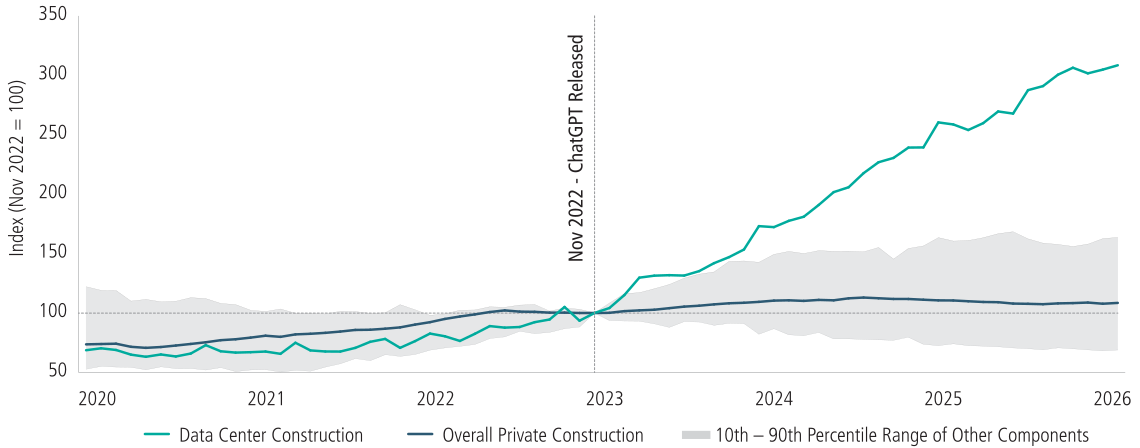
A brief glance at the contributors to Gross Domestic Product in the first half of 2025 shows the immense impact on growth from AI-related components such as computers and peripherals, software and data centers. Although these investment categories likely contain measurement errors and may overstate impacts,1 we think a plausible figure for the addition to net growth from AI is close to a 0.5% seasonally adjusted annual rate (SAAR). This is far from trivial, given the period’s overall growth of 1.6%.2 We fully expect, as is well telegraphed by the hyperscaler companies themselves, that capital expenditures could continue apace throughout 2026, contributing another healthy piece of the economic pie. However, recall that it is the growth not the level of activity that will matter to GDP. While impressive by any stretch of the imagination, the contribution will likely be lower in percentage terms than in 2025. This aside, AI capex and adjacent investments are key factors in our above-trend growth forecast for 2026.
Hyperscalers Are in Building Mode
Data Center Construction vs. Overall Private Construction
Source: Census Bureau, Value of Construction Put in Place. Data as of October 2025.
As meaningful as this capex is to near-term growth, we feel the real promise of AI is not increased capital associated with investment in the buildout, but rather productivity, which involves the spread of the technology and its integration into the productive process. The variance of current forecasts is massive: Some researchers find relatively little effect (less than 1% over a 10-year time horizon3) while others approach 20% per year.4 Across this vast range of potential outcomes, we would point out a few important considerations:
First, the historical pattern of general-purpose technologies resembles the so-called j-curve:5 Often, productivity initially appears unchanged or even lower in the presence of transformative technologies as workers and companies invest in intangibles to harvest the deferred gains.
Second, the underreported effect of bottlenecks probably deserves more attention. Whether in idea generation (research and development) or production, non-automatable or highly costly bottlenecks can significantly alter the translation of inputs into output in a way that could dampen the impressive task-specific capabilities of AI. To give a simple example, the productivity gain from having a computer run a regression, rather than a human being by hand, is almost hard to comprehend; yet the change may not result in a proportional improvement of end analysis.
Third, for the near and medium term, one final unsettling historical pattern is that of overinvestment—where even highly profitable and transformative technologies may require great initial spending that is out of sync with actual profits. In other words, the prospect of a financial bubble around a technology may not be preordained, but the apprehension it generates doesn’t strike us as irrational.
Inflation, Labor and Wages: Harvesting AI Disinflation Could Take Time; Watch Where You Work
Mainstream commentary often suggests that if the potential productivity increases of AI automation come to fruition, prices should fall or, at the very least, be less inflationary as cost savings accrue. We agree that certain products and industries could experience this effect, but as to aggregate disinflation, we urge caution.
First, we believe it will take time to integrate AI and harvest the cost savings discussed above, especially as companies navigate the “jagged frontier” of AI’s costs and abilities. In contrast, the buildout of these same transformative capabilities has, notwithstanding potential paradigm shifts in training, involved intensive resource utilization, the supply of which may be more inelastic in the short term, leading to price increases in electricity, for example. All told, we don’t anticipate a major impact on aggregate inflation in the near term, and stick to our long-held forecast of meaningful disinflation in 2026. As for the longer term, whether cost savings from automation ultimately accrues to consumers via lower prices (as opposed to producers through higher margins) is an open question.
Second, productivity in specific sectors (“highly automatable” businesses) often works more to shift the relative prices of goods and services rather than the absolute level of aggregates. This perspective6 is typically underappreciated, but can be observed in the diverging price trends of, say, televisions versus childcare. Over the long term, we hold the rather orthodox view that inflation will likely be pinned down by Federal Reserve policy.
The analysis is no less nuanced for labor. Many critics of AI regard it as a substitute for human labor rather than a complement. In our view, it could turn out to be both, depending on the specific task.
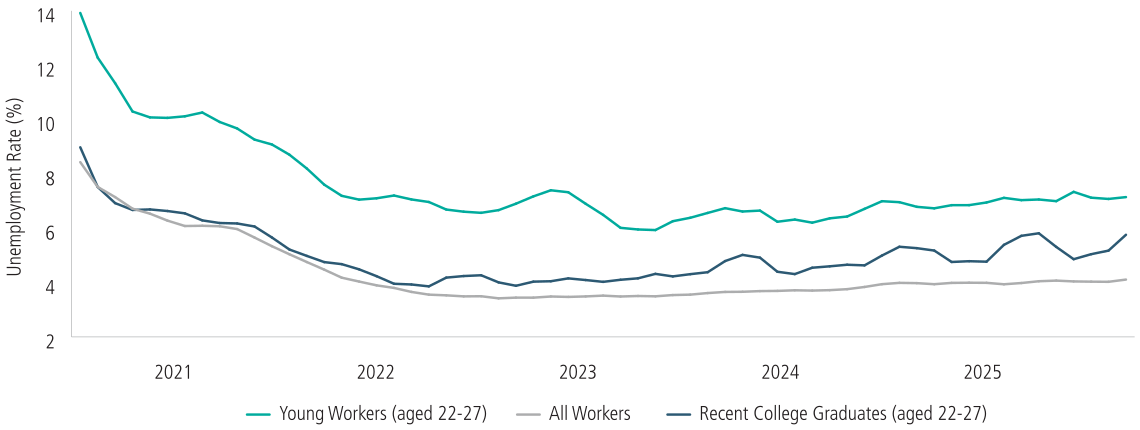
In these early days, AI, at best, seems a highly imperfect substitute even for rather routine cognitive tasks; on the margin, we suspect it is responsible for some hesitancy in hiring, but thus far, the effect on the labor market has been minimal. This will likely change over time, and if you squint and are particularly meticulous, you can begin to see some nascent signs of labor displacement in highly exposed jobs.7 Our near-term expectation is for continued anemic hiring, which causes the unemployment rate to slowly drift higher. A portion of this is AI-related: In our framing, hiring is a semiflexible investment in human capital which, at the margin, now carries more appreciable opportunity cost via an AI substitute.
Stepping back, the typical historical experience has been that labor reinstatement effects associated with technology—new job creation, increased demand in non-automated sectors—have offset this displacement over time and with lags. In the long run, whether AI proves to fully replicate labor remains uncertain, but the historical record supports caution despite the technology’s impressive abilities; furthermore, there will likely be at least some tasks in which labor maintains a comparative advantage and is not fully superfluous.
Overall, the net effect on wages appears ambiguous, although we think the variance in outcomes will likely be higher. Displaced workers who do not have flexible entry into non-automated or new work due to mismatched skills or other frictions could experience lower wages, while those workers whose labor is complemented by AI will likely see higher earnings with increased productivity. This would seem to imply growing wage and income inequality, although it bears noting that some of the most exposed jobs are seemingly not in lower-wage/-income quintiles. Highly skilled workers may eventually flood non-automated sectors with their labor, but, in the near term, manual labor-intensive tasks appear more insulated.
AI Is Starting to Affect the Employment Picture, Particularly for Recent College Graduates
Unemployment Rates: Young, All Workers and Recent Graduates, Last Five Years
Source: Federal Reserve Bank of New York, U.S. Census Bureau and U.S. Bureau of Labor Statistics, Current Population Survey (IPUMS). Data as of September 2025.
Monetary and Fiscal Policy: Cautious Easing Bias; Attention to Labor Shifts May Be Here to Stay
With AI at the forefront, the Federal Reserve continues to pursue its dual mandate, albeit with caveats, particularly in the labor market. As noted above, AI disruption involves a complicated interaction among labor displacement, absorption, matching efficiency and wage bargaining. Our near-term view is that these effects materialize in anemic hiring rather than outright layoffs, but even this distinction does not rule out increases in the unemployment rate. We expect that the labor market could spend 2026 on a knife’s edge between stability and weakness, which would leave in place a cautious easing bias on the part of the Federal Open Market Committee.
Longer term, the Fed may need to carefully consider that these same factors may push up NAIRU8 along with unemployment, which would imply less or no labor market slack relative to prior estimates. Relatedly, consider that the promise of AI is generally seen as increasing the potential growth rate of the economy, and, if this happens in conjunction with an increase in delivered growth, then the output gap9 need not expand. To the extent that a positive output gap is what is implied by the narrative of “run it hot,” this seems to us to be misguided given the economy would be in a higher gear. Finally, inflation effects are also difficult to discern, and the impacts may be varied and sector-specific (similar to what is occurring today).
Fiscally, the picture is decidedly mixed. On one hand, higher real growth from productivity would organically help the fiscal balance. However, recall that much of the government’s revenue comes from income and payroll taxes, the same parts that are highly disrupted in the broadly diffused transformative AI scenario. Thus, it seems plausible that government revenues could increase at a rate lower than nominal GDP. And that is before even considering outlays for retraining programs, UBI or strategic subsidization and investment such as for defense purposes. In short, our view is that AI will not be a silver bullet for fiscal balance.
Finally, like other aspects of the economy, the impact on interest rates appears ambiguous. Yes, higher productivity works downstream to increase the neutral rate, but it is only one factor among many and doesn’t move in isolation. Consumer preferences, precautionary saving, demographic considerations (does AI lead to increased life expectancy?) and market structure could all play a role, and it appears to us equally possible that these effects could net out to higher or lower trends for real and nominal rates in the long run.
Conclusion: Weighing the Variables
Investment and hype around artificial intelligence remains at a high level, not only as hyperscalers seek to build out their infrastructure, but as companies integrate this promising technology into work processes. In our view, the effect on the overall economy will likely be transformative, but the pace of productivity enhancement remains unclear. By extension, assessing the long-term impact on the macro picture, whether in growth, labor or inflation, continues to involve a degree of speculation. We will look to the data where we have a degree of confidence to gauge nearer-term effects and then extrapolate that data, informed by history, to track increasingly wide-ranging potential outcomes over the long term.
To read our series of insights related to this topic, How AI Is Reshaping Credit Markets, please click here.