



As we anticipate the arrival of U.S. Department of Labor guidance around the use of alternative investments in defined contribution plans, the focus of many in the industry has turned to preparation: Thinking about how to integrate alternatives into DC plans, how to select appropriate managers for investment options or sleeves (within target date funds, for example), and how to educate participants on the characteristics of private markets investments and the benefits and trade-offs that they may entail.
Interestingly, another core task may be for advisors to bring themselves up to speed on this important area. A recent survey by the Retirement Advisor Council found not only considerable interest on the part of advisors in alternatives asset segments and exploring them with DC plans, but also an urgent desire for education to arm them to do so (see displays).
Advisors and Alternative Assets
Motivated to Act
The Executive Order issued in August ’25, regarding “alternative assets” mentioned several asset classes on which the DOL is to provide guidance. Of these, which would you be interested in evaluating for retirement plans? (check all that apply)

A Desire to Learn
What is your level of interest in learning more about private market investments to support discussions with plan sponsors?
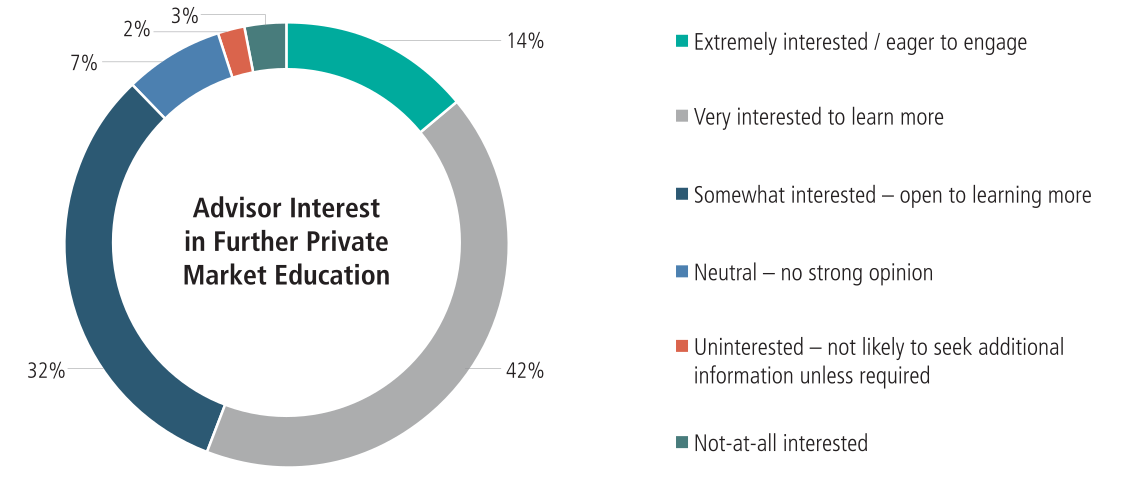
Source: Retirement Advisor Council, “Private Markets in Defined Contribution Plans: Advisor Perspectives, Practical Barriers, and the Path Forward,” 2026. Results based on a survey of 69 retirement plan advisors who responded between November 7, 2025, and December 6, 2025.
Obviously, there’s long been interest in expanding the presence of alternatives in DC plans, but regulatory-related caution (compounded by on again, off again stances by successive presidential administrations) and practical considerations regarding how to add them into plans have helped temper enthusiasm and progress. With Donald Trump’s Executive Order to democratize access to alternative assets for 401(k) investors (August 2025) and clarifying guidance to come, it seems likely that the first constraint will ease. However, there is still a lot to think about in the latter category, including the placement of alternatives, the appropriateness of the asset class for the demographics of a given plan, liquidity characteristics and managing them, and valuation techniques, among other considerations. (See our article, “Private Equity in DC: Developing a Game Plan,” for issues facing DC plan sponsors.)
Beyond these more technical sponsor issues is the task of positioning the asset class for participants. Many will fall into default investment options that may contain alternatives without an understanding of their exposures; others may choose those default options, such as target date funds, because they like the notion of a broadly diversified portfolio and will accept the various components provided to them in this context. However, a more engaged and potentially skeptical cohort may take some convincing.
Looking specifically at private equity, we believe the case is ready to be made: An expanded opportunity set, strong historical long-term returns relative to public markets and meaningful diversification reinforce the value of private asset exposures, even as advisors must also recognize the complexities and fee structures that make careful assessment of portfolio managers and terms a key part of the package. Making that case will require fluidity in communication around alternatives that can come only with knowledge and practice.
Where to begin? Obviously, few of us have a wealth of time for self-education, but relatively efficient resources can lay the groundwork for your discussions. You can start with the Defined Contribution Alternatives Association, which offers an array of videos, webinars and research papers on topics tied to alternatives within the DC space. In addition, the Defined Contribution Institutional Investment Association (DCIIA) alternatives page features published research and webinar replays on topics ranging from illiquid asset implementation to key considerations of private equity in DC plans.
We would also point you to our own Private Markets Academy, which offers extensive resources, including on-demand courses (for CE credit) that start with the basics and move up to more sophisticated topics. There are also various videos and infographics to help drive your understanding of the private equity asset class.
Finally, if you happen to be visiting Tampa from April 19 – 21, you can enroll in the NAPA 401(k) Private and Digital Assets Certificate Program, which we are offering in partnership with the National Association of Plan Sponsors (NAPA), as part of NAPA’s annual 401(k) summit. Modules include: an Overview of Private and Digital Assets, Understanding Asset Types, Inclusion of Mixed Asset Types in DC Menus, Incorporating into Your Practice, and Reviewing a DC Investment Menu.1
We hope to see you there, but even if we don’t, we urge you to brush up on your knowledge of alternatives to capitalize on potentially growing interest in the asset class among DC sponsors.