In this paper, we further our coverage of the shifting real estate (RE) landscape. Specifically, we highlight a combination of supportive trends—including still-modest valuations, widening access to capital and rising demand within specific sectors—and discuss various approaches to partnering directly with top-tier real estate operators (REOCs) and general partners (GPs) to seek potentially attractive risk-adjusted returns.
Real Estate Is “On Sale” Relative to Other Asset Classes
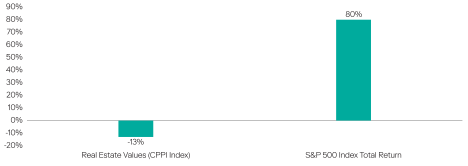
Between 2022 and 2025, RE values fell approximately 13% across both private and public markets, substantially trailing the performance of the S&P 500 Index (see Figure 1). We believe this significant pullback is creating various potential opportunities across the RE sector.
Figure 1: Real Estate Values Have Fallen Significantly, Creating Potential Opportunities Across the Sector
Source: Green Street and Bloomberg. Past performance is not indicative of future results.
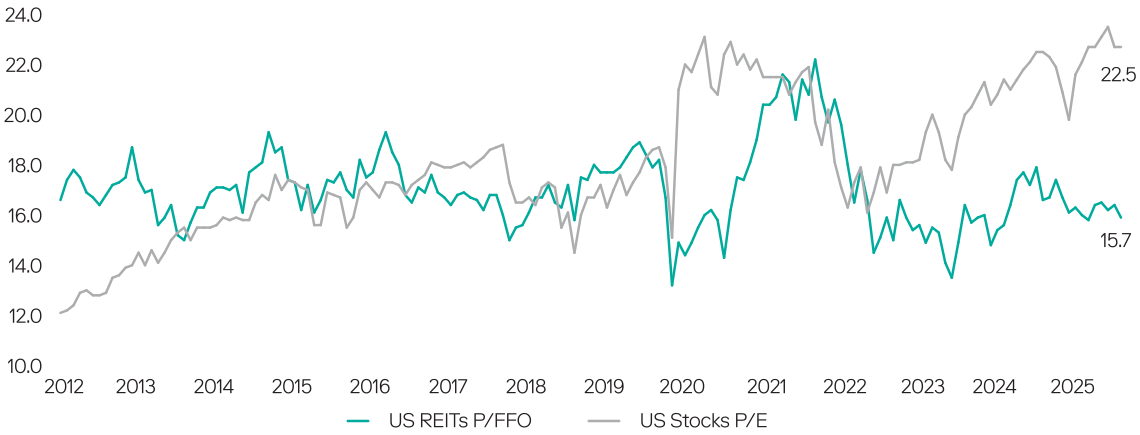
Publicly listed U.S. REITs have fared particularly poorly, underperforming the S&P 500 Index by roughly 60%, as shown in Figure 2. Even high-quality REITs now trade at meaningful discounts to private market values, many of which have also come down.
Figure 2: Publicly Listed REITS Have Significantly Trailed the Broader Equity Market
Source: UBS; data as of December 25, 2025. Past performance is not indicative of future results.
While we believe attractive entry points exist, selection remains critical. Across the sector, we find an array of assets trading at discounts to replacement costs as broader uncertainty persists. At the same time, demand in certain subsectors—including retail, data centers and senior housing—has outpaced available supply, shoring up pricing.
In our view, slumping valuations and economic weakness have put stress on some RE operators: first, top-line growth has flattened while expenses have risen, compressing margins; second, falling valuations have left some operators overlevered and struggling to re-finance their portfolios. We believe these dynamics continue to create opportunities for investors able to partner with RE operators and GPs more directly. (We discuss different “platform-level” approaches in greater detail below.)
At current levels, we believe certain pockets of the RE sector (public and private) offer attractive opportunities across the capital stack and with improved margin of safety relative to prior vintages. Furthermore, we think that healthier demand for REIT IPOs and follow‑on offerings, along with greater M&A activity, would signal improving capital-market conditions and help align public and private valuations, potentially positioning listed REITs as both a complement to—and a leading indicator for—private real estate performance.
The Cycle Continues to Turn
Interest Rates Have Gradually Stabilized, Supporting Activity
While cap rates may not compress meaningfully in the near term, lower interest rates are clearly supportive of the RE sector, in our view. We believe even modest rate declines—and better yet, rate stability—can improve financing terms, facilitate exits for lenders to overstretched RE operators, and encourage a broader rotation into RE as investors seek income‑oriented real‑asset exposure in a lower‑rate environment.
Debt Markets Are Thawing
Access to RE debt capital improved meaningfully in 2025, and we believe that trend should continue into 2026. We find that financing for both new deals and refinancings is increasingly available across the RE spectrum, including commercial mortgage-backed securities (CMBS), single-asset single-borrower (SASB) transactions and balance-sheet lending. As rates trended lower and values began to stabilize, large commercial banks also increased lending in select sectors.
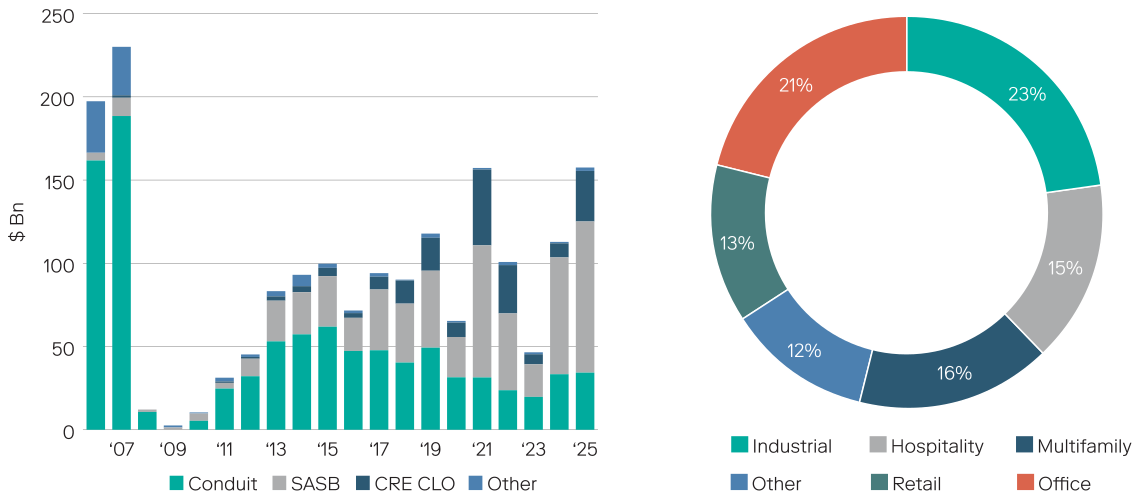
On the securitization front, private‑label CMBS issuance reached approximately $157 billion in 2025, the highest level since the Great Financial Crisis (see the left side of Figure 3). In particular, the CRE collateralized loan obligation (CRE CLO) market—an important source of financing for commercial real estate (CRE) debt funds—saw approximately $30 billion in issuance last year.
Figure 3: Securitization Volumes Have Rebounded, Supporting Broader Real Estate Activity, With Property Composition Skewing Toward the Industrial and Office Subsectors
Source: JP Morgan, Bloomberg; data as of December 31, 2025.
Institutional Allocators Are Regaining Conviction
Many institutional allocators largely paused new RE commitments over the past three years amid higher rates and market volatility. Liquidity has been a key constraint, especially for older funds. Yet as debt markets have stabilized and transaction activity has improved, we find that a growing number of these investors have begun to re‑engage, setting the stage for increased equity deployment in 2026; meanwhile, many older funds have remained active in the secondary market, using recapitalizations and sales of longer‑dated positions to generate additional liquidity. (More on secondaries below.)
Invigorated RE credit markets are also aiding price discovery and transaction volume, in our view. As more deals clear, valuation transparency improves, boosting confidence among equity investors and supporting a broader return of capital to the asset class.
Looking ahead in 2026, we expect that stabilized rates, renewed lending activity and gradually returning institutional capital should boost transaction volume.
In a recent PERE study of 103 institutional investors, 45% said they were underallocated to RE, up from 26% a year earlier; meanwhile, investor appetite appears to be on the rise, with 45% of the respondents expecting to invest more capital into private RE over the next 12 months than they did in 2025, while just 17% are looking to invest less capital in 2026, down from a peak of 35% in 2023.1 At the same time, we believe increased competition within the private debt market suggests that investors should pay strict attention to the positioning of their private RE debt portfolios.
Potentially Attractive Subsectors
AI Data Centers Offer a Mix of Growth and Risk
In the private RE market, we believe the ongoing AI datacenter buildout continues to offer select opportunities for investors who are able to partner with experienced operators—both datacenter specialists and opportunistic generalists—to meet significant hyper-scaler computing demand. Some projects are early‑stage and highly speculative, while others are more advanced and/or structured as pre‑leased, build‑to‑suit transactions —and all require substantial equity commitments.
We expect datacenter investment activity to continue, albeit with an inevitable mix of winners and losers. As a group, listed datacenter REITs—including best-in-class global operators that maintain modest financial leverage—were down approximately 14.2% in 2025, making them the worst‑performing REIT sector, according to Bloomberg. Data centers clearly remain a growth story, in our opinion. Yet if public markets are a guide to where some private markets might head, we believe data-center-themed RE investors should remain highly selective.
Retail Stages a Comeback
The retail subsector has seen renewed momentum across public and private markets, thanks to a combination of healthy consumer spending (despite tariffs and broader economic uncertainty), limited new construction (supporting rental growth and asset values) and overall leasing strength (reflecting improved fundamentals and tenant demand).
While we acknowledge that consumer strength remains a critical consideration for retail-focused RE investors, we believe the subsector’s recent resurgence indicates that well‑located, necessity‑based and experiential retail assets have the potential to offer compelling risk‑adjusted returns in the current environment.
The Need for GP-Focused Capital Solutions
We believe the current industry backdrop—marked by stressed valuations, tight liquidity and persistent uncertainty—continues to create a range of opportunities to partner directly with high‑quality REOCs and GPs.
Platform-Level Investments
We have observed that the last few years have proved a challenging fundraising environment for many operators, and many are now seeking flexible “platform-level” capital solutions to meet their needs. In these transactions, investors can provide capital directly to REOCs, enabling participation in a broader RE opportunity set rather than a narrow pool of underlying assets.
We believe platform-level investments can help operators address meaningful strategic challenges—such as managing balance sheet constraints, executing on existing business plans (rather than being forced into asset sales or suboptimal capital structures) and helping operators capitalize quickly on select opportunities at increasingly compelling valuations — while offering RE investors the potential to generate attractive risk-adjusted returns.
Secondaries and Recapitalizations
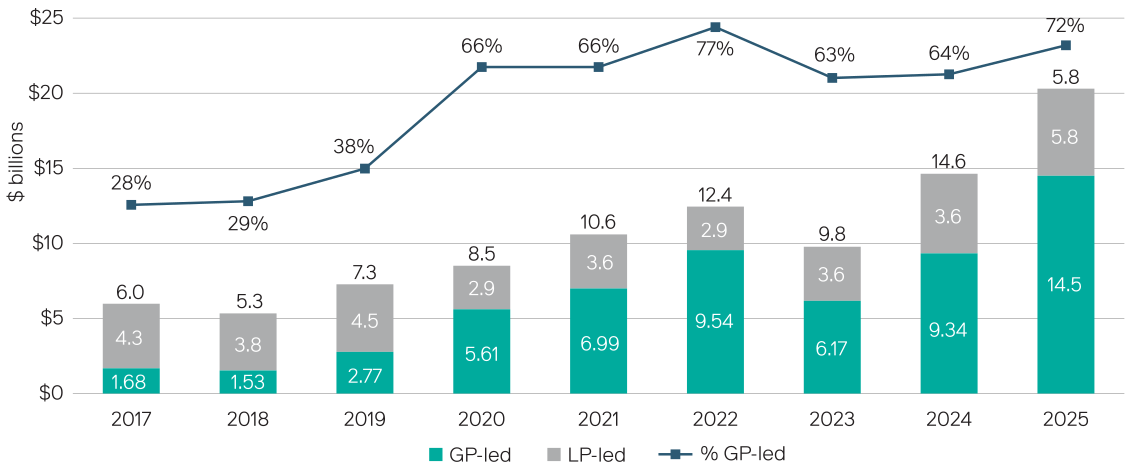
Activity in the secondaries market continues to sizzle as allocators seek liquidity from vehicles or portfolios nearing the end of their lives and RE managers aim to create additional value from certain high-quality assets (see Figure 4).
Figure 4: Demand for Liquidity Continues to Fuel the Real Estate Secondaries Market
Source: PERE News, Park Madison, Ares.
Prolonged illiquidity and valuation uncertainty have motivated some GPs to sell fund or portfolio positions to new “continuation” vehicles or via GP-led recapitalizations. We believe secondaries and recaps can offer new buyers access to seasoned portfolios with established cash flows, as well as the ability to transact at discounts to intrinsic value when sellers may be motivated more by liquidity needs rather than asset fundamentals. (For more details on the secondary RE market, see Real Estate: Uncovering Value Amid Uncertainty.)
GP Stakes and Outright Acquisitions
As the RE industry continues to consolidate, we find that GPs are increasingly open to bringing on financial and strategic partners who can help maintain relevance and scale, pursue new sectors or geographies and generally institutionalize their operations.
We expect consolidation to remain a prominent theme as large GPs expand their platforms and smaller managers look to wind down their operations, allowing institutional investors to provide targeted liquidity solutions for select GPs. At the same time, we encourage RE investors to stay disciplined and monitor struggling GPs closely in this environment.
Conclusion
Entering 2026, we believe the RE sector presents a compelling mix of cyclical and structural opportunities supported by a fortuitous combination of relatively attractive valuations, thawing capital markets, modest interest rates and renewed institutional appetite.
In our view, these forces should continue to drive RE transaction activity while opening potentially attractive opportunities across both public and private markets, including platform-level investments in high-quality operators, transactions in the secondary market and targeted liquidity solutions for disciplined GPs.
For more context on the evolving real estate landscape, please see Real Estate: Uncovering Value Amid Uncertainty.